DEEP VISA LABS · SOURCES
Data Sources
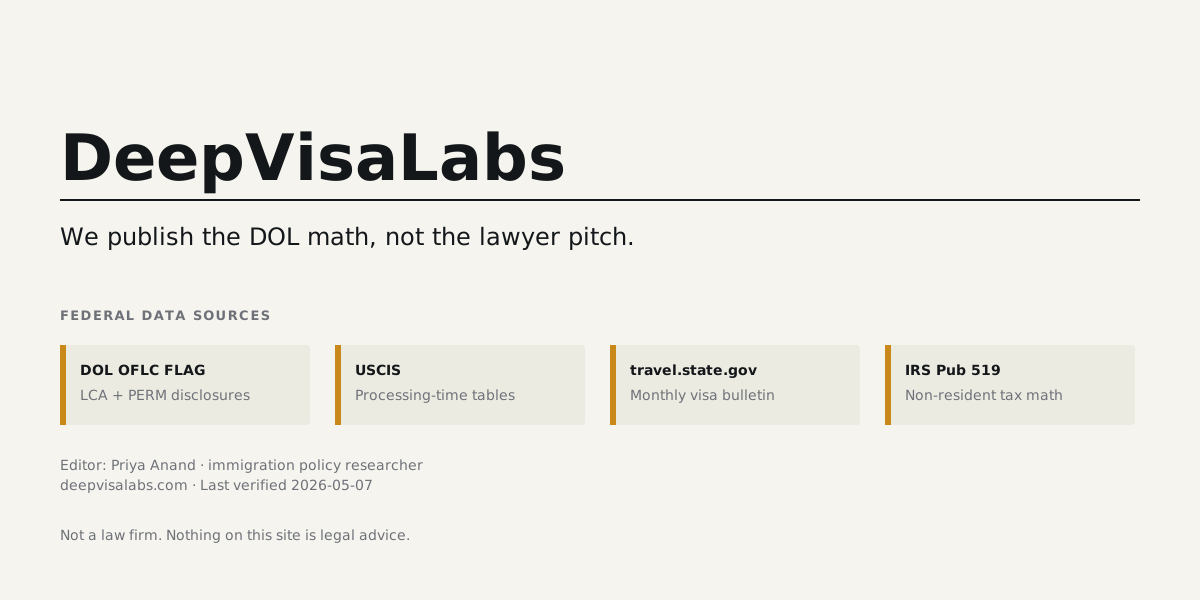
Every number on the site links inline to one of these federal sources. This page documents what each dataset covers, how often we re-sync, the typical publication lag, and the known limitations we surface to readers.
Overview
| Source | Description | Cadence | Link |
|---|---|---|---|
| DOL OFLC | Department of Labor — Office of Foreign Labor Certification (LCA + PERM + Prevailing Wage) | quarterly | official source |
| USCIS | US Citizenship and Immigration Services — processing times, I-129 / I-485 stats | monthly | official source |
| Visa Bulletin | US Department of State — Visa Bulletin (priority dates) | monthly | official source |
| IRS Pub 519 | IRS Publication 519 — US Tax Guide for Aliens (1040-NR, SPT, FBAR) | annual | official source |
1. DOL OFLC — Office of Foreign Labor Certification
What it covers: H-1B / H-1B1 / E-3 Labor Condition Applications (LCA), PERM labor certifications, Prevailing Wage Determinations (PWD) issued by the National Prevailing Wage Center, and H-2A / H-2B agricultural and seasonal-worker certifications. The OFLC publishes case-level disclosure CSVs for each adjudicated quarter.
Primary URL: dol.gov/agencies/eta/foreign-labor/performance (disclosure data) plus flag.dol.gov (FLAG portal status, processing-time dashboard).
Cadence and lag: quarterly disclosure releases land in January, April, July, and October. Each release covers cases adjudicated in the immediately preceding quarter, so the typical publication lag is 1-3 months from final determination.
Known limitations:
- Pending cases excluded. Only adjudicated (certified, denied, withdrawn) cases appear in the disclosure CSV. Cases still pending are not represented — biasing published median processing times toward the faster cohort.
- BLS top-coding. Wages above the OEWS 90th-percentile reporting cap are top-coded by BLS before flowing into PWDs. We surface the top-coded ceiling rather than implying a known wage above the cap.
- SOC code transitions. Legacy SOC 2010 codes appear in older disclosure files; we map them to SOC 2018 in the ETL with an explicit transition log.
- Worksite vs LCA address. Some LCAs list a generic "headquarters" worksite that doesn't match the actual physical work location. We report the LCA-attested worksite as filed.
2. USCIS — US Citizenship and Immigration Services
What it covers: processing times by form (I-129, I-140, I-485, I-539, I-765, I-907) by service center; case-status check; published petition statistics for H-1B, EB-1, EB-2, EB-3, EB-5; Form I-907 premium-processing eligibility lists; USCIS Policy Manual chapters.
Primary URLs: egov.uscis.gov/processing-times/ (processing tables), uscis.gov/policy-manual (binding policy), and the form-specific landing pages on uscis.gov for filing instructions.
Cadence and lag: processing times update monthly. Policy Manual chapters update on individual rule cycles; we link to the canonical chapter URL rather than mirroring chapter text.
Known limitations:
- 80th-percentile reporting only. USCIS publishes the time within which 80% of cases were adjudicated, not the median. Beneficiaries whose cases fall in the slowest 20% experience materially longer waits than the published number suggests.
- Service-center reroute breaks. When USCIS reroutes a form type from one service center to another, the published processing time for the new center starts from a small case sample and can swing meaningfully month-to-month for several cycles.
- Form-edition transitions. When USCIS releases a new form edition (e.g., I-129 12/2024 edition), prior-edition cases continue under the old edition's filing instructions. We note the transition cycle on relevant pages.
3. Department of State — Visa Bulletin and Consular Operations
What it covers: monthly visa bulletin with priority-date cut-offs by category (EB-1 through EB-5, FB-1 through FB-4) and chargeability area (All Other, China, India, Mexico, Philippines, plus the El Salvador / Guatemala / Honduras carve-out). Also: consular wait times, visa issuance statistics, and Department of State Foreign Affairs Manual.
Primary URLs: travel.state.gov/visa-bulletin (bulletin), travel.state.gov/wait-times (consular wait times), and travel.state.gov/visa-statistics (issuance data).
Cadence and lag: visa bulletin publishes mid-month for the following month — e.g., the May 2026 bulletin is published in mid-April 2026. Visa statistics publish annually with FY-level aggregation.
Known limitations:
- "C" (current) vs "U" (unavailable) distinction. Both states are common in the bulletin and have different consequences. We surface both rather than collapsing into "open / closed."
- Adjustment of Status Filing Chart. USCIS publishes a separate monthly chart determining whether to use the bulletin's Final Action Dates or Dates for Filing. The chart can flip month-to-month; pending I-485 strategies must track both.
- No predictions. The Charles Oppenheim "Chats" memo from the Visa Office is the only authoritative forward-looking source. Third-party retrogression predictions are not bulletin-equivalent.
4. IRS — Internal Revenue Service (Publication 519 and Form 1040-NR)
What it covers: Publication 519 (U.S. Tax Guide for Aliens), Form 1040-NR and instructions, FBAR (FinCEN Form 114) thresholds, Form 8938 thresholds, the Substantial Presence Test, F / J / M / Q exempt-individual rules, US tax treaty articles, and the Foreign Earned Income Exclusion (Form 2555 — not applicable to most NRA filers but referenced for resident-alien transitions).
Primary URLs: irs.gov/publications/p519, irs.gov/forms-pubs/about-form-1040-nr, and the IRS international-taxpayers landing at irs.gov/individuals/international-taxpayers.
Cadence and lag: annual. Pub 519 publishes typically in early Q1 for the prior tax year. Treaty articles update on bilateral treaty cycles (very slow — most treaties are decades old with periodic protocols).
Known limitations:
- State tax divergence. IRS rules govern federal tax only. State residency for income-tax purposes is determined by each state's domicile and statutory-residency rules, which can produce a different residency outcome than the federal Substantial Presence Test.
- Form / instruction lag. The IRS occasionally releases form revisions late in the filing season. We note the form revision date on tax-pillar pages and update when revisions are released.
- Treaty interpretation. The IRS's positions on treaty articles can differ from foreign tax authorities' positions. Where the IRS has issued a Revenue Ruling or Treasury technical explanation, we cite that as authoritative for US filing purposes.
5. Code of Federal Regulations and US Code
What it covers: 8 CFR (Aliens and Nationality), 20 CFR §656 (Labor Certification for Permanent Employment), 26 CFR (Internal Revenue Code regulations), and the underlying Immigration and Nationality Act (INA, codified primarily at 8 USC).
Primary URLs: ecfr.gov for the current eCFR (live updated), and uscode.house.gov for the US Code.
Use: we cite specific CFR sections (e.g., 8 CFR §214.1(l)(2) for the H-1B 60-day grace period) when explaining the regulatory authority for a procedural rule. Policy Manual chapters from USCIS are the operational gloss; CFR is the binding regulation.
What we don't cite
- Self-reported salary aggregators (Glassdoor, levels.fyi, Comparably). Selection bias in voluntary salary platforms is severe and undocumented; LCA filings are the legal floor and we cite those instead.
- Lawyer-blog estimates for processing times. USCIS publishes the official tables monthly — we cite USCIS. Lawyer-blog discussions of policy interpretation are useful for understanding adjudication trends but are not data sources.
- Reddit / forum threads for individual case experience. We don't generalize from anecdotes. Where sustained community discussion has surfaced a real issue (e.g., Mumbai consulate stamping delays during a specific quarter), we cite the underlying State Department wait-time data, not the forum thread.
- Visa-mill or "guaranteed approval" sites. No exceptions.
- Foreign-government immigration data in cases where it diverges from US-government data on the same question. US filings are governed by US data.
Source verification protocol
At build time, every source URL cited on the site is HEAD-checked. 404 responses block the build. When a federal agency restructures its URL hierarchy (as happens periodically), we update the canonical URL across the site in a single commit and re-build.