DEEP VISA LABS · ABOUT
About DeepVisaLabs
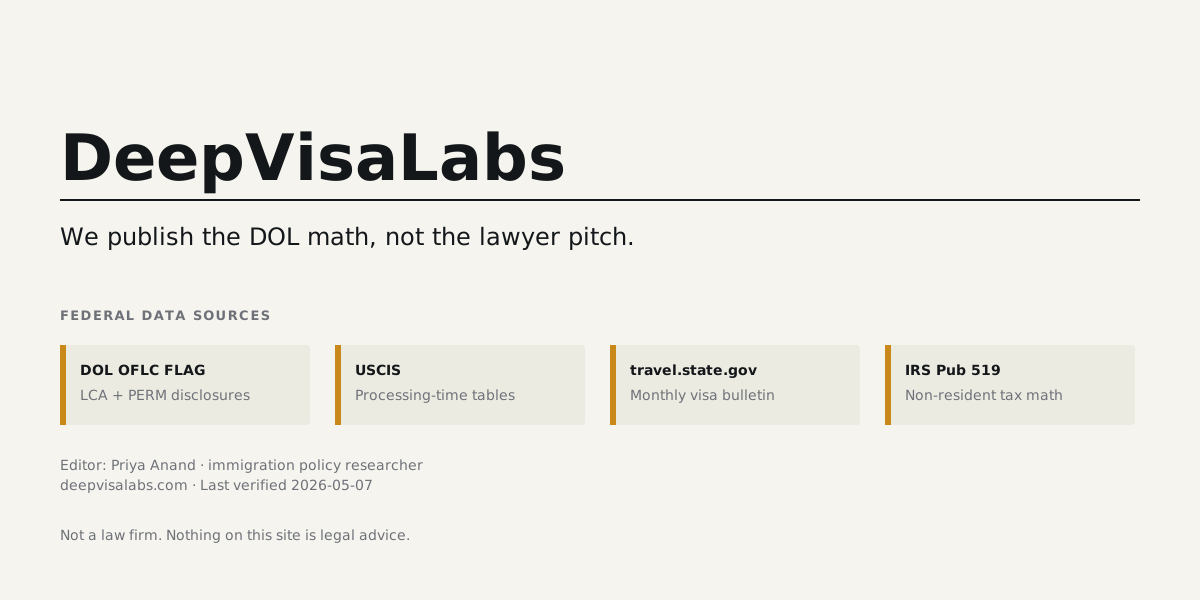
An independent US-immigration data lab. We pull DOL OFLC LCA + PERM, USCIS processing tables, travel.state.gov visa bulletins, and IRS Publication 519 — then publish the math behind H-1B, green card, OPT / CPT, and non-resident-tax decisions. No lawyer pitch. No sponsored placements.
Why DeepVisaLabs exists
Most consumer-facing US-immigration sites either bury federal data under "consult our attorney" CTAs, or repackage USCIS guidance as paid leads to law firms. The federal data is public, the decision math is publishable, and beneficiaries deserve to see the actual numbers — wage levels, processing times, priority dates, tax thresholds — without a sponsored placement standing between them and the answer.
DeepVisaLabs was built to prove the alternative model: federal-data-first, single-byline editorial, reproducible math, and an explicit refusal to pretend the site is a substitute for licensed counsel. We publish what the data says. When the data is silent, we say so. When counsel is required, we say that too.
What we publish
- Prevailing wage and LCA data — DOL OFLC quarterly LCA + PERM + Prevailing Wage Determinations, by SOC code × MSA × wage level 1-4. The actual federal floor for an H-1B offer.
- Visa bulletin priority dates — monthly travel.state.gov scrape, plus historical retrogression trend per category × country of birth back to FY1990.
- USCIS processing times — current and historical, per form × service center; refreshed monthly when USCIS publishes.
- PERM processing time — DOL FLAG dashboard plus our own recomputation from the underlying disclosure CSV (audited vs unaudited, BALCA appeals, supervised recruitment).
- Non-resident tax math — Substantial Presence Test, 1040-NR, FBAR, Form 8938, treaty election logic — all from IRS Pub 519 and the Form 1040-NR instructions, no Reddit thread aggregations.
- Procedural walkthroughs — what each USCIS form does, what evidence packages typically include, what RFE patterns look like, what the 8 CFR / 20 CFR sections say in plain English.
What we don't do
- Recommend specific lawyers or law firms. We are not a law firm and don't form attorney-client relationships. Where we discuss attorney evaluation, the framing is procedural ("here is how to verify bar admission") not promotional.
- Predict whether a specific case will be approved. Out of scope. We compute distributions, medians, and queue lengths from federal data — not approval probability for any individual.
- Run scaled-content matrices for SEO purposes. No state × city × SOC × employer permutations. Every page corresponds to a federal-data question with a Semrush-validated search query.
- Aggregate self-reported salary data (Glassdoor, levels.fyi). Selection bias is severe; LCA filings are the legal floor and we cite those instead.
- Operate visa-mill content for asylum, deportation, fraud, or other categories where the right answer is "consult counsel before reading any further."
- Accept payment for editorial inclusion or ranking. No pay-to-play.
Editorial principles
- Show the source. Every page links inline to the DOL / USCIS / travel.state.gov / IRS document the number came from. Minimum three citations per page.
- Federal first. If DOL / USCIS / travel.state.gov / IRS publishes it, that is our number. We don't substitute lawyer-blog estimates or forum-thread averages.
- Update visibly. "Last verified" timestamp on every data-driven page, synced with our ETL build that ingested the source.
- Acknowledge policy churn. H-1B caps, Day 1 CPT enforcement, STEM OPT eligibility, the H-1B Modernization rule — all change with administrations and Federal Register cycles. We say so on the page.
- Refuse the lawyer pitch. The lawyer pillar exists to publish how to evaluate counsel — not to sell leads. Affiliate disclosure on the small number of pages with referral links is explicit and FTC-compliant.
How we are funded
DeepVisaLabs is a self-funded independent project. Revenue sources, in order of magnitude:
- Display advertising — Google AdSense ads served on most pages. Ad selection is automated by Google; we do not pre-screen advertisers and ad placement does not influence editorial.
- Affiliate referral fees — small number of pages link to Sprintax (NRA tax filing), Boundless (immigration filing assistance), and Lawfully (case-status tracking and attorney referrals). Affiliate status is disclosed on each page in accordance with FTC 16 CFR Part 255.
- No paid placements. No "best lawyer" rankings purchased. No sponsored content. No advertorials.
Priya Anand holds no equity in any immigration law firm, visa-services company, or CPT-school operation. The full conflicts-of-interest disclosure is in the Editorial Policy.
What DeepVisaLabs is not
- Not a law firm. We do not form attorney-client relationships, do not provide legal advice, and do not sign opinions or memoranda. Where you need legal advice, consult a licensed immigration attorney.
- Not a tax preparer. We publish 1040-NR / 1040 / FBAR procedural explanations from IRS Pub 519. We do not prepare or sign returns. For specific filings, consult a licensed CPA, enrolled agent, or tax attorney.
- Not a school broker. We list F-1 / OPT / CPT schools where the school's federal status is publicly verifiable (SEVP enrollment, DOJ EOIR records). No school pays for inclusion.
- Not a recruiter. We do not place beneficiaries with employers, do not collect resumes, and do not endorse employer sponsors.
- Not a visa-status oracle. We cannot tell you whether your case will be approved, when your priority date will be current, or whether to file now or later. Those decisions belong to you and your counsel.
Accountability
The site has a single editor (Priya Anand), a published methodology (Methodology), an enumerated source list (Sources), and a transparent corrections process (Corrections). Reader-reported corrections are acknowledged within 2 business days and resolved within 5. Where a correction touches a number on the page, the prior value and the correction date are preserved in the page-history note.

Disclaimer
Deep Visa Labs publishes data from DOL OFLC, USCIS, travel.state.gov and IRS. This is not legal advice. Consult a licensed immigration attorney for advice on your specific case.
Contact
Editorial corrections: [email protected]. Data-source suggestions: [email protected]. Press inquiries: [email protected]. Anything else: [email protected]. See the Contact page for full channel breakdown and response-time SLAs.