EB-5 Investor Green Card: $800K TEA Investment, Set-Asides, and the I-526E Path
EB-5 for All Chargeability Areas has no queue this month. Eligibility is gated only by petition adjudication and medical / biometric scheduling, not by visa-number availability.
EB-5 After the 2022 RIA
The EB-5 Reform and Integrity Act of 2022 (RIA) significantly restructured the EB-5 investor program. Key changes: investment threshold raised to $1,050,000 standard / $800,000 in Targeted Employment Areas (TEAs); set-aside categories created for rural (20%), high-unemployment (10%), and infrastructure (2%) projects; new oversight requirements for Regional Centers.
EB-5 is administered by USCIS under INA §203(b)(5). Eligibility requires lawful capital invested in a new commercial enterprise that creates 10+ full-time US jobs.
Investment Amounts and TEA Designation
$1,050,000 is the standard minimum investment; $800,000 in TEAs (rural areas or high-unemployment areas with unemployment ≥150% of national average). RIA also adjusts amounts for inflation every 5 years starting January 2027.
TEA designation is determined by the proposed enterprise's location at investment time. Rural TEAs are outside Metropolitan Statistical Areas; high-unemployment TEAs require qualifying census tract or county data. Source-of-funds (SOF) documentation is required for all investment amounts.
Set-Aside Categories — The 2022 Game-Changer
RIA reserved 32% of annual EB-5 visas for set-aside categories: 20% for rural, 10% for high-unemployment, 2% for infrastructure. These set-asides are not subject to the standard EB-5 backlog — they have their own visa-bulletin lines, currently flowing faster than the unreserved EB-5 line.
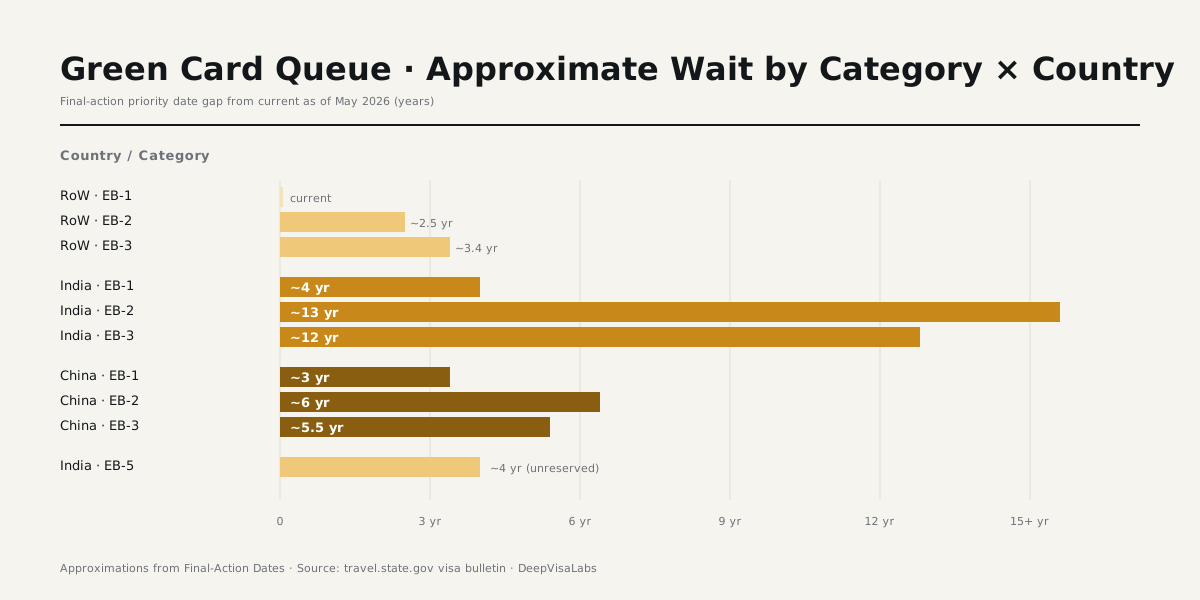
Indian and Chinese investors in particular benefit from set-asides because the unreserved EB-5 line is heavily backlogged for these countries. Set-aside categories give a faster path to conditional permanent residence.
I-526E Filing and Conditional Green Card
The investor files Form I-526E (Regional Center investor) or I-526 (direct investor) with USCIS. Approval grants conditional 2-year permanent resident status if priority date is current. Within the 90-day window before the 2-year mark, investor files Form I-829 to remove conditions.
I-526E processing currently runs 24–48 months for unreserved cases; set-aside category cases process faster (12–18 months). I-829 processing runs 30–60 months at current USCIS workload.
Job Creation Requirement
The investment must create at least 10 full-time, qualifying US jobs. Direct investments require direct employer-employee relationships with US workers. Regional Center investments allow indirect and induced jobs counted via economic-modeling methodologies (RIMS II, IMPLAN, REDYN).
The 10-job requirement is verified at I-829 stage. Failure to demonstrate sustained job creation results in I-829 denial and loss of permanent residence — a critical risk that distinguishes EB-5 from non-investment paths.
Priority Dates and Backlogs
EB-5 Unreserved for All Chargeability Areas is currently C. China and India face multi-year backlogs in the unreserved line. Set-aside categories (rural / high-unemployment / infrastructure) typically remain current or near-current as the carve-outs absorb less demand.
The set-aside structure creates planning value: an Indian or Chinese investor choosing a rural TEA project unlocks both a lower investment ($800K vs $1.05M) and a faster visa-bulletin path.
Cross-Pillar Reading
- I-485 Adjustment of Status · concurrent filing path for in-US investors
- EB-1 — Multinational Manager (EB-1C) · alternate immigrant path for executive transferees
- E-2 Treaty Investor Visa · non-immigrant alternative without green-card path
- Visa Bulletin · EB-5 unreserved and set-aside priority dates
- Priority Date Tracker · interactive widget
Bottom line
Current category. The visa-bulletin queue is not active, so total wait reduces to USCIS form processing plus medical / biometrics scheduling.
Frequently asked questions
- What's the difference between adjustment of status and consular processing?
- AOS keeps you in the US during adjudication and grants employment / travel authorization while pending. CP requires leaving the country for a consular interview, and timing is harder to predict because of NVC backlogs.
- What if EB-5 retrogresses while my I-485 is pending?
- USCIS can hold the I-485 in the queue if your priority date retrogresses after filing. Your case is not denied — it sits until the priority date is current again, at which point USCIS picks up adjudication.
- Does EB-5 require a labor certification (PERM)?
- EB-2 (advanced degree / exceptional ability) and EB-3 require an approved PERM labor certification before filing the I-140. EB-1 (extraordinary ability / outstanding researcher / multinational manager) and EB-2 NIW skip PERM entirely.
- Can I file I-485 and I-140 concurrently?
- If your priority date is current, concurrent I-140 + I-485 filing is the standard playbook. The combo unlocks employment authorization (I-765) and travel document (I-131) eligibility while the case is pending.
- How does premium processing apply to EB-5?
- I-907 premium processing covers EB-1A, EB-1B, EB-1C, EB-2 (non-NIW), and EB-3 I-140s with a 15-calendar-day adjudication SLA. I-485 is not eligible for premium processing.