EB-1 Green Card: Extraordinary Ability, Outstanding Researcher, Multinational Manager
With no chargeability backlog for EB-1 (All Chargeability Areas) in the current bulletin, total time-to-green-card runs about 8–14 months — the I-140 / I-485 adjudication window itself.
The Three EB-1 Sub-Categories
EB-1 is the first employment-based preference category and covers three distinct paths under USCIS guidance: EB-1A (Extraordinary Ability), EB-1B (Outstanding Researcher / Professor), and EB-1C (Multinational Executive / Manager).
EB-1A is self-petitionable; EB-1B and EB-1C require an employer petitioner. All three skip PERM, making EB-1 the fastest employer-sponsored category for qualifying petitioners.
EB-1A — Extraordinary Ability
EB-1A applies to individuals with sustained national or international acclaim in sciences, arts, education, business, or athletics. Petitioners satisfy 3 of 10 regulatory criteria under USCIS Policy Manual Volume 6, Part F, Chapter 2: nationally/internationally recognized awards, association memberships, published material about the petitioner, judging others' work, original contributions, scholarly articles, artistic exhibitions, leading roles, high salary, or commercial successes.
USCIS uses a Kazarian-style two-step review: (1) count satisfied criteria, (2) qualitatively assess "sustained acclaim." Self-petition is the primary advantage — no employer sponsor required.
EB-1B — Outstanding Researcher / Professor
EB-1B requires (1) international recognition for outstanding achievement in a specific academic area, (2) at least 3 years of teaching/research experience, and (3) a permanent research position (or tenure-track) at a US university or research entity. Two of six criteria must be satisfied: major prizes, association memberships, published material, judging research, original contributions, or authorship of scholarly books/articles.
EB-1B requires employer petitioning (university or research entity) but does not require PERM. Premium processing is available.
EB-1C — Multinational Executive / Manager
EB-1C is the immigrant analog to L-1A: applies to executives or managers transferred from a foreign affiliate to a US employer. Requires (1) qualifying corporate relationship between US and foreign entities, (2) 1 year of qualifying foreign employment in past 3 years, (3) executive or managerial role both abroad and in US.
EB-1C is employer-petitioned and does not require PERM. Premium processing is now available for EB-1C as part of USCIS's expanded I-907 program.
Current Priority Dates and Premium Processing
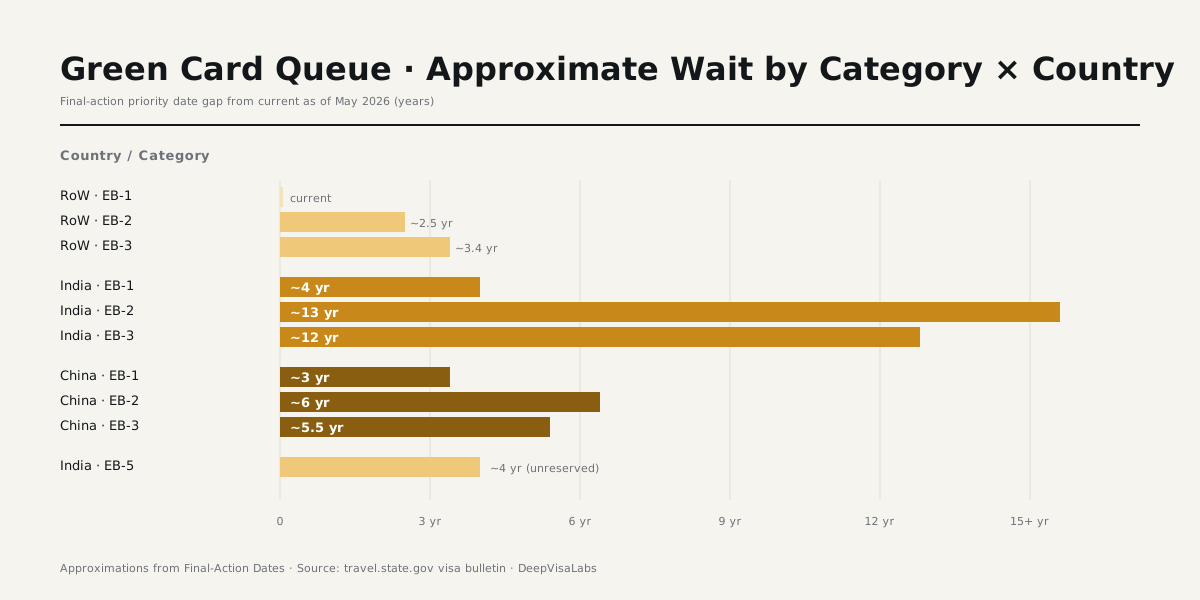
EB-1 worldwide is currently C per the latest visa bulletin. China and India face significant EB-1 backlogs (currently ~3 years for both). Other chargeability areas typically remain current.
I-140 standard processing for EB-1 runs 8–14 months; premium processing (Form I-907) available at $2,805 for 15-calendar-day adjudication for all three EB-1 sub-categories.
Cross-Pillar Reading
- EB-2 NIW — National Interest Waiver · alternative self-petition path with lower bar
- EB-2 — Advanced Degree / Exceptional Ability · standard PERM-required path
- Form I-140 · the immigrant petition itself
- O-1 Extraordinary Ability Visa · non-immigrant counterpart to EB-1A
- L-1 Intracompany Transferee · non-immigrant counterpart to EB-1C
- Visa Bulletin · current EB-1 priority dates
- Priority Date Tracker · interactive widget
Bottom line
Verdict: priority date current — the queue is not the bottleneck. Adjudication time and form readiness are.
Frequently asked questions
- Can I file I-485 and I-140 concurrently?
- Yes — when your priority date is current under the chart USCIS is using that month, you can file the I-485 concurrently with the I-140 (or shortly after). Concurrent filing saves months and unlocks the I-765 EAD / I-131 advance parole.
- How does premium processing apply to EB-1?
- Premium processing (Form I-907) is now available for most I-140 categories — adjudicated within 15 calendar days. EB-2 NIW is the notable exclusion: USCIS has not extended I-907 to NIW filings.
- What is the priority date in EB-1?
- Your priority date is fixed when the first qualifying filing was accepted: PERM for most EB-2/EB-3, the I-140 itself for EB-1 and EB-2 NIW, the I-526 for EB-5.
- Can I port my priority date to another I-140?
- Priority-date retention is automatic when the original I-140 is approved, regardless of whether the original employer withdraws it more than 180 days after approval. New PERM may be required, but the priority date carries.
- What's the difference between adjustment of status and consular processing?
- Adjustment of Status (I-485) is filed inside the United States; Consular Processing routes through the National Visa Center and a US embassy abroad. AOS unlocks a pending-EAD; CP issues a sealed immigrant visa for entry.
Sources
- https://www.uscis.gov/working-in-the-united-states/permanent-workers/employment-based-immigration-first-preference-eb-1
- https://travel.state.gov/content/travel/en/legal/visa-law0/visa-bulletin.html
- https://www.uscis.gov/policy-manual/volume-6-part-f-chapter-2
- https://www.uscis.gov/i-140
- https://www.uscis.gov/i-907