Form I-485: Adjustment of Status to Permanent Resident
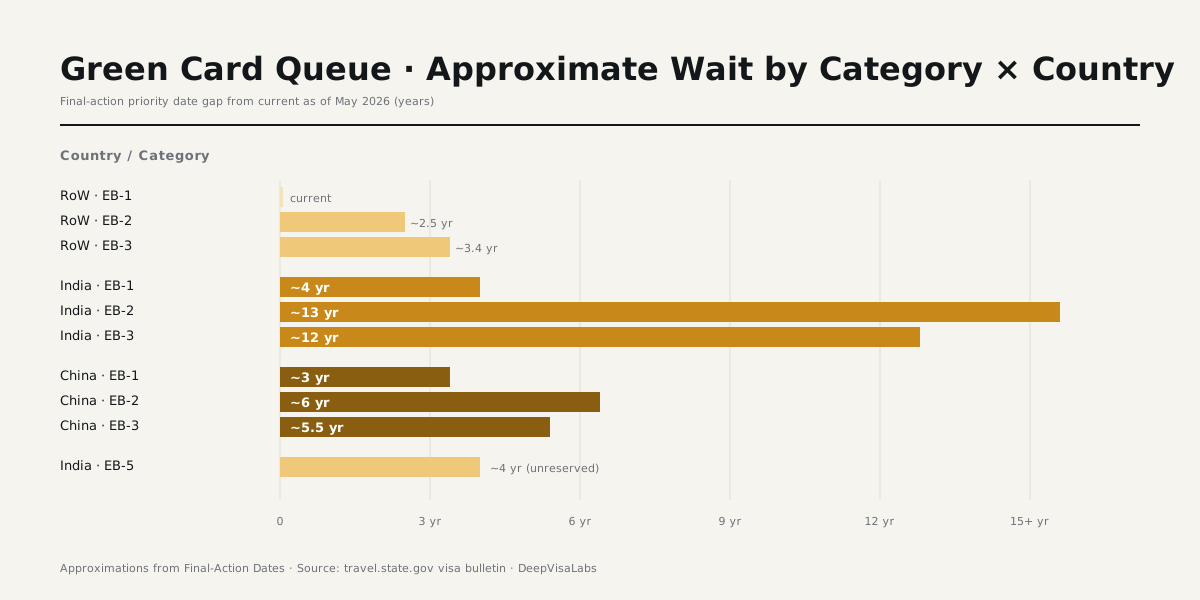
With no chargeability backlog for Form I-485 (All Chargeability Areas) in the current bulletin, total time-to-green-card runs about 10–18 months — the I-140 / I-485 adjudication window itself.
What I-485 Is
Form I-485 is the application to register permanent residence — the inside-the-US path to a green card. Filed by an applicant in the United States with a valid underlying immigrant petition (I-140, I-130, etc.) and a current priority date.
I-485 is governed by USCIS Policy Manual Volume 7, Part A. The alternative path is consular processing — a US embassy abroad issues an immigrant visa for entry as a permanent resident.
Concurrent Filing with I-140
When the priority date is current under the chart USCIS is using that month, applicants can file I-485 concurrently with the I-140 (or after I-140 approval). Concurrent filing saves months and unlocks Form I-765 (EAD) and Form I-131 (Advance Parole) applications.
Concurrent filing has been allowed for most employment-based categories since 2002. The combination is the standard playbook for in-US employment-based applicants whose priority date is current.
The Pending-AOS EAD
Form I-765 with category (c)(9) provides Employment Authorization Document (EAD) while I-485 is pending. Under USCIS's 2023 validity-extension policy, pending-AOS EADs are issued for up to 5-year validity periods, eliminating the renewal-cycle gaps that previously interrupted employment.
The 5-year EAD significantly reduces the operational burden of pending I-485 cases — particularly important for India and China EB-2 / EB-3 cases that may pend for 5+ years awaiting priority date movement.
Advance Parole and Travel
Form I-131 (c)(11) advance parole authorizes international travel during pendency without abandoning I-485. Without advance parole, departure during I-485 pendency typically constitutes abandonment of the adjustment application.
Advance parole validity is now also extended to multi-year periods. Travel returnees re-enter under parole status; H-1B and L-1 status remain available for those who maintain underlying nonimmigrant status throughout.
Processing Time and Interview
USCIS quotes I-485 employment-based processing at 10–18 months 80th-percentile per the processing-times dashboard. Times vary by service center and field office.
USCIS field offices conduct interviews on most employment-based I-485s as part of post-2017 enhanced screening, though some cases are interview-waived. Premium processing is not available for I-485.
What Triggers I-485 Denial
Common denial reasons: failure to maintain valid status during pendency (with limited exceptions for INA §245(k) immediate-family / employment-based cases), inadmissibility under INA §212(a) (criminal history, prior overstays, fraud), failure to attend biometrics or interview, or material change in employment after I-140 approval (for portability cases, INA §204(j)'s same-or-similar standard).
Most denials are appealable via Motion to Reopen / Reconsider (Form I-290B) within 33 days of the denial notice.
Cross-Pillar Reading
- I-485 Processing Time · current windows by category
- Adjustment of Status · concept overview
- Form I-140 · the underlying immigrant petition
- EB-2 Green Card · most common I-485-eligible category
- Visa Bulletin · priority-date check before filing
- Priority Date Tracker · interactive widget
Bottom line
Status reading: current. File when the I-140 is approved (or concurrently); USCIS adjudication is the binding constraint.
Frequently asked questions
- Can I port my priority date to another I-140?
- Yes. INA §204(j) lets you keep your priority date on a new I-140 in the same or higher preference category, even after changing employers, as long as the original I-140 was approved (or pending and ultimately approved).
- What's the difference between adjustment of status and consular processing?
- AOS keeps you in the US during adjudication and grants employment / travel authorization while pending. CP requires leaving the country for a consular interview, and timing is harder to predict because of NVC backlogs.
- What if Form I-485 retrogresses while my I-485 is pending?
- Retrogression after I-485 filing means USCIS pauses adjudication. Pending-AOS EADs and advance parole remain valid; the I-485 simply waits for the priority date to become current again.
- Does Form I-485 require a labor certification (PERM)?
- EB-2 (advanced degree / exceptional ability) and EB-3 require an approved PERM labor certification before filing the I-140. EB-1 (extraordinary ability / outstanding researcher / multinational manager) and EB-2 NIW skip PERM entirely.
- Can I file I-485 and I-140 concurrently?
- Yes — when your priority date is current under the chart USCIS is using that month, you can file the I-485 concurrently with the I-140 (or shortly after). Concurrent filing saves months and unlocks the I-765 EAD / I-131 advance parole.