H-1B Sponsorship: Employer Costs, LCA Compliance, and Approval Timeline
To sponsor H-1B, an employer files an LCA on flag.dol.gov attesting to wage compliance and worksite posting requirements, then files Form I-129 once the LCA is certified. Cap-subject petitions also require electronic registration during USCIS's spring window.
What H-1B Sponsorship Requires from the Employer
H-1B sponsorship requires the employer to (1) obtain a DOL-certified Labor Condition Application (LCA) on the FLAG portal, (2) file Form I-129 with USCIS, and (3) pay statutory fees and prevailing-wage compliance.
The LCA attests that the employer will pay at least the prevailing wage for the role, will not adversely affect working conditions of US workers, will provide notice to existing workers, and will document compliance in the public-access file (PAF).
Employer Fees Per Petition
Statutory fees the employer must pay per I-129:
- I-129 base filing: $460
- ACWIA training fee: $1,500 (employers with 26+ workers) or $750 (under 26)
- Fraud-prevention fee: $500
- Asylum-program fee: $600
- Optional I-907 premium processing: $2,805
Total per-petition statutory cost: $3,000–6,000 depending on employer size and premium-processing election. Add legal fees ($1,500–4,000 typical). All-in cost typically $4,500–10,000 per petition.
Prevailing Wage Compliance
Under the H-1B Reform Act, employers must pay the higher of (a) actual wage paid to similarly-situated US workers at the same worksite or (b) the prevailing wage from DOL's BLS OEWS-derived methodology. DOL Wage Levels 1–4 map to BLS OEWS 17th, 34th, 50th, and 67th percentiles.
Wage Level selection is the employer's decision on the LCA, with USCIS reserving the right to challenge if the level doesn't match the role's actual complexity. Wage-level-1 RFEs are common for roles that USCIS deems senior or specialized.
What the Employee Cannot Pay
Several fees are statutorily employer-paid: ACWIA, fraud-prevention, asylum-program, and the I-129 base. The H-1B beneficiary cannot legally reimburse these. DOL Wage and Hour Division enforces this through periodic audits.
Premium processing is the one fee that can be employee-paid in limited circumstances — if the beneficiary requests expedited adjudication for personal reasons (travel, paperwork). Attorney fees may be employee-paid if the beneficiary independently retains counsel for matters beyond the petition.
LCA Posting Requirements
Before filing the I-129, employers must post the certified LCA at the worksite for 10 business days in 2 conspicuous locations (or provide notice to the bargaining representative if unionized; or electronic notification to similarly-situated US workers). Documentation of posting goes into the public-access file (PAF) at the worksite.
The PAF must be available for DOL or worker inspection for 1 year past employment end. Failure to maintain proper PAF documentation triggers DOL fines and can result in debarment from future H-1B sponsorship.
Sponsorship Timeline
Standard timeline from start to work-ready: LCA filing → certification (7–10 days), I-129 filing → standard adjudication (2.5–5.5 months) or premium processing (15 calendar days). Total: 4–8 months standard, 1–2 months with premium.
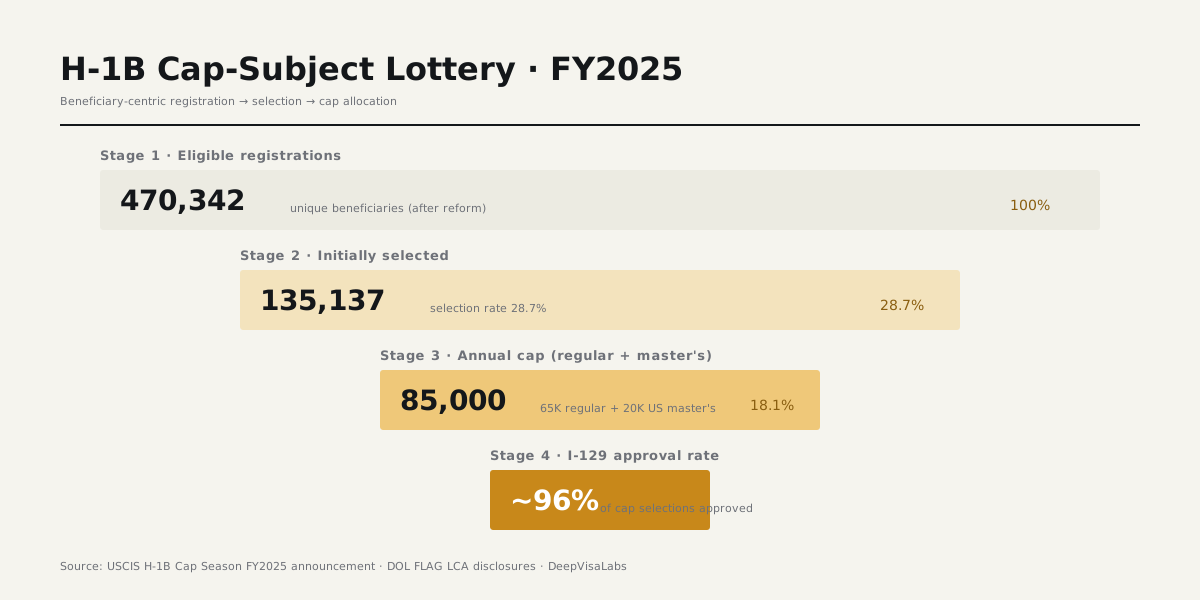
Cap-subject petitions add the March registration cycle as a gate — sponsoring employers must register the beneficiary in March, await April 1 selection notification, and file I-129 in the April 1 – June 30 window.
Cross-Pillar Reading
- H-1B Lottery · cap-subject registration cycle
- H-1B Transfer · year-round filing for cap-counted beneficiaries
- H-1B Cap-Exempt · year-round filing for university and nonprofit research
- H-1B Extension · post-initial-petition continuation
- H-1B Salary Database · DOL FLAG LCA disclosure data
- Prevailing Wage Checker · interactive widget
Bottom line
Verdict: H-1B sponsorship is a structured but expensive employer commitment. Plan for $5,000+ per petition plus 4–8 month timelines (1–2 months with premium). DOL and USCIS audits enforce wage and worksite compliance.
Frequently asked questions
- What does H-1B sponsorship cost the employer?
- Per-petition statutory cost (employer must pay these directly): $460 base, $1,500/$750 ACWIA, $500 fraud, $600 asylum = ~$3,000. Add $2,805 if using premium. Add legal fees ($1,500–4,000). Total ≈ $4,500–10,000 per petition.
- Can the employee pay for H-1B fees?
- DOL prevailing-wage compliance means the employer cannot deduct H-1B fees from the beneficiary's wages. ACWIA and fraud fees are non-passable to the employee. Premium processing is the one fee that can be employee-paid in limited circumstances.
- What is the prevailing-wage requirement?
- Prevailing wage is set by DOL based on SOC code, worksite, and wage tier (1=entry / 2=qualified / 3=experienced / 4=fully competent). Employer must pay at least this amount; the LCA attestation is the legal commitment. Underpayment violates DOL rules and can lead to debarment.
- Can a small startup sponsor H-1B?
- Startups sponsor H-1B regularly but carry higher RFE rates. Common challenges: founder-employee relationships (USCIS asks 'who controls'), early-stage financial proof of wage capacity, and worksite suitability. Detailed organizational charts and venture funding documentation help.
- What are the LCA posting requirements?
- LCA posting: 10 business days at the worksite in 2 conspicuous places (or electronic to all similarly-situated US workers). Public-access file must be maintained at the worksite or principal place of business for 1 year past employment end. DOL audits enforce this.