Asylum Lawyer: Affirmative I-589, Defensive EOIR, and One-Year Filing Rule
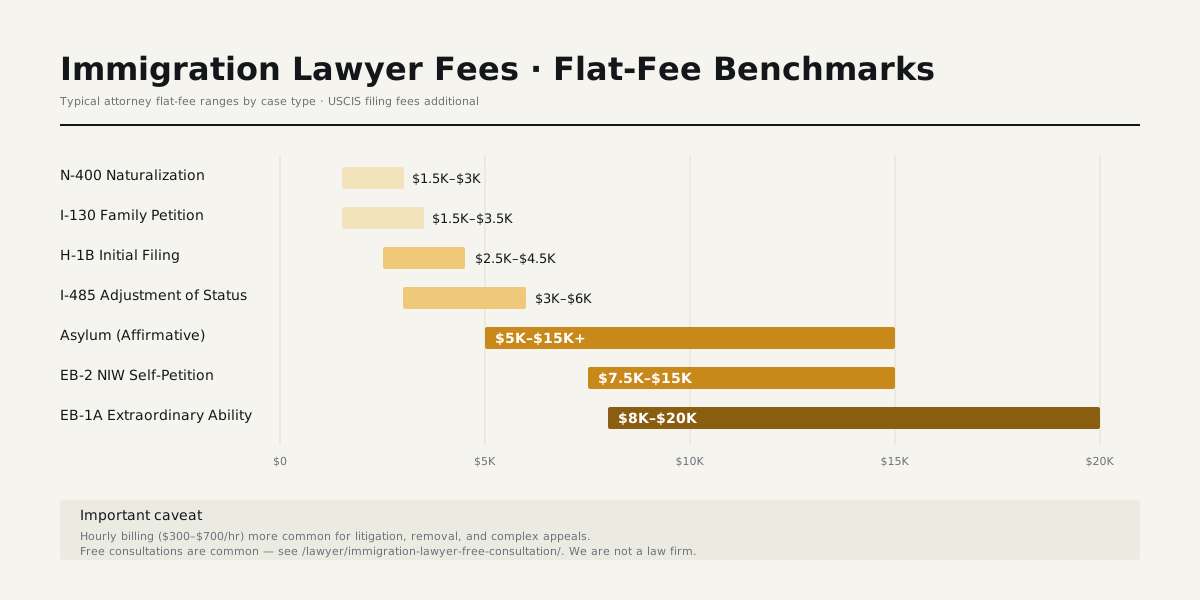
For asylum lawyer, attorney fees in the $4,000–$15,000 range are common. Government filing fees (USCIS / DOL) are not legal fees and vary by form.
Affirmative vs Defensive Asylum — Different Practice Areas
Asylum splits into two procedural tracks, and an asylum lawyer's experience in one does not guarantee competence in the other.
Affirmative Asylum
Filed proactively on Form I-589 with USCIS by an applicant not in removal proceedings. The applicant is interviewed by a USCIS asylum officer at a regional asylum office. If granted, asylum is conferred. If not granted (and the applicant has no other status), the case is referred to EOIR for removal proceedings — where the applicant can pursue defensive asylum as a defense.
Defensive Asylum
Pursued in EOIR immigration court as a defense against removal. The applicant has been issued a Notice to Appear (NTA) and is in removal proceedings before an immigration judge. Defensive asylum runs through master and individual hearings, with appeal rights to the Board of Immigration Appeals and the federal circuit courts.
An asylum lawyer practicing only affirmative cases may not be the right fit for a client already in EOIR proceedings — the procedural rules, evidence-presentation expectations, and timeline are different.
The Five Protected Grounds and the One-Year Bar
Per USCIS asylum eligibility, asylum requires past persecution or well-founded fear of future persecution on account of one of five protected grounds: race, religion, nationality, political opinion, or membership in a particular social group. The most analytically complex is "particular social group" — case law on what qualifies has evolved substantially through Matter of Acosta, Matter of M-E-V-G-, Matter of W-G-R-, and circuit-level cases.
One-Year Filing Deadline
The applicant must file I-589 within one year of arrival in the United States, with limited exceptions for "changed circumstances" or "extraordinary circumstances" per INA §208(a)(2)(D). Filing late triggers an immediate eligibility issue that requires legal-argument drafting; specialist asylum lawyers handle the changed/extraordinary-circumstances analysis routinely.
What Vetting an Asylum Lawyer Looks Like
- Recent volume. Affirmative-asylum specialists file 50-200+ cases/year. Defensive specialists handle 30-100+ EOIR matters annually.
- Country expertise. Country-conditions evidence is field-specific. A specialist who handles 50 China-PRC religious-persecution cases is different from one handling 50 Honduras gang-violence cases. Ask whether the firm has handled cases from your country and on your protected ground.
- EOIR-court access. For defensive cases, ask whether the lawyer regularly appears at the immigration court that will hear your case — geographic familiarity with the court culture matters meaningfully here.
- Particular-social-group framing. Specialists working in PSG cases articulate the social group with regulatory precision — common immutable characteristic, social distinction, and particularity per Matter of M-E-V-G-.
- Country-conditions evidence library. Specialists maintain in-house libraries of country reports (DOS Human Rights, USCIRF, UN reports, NGO reports). Ask how they assemble country-conditions packages.
- EAD and work-authorization tracking. Asylum applicants become eligible for EAD (employment authorization) 150 days after I-589 filing under 8 CFR 208.7. Specialist firms track the EAD clock and file I-765 timely.
What's Inside an Asylum Case Package
- I-589 form with attached personal-statement narrative.
- Identity / nationality documents (passport, birth certificate, national-ID).
- Corroborating evidence of harm — police reports, medical records, photographs, witness statements.
- Country-conditions package — DOS Human Rights Reports, USCIRF Annual Reports, NGO reports (Human Rights Watch, Amnesty), academic articles, news coverage.
- Expert reports in cases requiring specialist country-conditions opinions.
- Psychological evaluation when relevant — past torture, PTSD, credibility-supporting evaluations.
- Witness affidavits from family members, fellow members of the protected group, organizational sources.
Cost Range
Asylum attorney fees in 2026 typically span:
- Affirmative I-589 with USCIS interview: $4,000–$10,000.
- Defensive asylum at EOIR (master + individual hearing): $6,000–$15,000+.
- BIA appeal of denial: $4,000–$8,000.
- Federal circuit-court petition for review: hourly billing — $5,000-$20,000+ depending on complexity.
I-589 has no government filing fee. The biometrics fee is also currently waived for asylum applicants. Asylum-seekers facing financial hardship should explore EOIR-recognized non-profits — see the EOIR pro-bono provider directory.
Pro Bono and Reduced-Fee Resources
Asylum is one of the most heavily-served pro-bono case types in US immigration:
- Catholic Legal Immigration Network (CLINIC).
- International Rescue Committee (IRC).
- Asylum-specific clinics: HIAS, RAICES, Tahirih Justice Center, Center for Gender & Refugee Studies (CGRS) at UC Hastings.
- Law-school asylum clinics — most US law schools in major metros run asylum clinics.
- AILA pro-bono pairings, especially for unaccompanied minors and detained respondents.
Cross-Pillar Reading
Bottom line
How to evaluate: match attorney experience to asylum applications and EOIR removal proceedings specifically — case-type approvals, engagement-letter clarity, communication cadence, and bar verification. We do not recommend lawyers; we describe what to look for.
Frequently asked questions
- What questions should I ask before hiring?
- Ask about prior approvals in the specific category you are filing — for asylum lawyer, that means specific case types, not 'years of immigration experience' broadly. Ask for the engagement letter, fee structure, refund policy, communication cadence, and who will actually handle the file.
- Are flat fees or hourly billing better?
- Flat fees are common for predictable form filings (H-1B, I-130, naturalization) where the workload is bounded. Hourly billing is standard for litigation, appeals, RFE responses with novel issues, and consular matters with unpredictable complications.
- Can I file my immigration case without an attorney?
- Yes — many forms (I-130, N-400, I-90, I-765 for OPT) are filed pro se by applicants every day. USCIS publishes form instructions designed for self-filers. The trade-off is research time and the risk that a procedural mistake triggers an RFE or denial.
- What are red flags when choosing an immigration lawyer?
- Red flags: outcome guarantees, vague fee quotes, no written engagement letter, generic case descriptions that do not match your specific facts, and any individual not listed on a state bar directory who is preparing forms for compensation.
- Where can I find low-cost or pro-bono immigration help?
- Try EOIR-recognized organizations first; many large cities also have law-school clinics that take on complex cases at low or no cost. The American Bar Association's pro-bono directory is another starting point.