Immigration Lawyer Cost: 2026 Flat-Fee Benchmarks by Case Type
Most attorneys quote $1,500–$15,000 for immigration lawyer cost. The variance reflects firm size, geography, and whether the matter requires litigation or appeals — flat-fee structures dominate for routine filings, hourly for complex cases.
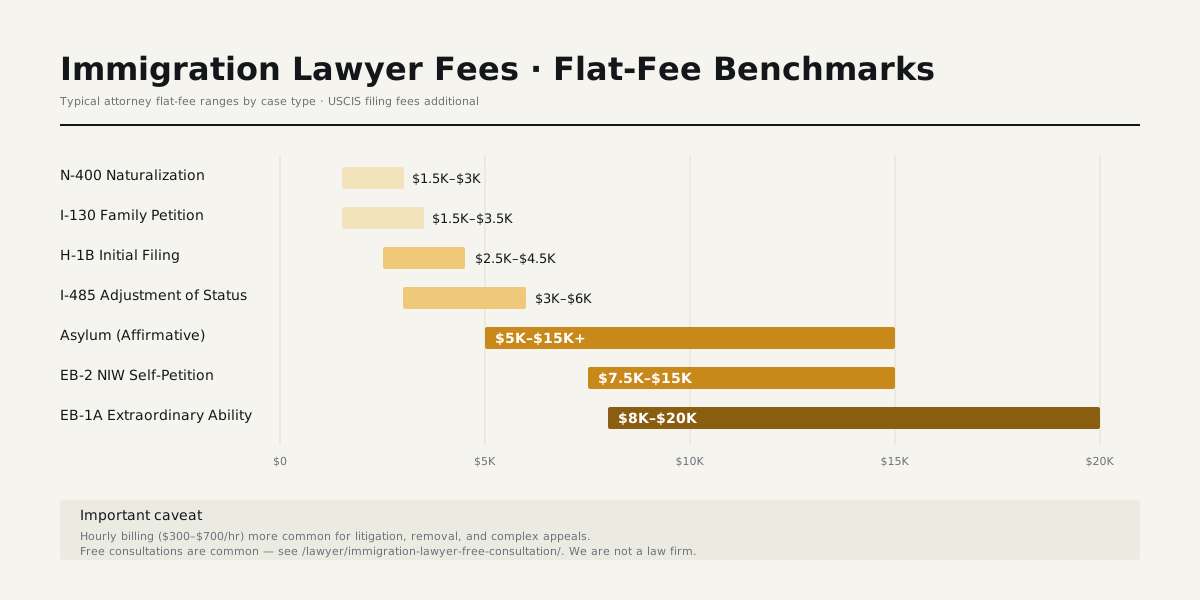
How Immigration Lawyer Cost Is Quoted in 2026
US immigration attorney fees vary by case type, geography, and firm size, but the structure of how fees are quoted is standardized across most of the bar. Three numbers appear on every quote:
- Attorney fee — the legal services charge, paid to the firm.
- Government filing fee — paid directly to USCIS / DOL / DOS, listed on the USCIS filing-fees page. The 2024 fee-rule revisions adjusted most amounts; confirm the current number on USCIS before submitting.
- Premium-processing surcharge — optional, paid via Form I-907. Available for I-129, I-140, I-539 (specific classifications), I-765 (specific categories) and a few others. Currently $2,805 for most I-129 / I-140 categories.
When someone says "the H-1B costs $5,000," ask which of those three numbers they mean. Confusing them produces sticker shock at filing.
2026 Attorney-Fee Benchmarks by Case Type
The ranges below are typical attorney-fee benchmarks observed across the US immigration bar in 2026. They exclude government filing fees and premium processing. They are not quotes — your case-specific quote depends on geography, firm seniority, complexity, and prior history.
Employment-Based Filings
- H-1B initial petition: $2,500–$5,000 attorney fee. Plus USCIS I-129 + ACWIA + asylum-program fees.
- H-1B extension (same employer): $1,500–$3,500.
- H-1B transfer (new employer): $2,500–$4,500.
- L-1A / L-1B initial: $3,500–$7,000.
- O-1 initial: $4,000–$8,000 (more if extensive evidence drafting required).
- PERM labor certification: $4,500–$8,000 attorney fee. Plus DOL recruitment costs ($1,500–$5,000) borne by the employer.
- I-140 (EB-1B / EB-2 / EB-3 with PERM): $2,500–$5,000.
- EB-1A self-petition (extraordinary ability): $8,000–$20,000 — wide spread reflects evidence-package complexity.
- EB-2 NIW self-petition: $5,000–$12,000.
- I-485 adjustment of status: $1,800–$4,000 (per applicant; family rates often discounted).
Family-Based Filings
- I-130 spouse petition: $1,200–$3,500.
- K-1 fiancé(e): $2,000–$4,500.
- I-751 removal of conditions: $1,500–$3,500.
- Consular processing (DS-260) post-I-130: $1,500–$3,500 incremental.
Humanitarian and Removal
- Affirmative asylum (I-589): $4,000–$10,000.
- Defensive asylum at EOIR: $6,000–$15,000+ (depends on hearing complexity and country-conditions evidence).
- U-visa (I-918): $3,000–$7,000.
- VAWA self-petition (I-360): $3,500–$7,500.
- Cancellation of removal: $5,000–$15,000.
- Bond hearing: $2,000–$5,000.
- BIA appeal: $4,000–$10,000.
Naturalization and Citizenship
- N-400 naturalization (no complications): $1,000–$2,500.
- N-400 with good-moral-character issues: $2,500–$5,000.
- N-600 certificate of citizenship: $1,000–$2,500.
What's Excluded from a Flat Fee
Read the engagement letter for what the flat fee does not cover:
- Government filing fees — separate. The USCIS I-485 filing fee alone is over $1,400 and changes periodically.
- Premium processing — $2,805 surcharge is your decision and your cost, not the attorney's.
- RFE / NOID responses beyond the first — many engagement letters cover one RFE response in the flat fee; subsequent responses bill hourly.
- Adjacent filings — adding I-131 advance parole or I-765 EAD to an I-485 may incur incremental flat-fee charges.
- Translation and credential evaluation — typically $50-$200 per document, paid to third-party services.
- Federal-court litigation — if a USCIS decision is challenged in federal court (mandamus, APA review), that is hourly billing in nearly all cases.
Why the Same Filing Has a 3× Spread
An H-1B initial petition might be quoted at $2,500 by one firm and $7,500 by another. The spread is real, not arbitrary, and tracks four factors:
Geography
NYC, SF, Boston, and DC firms quote 30-60% higher than smaller-metro practices. Some of that is overhead; some is attorney compensation; some is the case mix the firm specializes in.
Firm Seniority and Mix
A senior partner with 25 years of EB-1A experience charges more than a 4th-year associate at the same firm — but for a routine H-1B extension, the associate may be the better fit. Ask who, by name, will be drafting the filing.
Specialization Premium
Firms that have built reputation in EB-1A, NIW, or O-1 charge a premium because their pattern recognition is real. For complex cases that's often worth it; for routine H-1B extensions it isn't.
Volume Discount Markets
High-volume H-1B and L-1 outsourcing firms operate at the low end of the range — $2,500-$3,500 per H-1B — because they file thousands and have streamlined templates. The trade-off is less individualized attention.
Who Pays — Employer or Beneficiary
For employment-based cases, who legally pays which fee is partially regulated:
- H-1B: USCIS rules require the employer to pay the ACWIA training fee, anti-fraud fee, and (per 20 CFR 655.731) attorney fees and premium processing if the employer initiates premium processing. The base I-129 filing fee can sometimes be split. The PERM attorney fee and recruitment costs must be paid by the employer per 20 CFR 656.12.
- L-1, O-1, TN, E-3: more flexibility — but if the employer files, the employer typically covers attorney fees.
- Self-petitioned categories (EB-1A, EB-2 NIW): paid entirely by the beneficiary. There is no employer.
- Family-based, naturalization, asylum: paid by the applicant.
Low-Cost and Pro-Bono Alternatives
If the cost ranges above are out of reach, real alternatives exist:
- EOIR-recognized non-profits (CLINIC, Catholic Charities, IRC, regional immigration legal aid) — see the EOIR pro-bono provider directory.
- Law-school immigration clinics — at most law schools in major US cities. Especially active in asylum, U-visa, and SIJS cases.
- AILA pro bono pairings — the American Immigration Lawyers Association coordinates pro-bono representation, especially for unaccompanied minors and detained respondents.
- State and local bar association referrals — many state bars have low-cost or sliding-scale referral panels.
- Pro se filing for routine cases — N-400, I-130 spouse, I-90 green-card renewal, and OPT I-765 are commonly self-filed.
Cross-Pillar Reading
- Lawyer pillar hub
- Immigration lawyer evaluation framework
- Fee structure (flat vs hourly vs hybrid)
- Free consultation scope and signal value
- EB-2 NIW lawyer (cost-band $5K-$12K)
- Asylum lawyer (affirmative $4K-$10K, defensive $6K-$15K+)
- Deportation defense lawyer ($5K-$25K)
- H-1B tax calculator (interactive)
Bottom line
Decision framework: bar status verified, case-type volume in general US immigration cases, written fee scope, transparent communication policy. Skip outcome guarantees and unverifiable success rates.
Frequently asked questions
- What are red flags when choosing an immigration lawyer?
- Be cautious if the attorney guarantees approval, refuses to put fees and scope in writing, or pressures you to decide immediately. Also watch for 'notarios' or 'visa consultants' charging legal fees without a state bar license — that is unauthorized practice of law in most states.
- Where can I find low-cost or pro-bono immigration help?
- Low-cost options include EOIR-recognized non-profits, law-school immigration clinics, and AILA pro-bono referrals. Asylum cases, special immigrant juvenile status, and victims-of-trafficking matters are common pro-bono case types.
- How much does an immigration lawyer cost for immigration lawyer cost?
- Costs cluster around case complexity: PERM + I-140 packages, EB-2 NIW filings, asylum representation, and removal-defense cases sit at the higher end; H-1B extensions, I-130 spouse petitions, and naturalization at the lower end.
- How do I know if an immigration attorney is licensed?
- Beyond bar verification, search the EOIR list of recognized organizations and accredited representatives if you are working with a non-profit. Be cautious of 'visa consultants' or 'notarios' who are not licensed attorneys — that practice is unauthorized in most states.
- What questions should I ask before hiring?
- Ask about prior approvals in the specific category you are filing — for immigration lawyer cost, that means specific case types, not 'years of immigration experience' broadly. Ask for the engagement letter, fee structure, refund policy, communication cadence, and who will actually handle the file.