B-1/B-2 Visa: Visitor Visa for Business and Tourism
B-1/B-2 visa for All Chargeability Areas is current this month: every qualifying applicant has a visa number available, and USCIS will accept the corresponding I-485 filings without waiting on the queue.
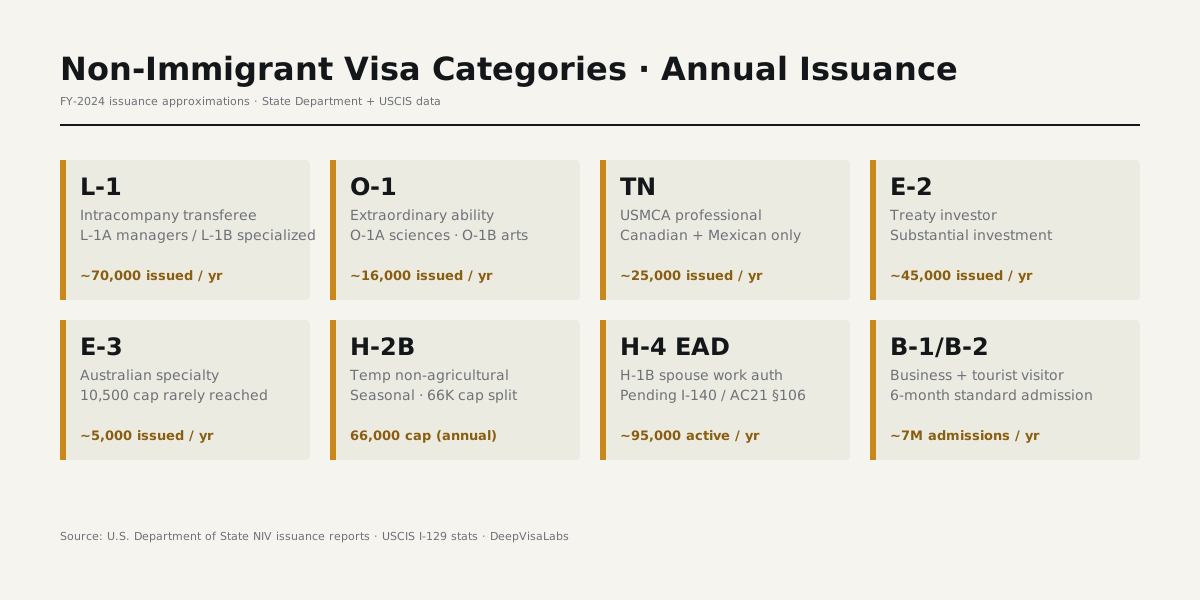
B-1 vs B-2: The Visitor Visa Categories
The B-1/B-2 visa is the standard US visitor visa. B-1 covers business visitors — attending meetings, negotiating contracts, attending conferences, consulting with associates. B-2 covers tourism, social visits, medical treatment, and other personal travel. A combined B-1/B-2 visa stamp authorizes both purposes, and most US embassies issue the combined stamp by default.
B-1 specifically excludes employment in the US — paid by a US source or otherwise productive work for a US entity. The line between permitted business activities and unauthorized work is set by USCIS Policy Manual Volume 2 Part B: meetings, negotiations, training, consultations are permitted; on-the-ground productive work for a US client is not.
Permitted B-1 Business Activities
Permitted B-1 activities include: attending business meetings or conferences, negotiating contracts, consulting with business associates, settling estates, attending conventions and trade shows, undertaking independent research (with no US employer), and taking short business-training courses (where the trainee is paid by a foreign employer and the training does not constitute productive work for a US entity).
The "B-1 in lieu of H-1B" sub-category — historical exception allowing certain professional-level work activities by foreign-employer-paid beneficiaries — has been narrowed since 2012 and is rarely viable in 2026. Practitioners default to true H-1B, L-1, or O-1 for any work-substantive activity.
Permitted B-2 Tourism / Personal Activities
B-2 allows tourism, visiting friends and relatives, medical treatment, participation in social events, recreational courses (where the courses are not for credit), and amateur participation in arts, music, sports, or similar events (where the beneficiary is not paid). Per travel.state.gov visitor visa page.
B-2 prohibits: study (for credit), employment, paid performances, or arrival on B-2 with intent to marry a US citizen for immigration purposes. Marriage during B-2 is permitted — but marriage with pre-arrival intent to file I-485 is a misrepresentation and can lead to inadmissibility findings.
6-Month Standard Admission
CBP officers at the port of entry typically grant B-1/B-2 admission for 6 months — annotated on the I-94 record. Shorter admissions are at the officer's discretion based on stated purpose, evidence of intent to depart, and prior travel history. The 6-month maximum is administrative; INA §214(b) authorizes admission for the period necessary for the visit.
Extension of stay (Form I-539) can extend B-2 by an additional 6 months in most cases — granting a total 1-year US presence on a single B-1/B-2 entry. Multi-year continuous stays trigger USCIS scrutiny of nonimmigrant intent and can lead to denial of future visas or extensions.
ESTA Visa Waiver Program vs B-1/B-2
Citizens of 41 Visa Waiver Program countries (UK, France, Germany, Japan, South Korea, Australia, etc.) can travel to the US on ESTA for up to 90 days for business or tourism — without applying for a B-1/B-2 visa. ESTA is faster (online, 72-hour approval typical) and cheaper ($21 vs $185 visa application fee).
ESTA limitations: 90-day max stay (vs 6 months for B-1/B-2), no extensions available, no change of status to F-1 / H-1B / etc. while in the US. Citizens of VWP countries who plan to stay longer than 90 days, study, or potentially adjust status often choose B-1/B-2 for greater flexibility despite the visa application overhead. Per travel.state.gov VWP page.
Change of Status From B-2
Beneficiaries already in the US on B-2 can change status to F-1 (student), H-1B (with cap-subject lottery selection or cap-exempt employer), or other categories via Form I-539 filed before B-2 expiration. Change of status from B-2 is procedurally allowed but draws USCIS scrutiny — particularly if the change is filed within 90 days of B-2 entry, which the State Department's "90-day rule" treats as evidence of pre-arrival misrepresentation of nonimmigrant intent.
Best practice: wait at least 90 days after B-2 entry before filing change of status, document evolving intent (e.g., received unexpected job offer, decided to enroll in school), and avoid statements at the visa interview that contradict the eventual change.
B-1/B-2 Refusal Risks Under §214(b)
The most common reason for B-1/B-2 visa denial is INA §214(b) — failure to demonstrate nonimmigrant intent. Consular officers presume immigrant intent unless the beneficiary demonstrates strong ties to the home country: stable employment, family residing abroad, property ownership, prior travel history showing return.
Young single beneficiaries from high-immigration countries face the highest §214(b) refusal rates. Practical mitigations: documenting employment with a strong sponsor letter, demonstrating significant assets in the home country, and limiting the requested purpose to specific dates and activities (vs an open-ended "tourism").
Cross-Pillar Reading
- Non-Immigrant Visas · category overview
- H-1B Grace Period · 60-day grace + I-539 to B-2 bridge
- O-1 Visa · for performance / extraordinary-ability beneficiaries
- L-1 Visa · for intracompany transferees
Bottom line
B-1/B-2 sits in the broader non-immigrant work-visa landscape. Each category has distinct eligibility, evidence, and validity-period rules — read the USCIS Policy Manual chapter and 8 CFR §214.2 sub-section before filing.
Frequently asked questions
- Who can sponsor a B-1/B-2 visa?
- Petitioning eligibility for B-1/B-2 depends on the role and beneficiary's relationship to the US entity. Most categories are employer-petitioned; some allow agent or self-petition arrangements.
- How long is the B-1/B-2 validity period?
- Each non-immigrant category has its own validity rules — see the USCIS Policy Manual or 8 CFR for the specific category's maximum stay and renewal patterns.
- Does B-1/B-2 allow dual intent?
- Dual-intent doctrine: L-1 and H-1B explicitly allowed; O-1 implicitly accepted; TN, E-3, H-2B require strict nonimmigrant intent. E-2 historically nonimmigrant but practitioners increasingly file AOS without issue.
- Can my spouse work on B-1/B-2?
- Work-authorization for spouses varies. L-2 and E-3D/E-2 spouses: automatic. O-3, TN-D, H-4 (H-2B): no general work authorization. Spousal benefit is a significant differentiator between categories.
- Is premium processing available for B-1/B-2?
- I-129 premium processing applies to most B-1/B-2 petitions. Categories without I-129 (TN port-of-entry for Canadians, E-2/E-3 consular processing) follow different acceleration models — typically just consulate scheduling.
Sources
- https://travel.state.gov/content/travel/en/us-visas/tourism-visit/visitor.html
- https://www.uscis.gov/working-in-the-united-states/temporary-business-visitor
- https://www.uscis.gov/i-539
- https://travel.state.gov/content/travel/en/us-visas/visa-information-resources/visa-waiver-program.html
- https://www.uscis.gov/policy-manual/volume-2-part-b