O-1 Visa: Extraordinary Ability in Sciences, Business, Arts, and Athletics
The O-1 standard is 'extraordinary ability' demonstrated by 8 regulatory criteria (3 must be satisfied) plus a Kazarian-style final-merits review. O-1A applies to sciences/business; O-1B to arts. Initial validity up to 3 years, renewable in 1-year increments without cap.
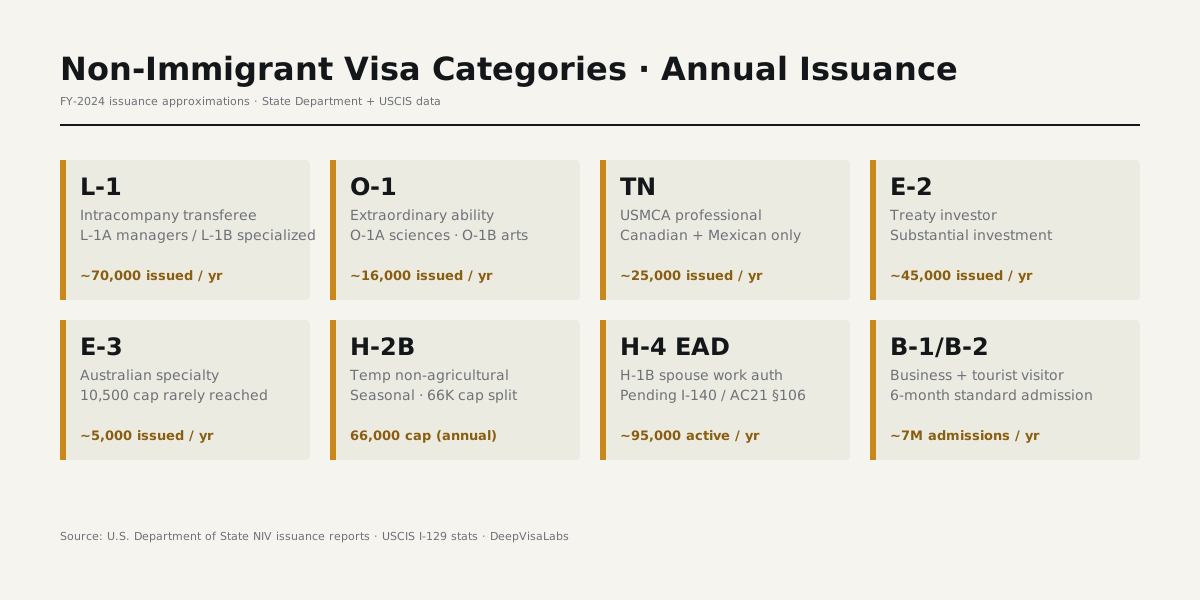
O-1 Sub-Categories
O-1 has two sub-categories under USCIS guidance: O-1A for individuals with extraordinary ability in sciences, education, business, or athletics; O-1B for individuals with extraordinary ability or achievement in the arts, motion picture, or television industry.
Both require demonstrating "sustained national or international acclaim" and recognition of achievements through extensive documentation.
The 8 Regulatory Criteria (O-1A)
For O-1A, the beneficiary must satisfy at least 3 of the 8 criteria in 8 CFR §214.2(o)(3)(iii):
- Receipt of nationally / internationally recognized prizes or awards
- Membership in associations requiring outstanding achievements
- Published material about the beneficiary in professional / major trade publications
- Participation as judge of others' work
- Original scientific / scholarly / business contributions of major significance
- Authorship of scholarly articles in professional journals
- High salary or other remuneration
- Employment in critical / essential capacity at organizations with distinguished reputations
Final-Merits Review (Kazarian)
USCIS uses a Kazarian-style two-step review per USCIS Policy Manual Volume 2, Part M, Chapter 4: (1) count satisfied criteria (must be ≥3), (2) qualitative final-merits determination — whether the totality of evidence demonstrates extraordinary ability and sustained acclaim.
The final-merits step is where many petitions are lost. Satisfying 3 criteria mechanically is not enough — the Kazarian standard requires genuine demonstration of extraordinary ability, not mere checkbox compliance.
Advisory Opinion Requirement
O-1 petitions require an advisory opinion from a peer group, labor union, or expert in the beneficiary's field. The opinion attests to the beneficiary's extraordinary ability and the role's appropriateness. For O-1B in arts, the opinion typically comes from a labor union or guild.
Some industries don't have a clear advisory body — in such cases, USCIS accepts opinions from industry experts (e.g., distinguished academics, well-known industry figures). The advisory opinion is a required attachment, not an option.
Validity Period and Renewals
O-1 initial validity is up to 3 years; extensions are 1-year increments and are renewable indefinitely as long as the qualifying activity continues. There is no statutory cumulative cap. This is one of O-1's structural advantages over H-1B's 6-year cap.
Each extension requires a fresh I-129 with continued evidence of extraordinary ability and current employer / agent support. Premium processing ($2,805) is available.
Self-Petition vs Employer / Agent Petition
O-1 cannot be self-petitioned by the beneficiary directly — there must be a US employer or agent petitioner. Agent petitioners are common in arts and entertainment where beneficiaries work for multiple employers (the agent represents them across engagements).
For sciences and business, employer petitioning is standard. EB-1A (immigrant) is the self-petitionable analog of O-1A; many O-1 holders later pursue EB-1A for permanent residence.
Cross-Pillar Reading
- O-1 Visa Requirements · detailed evidence guidance
- EB-1A Extraordinary Ability · immigrant counterpart
- H-1B Extension · alternative employer-sponsored visa
- L-1 Visa · multinational transferee alternative
- USCIS Processing Times · I-129 windows
Bottom line
Verdict: O-1 rewards rigorously documented evidence. Petitions with thin documentation face denial; well-prepared petitions succeed at high rates. The advisory-opinion requirement and Kazarian final-merits review make this a documentation-intensive process.
Frequently asked questions
- Can my spouse work on O-1?
- L-1 spouses (L-2): automatic work authorization upon admission as of 2022; no separate EAD needed. O-3 (O-1 spouse): no work authorization, must change status. TN-D (TN spouse): no work authorization. E-3D / E-2 spouses: automatic work authorization. H-4 (H-2B spouse): no general work authorization.
- Is premium processing available for O-1?
- Premium processing (Form I-907) covers I-129 petitions for O-1 (where applicable) at $2,805 fee for 15-calendar-day adjudication. TN port-of-entry processing for Canadians does not need premium because adjudication is on-the-spot. E-2/E-3 visa stamping at consulates is separate from I-129 premium processing.
- What evidence does USCIS expect for O-1?
- Evidence packages vary by category. L-1: corporate-relationship evidence; O-1: 3-of-8 criteria + advisory opinion; TN: Annex 16-A occupation match; E-3: Australian citizenship + specialty occupation; H-2B: TLC + temporary need; E-2: substantial investment.
- Who can sponsor a O-1 visa?
- O-1 sponsorship rules vary by category — some require employer sponsorship (L-1, H-2B), others can be agent-petitioned (O-1), some are self-sponsored at the port (TN for Canadians) or based on individual qualification (E-2 investor).
- How long is the O-1 validity period?
- L-1A: 7 years cumulative; L-1B: 5 years; O-1: 3 years initial + 1-year extensions indefinitely; TN: 3 years renewable; E-3: 2 years renewable indefinitely; H-2B: tied to job duration up to 1 year + extensions to 3 years; E-2: 2 years renewable indefinitely.