L-1 Intracompany Transferee Visa: L-1A Manager/Executive vs L-1B Specialized Knowledge
The L-1 intracompany transferee visa lets multinational employers transfer managers/executives (L-1A, up to 7 years) or specialized-knowledge employees (L-1B, up to 5 years) to a US office. Requires 1 of the past 3 years in continuous employment with the foreign affiliate. Dual intent is allowed.
L-1 Sub-Categories
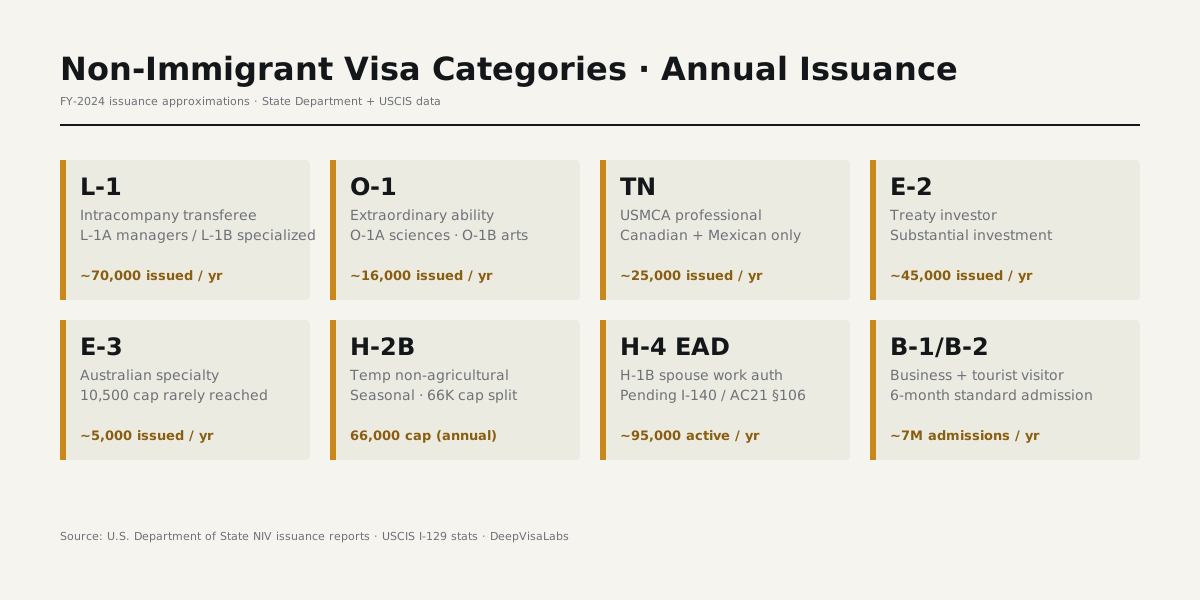
L-1 has two distinct sub-categories: L-1A for managers and executives transferring to a US affiliate, with up to 7 years cumulative stay; L-1B for specialized-knowledge employees, with up to 5 years cumulative stay. Both require qualifying corporate relationship between the US and foreign entities.
L-1A applies to managerial / executive roles; L-1B to specialized-knowledge roles. The distinction matters because L-1A maps to EB-1C immigrant petition (no PERM required), while L-1B does not have a parallel I-140 path.
Qualifying Foreign Employment
The beneficiary must have been continuously employed by the foreign affiliate for at least 1 year of the past 3 years. Time spent in the US (e.g., on prior nonimmigrant visas) does not count toward the 1-year foreign employment requirement.
The foreign role must have been in a managerial / executive capacity (for L-1A) or specialized-knowledge capacity (for L-1B). The US role must continue in the same capacity.
Qualifying Corporate Relationship
The US and foreign entities must have a qualifying relationship: parent / subsidiary / branch / affiliate. Common ownership and control are key — pure licensing arrangements or vendor relationships do not qualify. USCIS Policy Manual Volume 2, Part L details the relationship test.
New-office L-1s — where the US entity is being newly established by the foreign affiliate — get an initial 1-year cap with extensions thereafter contingent on demonstrated business activity.
L-1A Specifics — Managerial / Executive
L-1A standard requires the beneficiary to function in a managerial or executive role abroad and in the US. "Managerial" means primarily directing the management of an organization, department, subdivision, or function. "Executive" means primarily directing the management at a high level with broad latitude.
USCIS scrutinizes the role's actual functions — first-line supervisors of professional employees can qualify, but managers of non-professional staff face higher RFE rates.
L-1B Specifics — Specialized Knowledge
L-1B standard requires "special knowledge" of the petitioning organization's products, services, research, equipment, techniques, management, or processes — knowledge held by relatively few employees and not generally known. USCIS issues RFEs frequently on the specialized-knowledge standard.
Documentation strategies: detailed descriptions of how the beneficiary's knowledge was acquired (often through years of internal training), comparison to general industry knowledge, evidence that few peer employees hold equivalent knowledge.
Dual Intent and Premium Processing
L-1 explicitly allows dual intent under INA §214(h). Beneficiaries can pursue green-card status (most commonly EB-1C for L-1A) without prejudicing visa renewals.
Premium processing (Form I-907, $2,805) is available for L-1 I-129 petitions filed by US employers. Blanket L petitions (for large multinationals) follow a different consular processing path.
L-2 Spouse Work Authorization
L-2 spouses receive automatic work authorization upon admission as of the 2022 USCIS policy update — no separate EAD application required. This is a significant differentiator from H-4 dependents, who need an EAD with eligibility conditions.
L-2 children under 21 receive L-2 dependent status but not work authorization (must change status for employment).
Cross-Pillar Reading
- EB-1 Green Card (EB-1C) · multinational manager / executive immigrant path
- O-1 Visa · alternative for individuals with extraordinary ability
- H-1B Extension · alternative employer-sponsored work visa
- USCIS Processing Times · I-129 windows by classification
Bottom line
Verdict: L-1 fits multinational employers with established corporate structures abroad. L-1A enables a 7-year runway with dual intent (parallel green-card pursuit); L-1B is more contested at adjudication due to the specialized-knowledge standard.
Frequently asked questions
- Does L-1 allow dual intent?
- Dual-intent doctrine: L-1 and H-1B explicitly allowed; O-1 implicitly accepted; TN, E-3, H-2B require strict nonimmigrant intent. E-2 historically nonimmigrant but practitioners increasingly file AOS without issue.
- Can my spouse work on L-1?
- L-1 spouses (L-2): automatic work authorization upon admission as of 2022; no separate EAD needed. O-3 (O-1 spouse): no work authorization, must change status. TN-D (TN spouse): no work authorization. E-3D / E-2 spouses: automatic work authorization. H-4 (H-2B spouse): no general work authorization.
- Is premium processing available for L-1?
- For L-1 petitions filed via I-129, premium processing is available. Cost: $2,805. SLA: 15 calendar days. RFE issuance pauses the clock; resumption upon response.
- What evidence does USCIS expect for L-1?
- Evidence packages vary by category. L-1: corporate-relationship evidence; O-1: 3-of-8 criteria + advisory opinion; TN: Annex 16-A occupation match; E-3: Australian citizenship + specialty occupation; H-2B: TLC + temporary need; E-2: substantial investment.
- Who can sponsor a L-1 visa?
- L-1 sponsorship rules vary by category — some require employer sponsorship (L-1, H-2B), others can be agent-petitioned (O-1), some are self-sponsored at the port (TN for Canadians) or based on individual qualification (E-2 investor).
Sources
- https://www.uscis.gov/working-in-the-united-states/temporary-workers/l-1a-intracompany-transferee-executive-or-manager
- https://www.uscis.gov/working-in-the-united-states/temporary-workers/l-1b-intracompany-transferee-specialized-knowledge
- https://www.uscis.gov/i-129
- https://www.uscis.gov/policy-manual/volume-2-part-l
- https://egov.uscis.gov/processing-times/