Prevailing Wage Determination: ETA-9141, Wage Levels 1–4, NPWC Processing
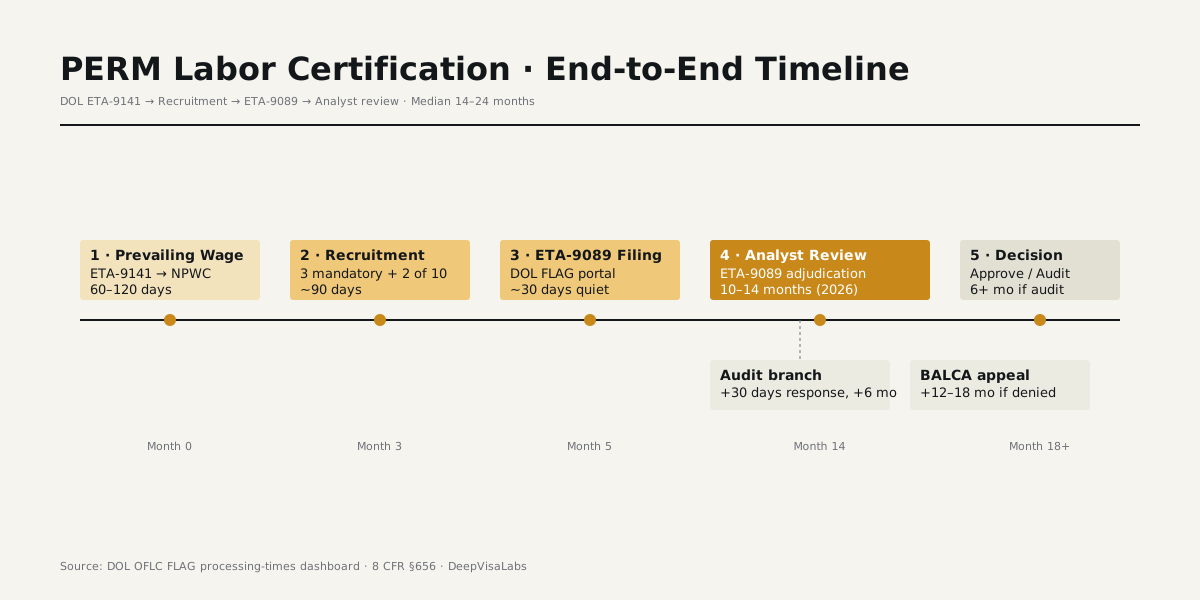
Total PERM wait depends on whether the case is audited: analyst-only review clears in roughly 9–12 months, audit selection adds 7–12 months on top, and BALCA appeal can extend the timeline beyond two years.
What a Prevailing Wage Determination Is
A prevailing wage determination (PWD) is the DOL National Prevailing Wage Center's binding statement of the prevailing wage for the offered occupation, the area of intended employment, and the required experience level. PWDs are issued in response to Form ETA-9141 filings on the DOL FLAG portal.
PWDs are required for both PERM (EB-2 / EB-3 green card) and H-1B / H-1B1 / E-3 / H-2B Labor Condition Applications. PWDs are valid for 1 year (90 days for some H-2B uses) — recruitment must commence within the validity window.
Wage Sources: OES, CBA, and Employer Survey
Three wage sources can produce a prevailing wage. OES (Occupational Employment and Wage Statistics) — published by the Bureau of Labor Statistics — is the default, used in roughly 90%+ of PWDs. OES wages are organized by SOC code and Metropolitan Statistical Area (MSA), with four wage levels mapped to BLS percentiles.
Collective Bargaining Agreement (CBA) — when the offered position is covered by a current CBA, the CBA wage governs and supersedes OES. Employer-provided wage survey — under restrictive conditions, the employer can submit an alternative private survey if it meets DOL methodology requirements (random sampling, current data, geographic relevance, multiple employers covered). Employer surveys are challenged frequently and rarely accepted on first review.
Wage Levels 1–4
OES PWDs are organized into four wage levels mapped to BLS percentiles per the H-1B Visa Reform Act of 2004:
- Level 1 (Entry-level): 17th percentile — beginning level requiring basic understanding of the occupation
- Level 2 (Qualified): 34th percentile — moderate understanding of the occupation, performing routine tasks
- Level 3 (Experienced): 50th percentile — sound understanding of the occupation, exercising judgment
- Level 4 (Fully competent): 67th percentile — advanced understanding, planning and supervising the work of others
The employer self-selects the wage level on ETA-9141 based on the position's required experience, education, and supervisory responsibility. Level selection methodology is documented in the DOL Prevailing Wage Determination Policy Guidance — Job Zone (O*NET), required experience, supervisory duties, and special skills are all factors.
NPWC Processing Time
The National Prevailing Wage Center processes ETA-9141 filings in a centralized queue. Current processing time runs 4–8 months in 2026 — published monthly at flag.dol.gov/processingtimes.
NPWC does not offer premium processing. The only acceleration mechanism is filing early in the PERM cycle and avoiding common deficiencies that trigger redetermination requests. PWD redetermination requests reset the queue position and add 3–4 months on average.
Common ETA-9141 Issues
SOC code mismatch: the listed job duties don't align with the SOC code's standard description, triggering NPWC to either reclassify the position or request clarification. SOC reclassification can shift the wage materially.
Wage level dispute: NPWC may reclassify the wage level upward if the listed required experience or supervisory duties exceed the employer's selected level. A Level 1 selection for a senior or supervisory role frequently gets reclassified to Level 2 or 3.
Area of intended employment: the geographic scope must match the worksite — multi-site positions require separate PWDs or careful documentation of "normal commuting distance" per DOL guidance.
PWD Redetermination and Appeal
If the issued PWD is unfavorable, the employer has three options: (1) accept and proceed with recruitment at the determined wage, (2) request redetermination within 30 days under 20 CFR §656.41(d), or (3) appeal to the Center Director. Redetermination requires new wage data or evidence of analytical error; bare disagreement with the wage level is not a valid basis.
For H-1B / H-1B1 / E-3 / H-2B, the employer can also use a National Prevailing Wage Center wage source or an alternative source (CBA, OES alternative percentile under certain conditions). PERM is more restrictive — OES is the default and alternatives require strong documentation.
How PWD Affects Petition Timing
PWD is the gating step for PERM. Recruitment cannot commence until PWD is issued; recruitment must commence within the 1-year PWD validity window. A 6-month PWD wait followed by 60-day recruitment + 30-day cooling + 9-12 month analyst review = 16-20 months minimum for PERM end-to-end, before any audit.
For H-1B LCA, the PWD interaction is different: H-1B LCA filings can use the OES wage from DOL FLAG wage search directly, without a separate ETA-9141 filing. PWD via ETA-9141 is required only when the employer disputes the OES wage or wants a binding determination.
Cross-Pillar Reading
- Labor Certification · full PERM process
- PERM Processing Time · current FLAG dashboard numbers
- PERM Audit · selection sources and document file
- H-1B LCA · LCA wage-tier compliance
Bottom line
Verdict on PERM timing: the binding constraint is DOL workflow, not the visa bulletin. Build the I-140 strategy assuming 15–24 months from PWD to ETA-9089 certification.
Frequently asked questions
- Does premium processing exist for PERM?
- PERM has no premium-processing option. Acceleration only happens through case characteristics (e.g., physician National Interest Waiver paths bypass PERM entirely) or by avoiding audit triggers in the application.
- What's the practical PERM timeline I should plan for?
- Total PERM duration in 2026 typically lands at 15–24 months. The bottleneck rotates between PWD issuance and analyst review depending on DOL workload swings.
- What is PERM and where does it sit in the green-card process?
- PERM is the U.S. Department of Labor's pre-USCIS step for employer-sponsored EB-2 / EB-3 green cards. It tests the U.S. labor market through prevailing-wage determination, recruitment, and a Form ETA-9089 application before the case ever reaches USCIS.
- How long does PERM analyst review take in 2026?
- Current analyst-review processing runs about 9–12 months, per DOL's FLAG dashboard. That assumes no audit selection — audited cases sit in a separate, longer queue.
- What happens if my PERM case is audited?
- Audit cases move to a separate queue currently running 16–24 months from filing. DOL requests a Recruitment Report and supporting documentation; non-response within the 30-day window leads to denial.