PERM Processing Time: Analyst Review, Audit Queue, BALCA Appeals (DOL FLAG Data)
DOL's FLAG dashboard publishes monthly processing times for PERM. Analyst review is the baseline (9–12 months); audit, supervised recruitment, and BALCA appeal each add a separate queue, all tracked at flag.dol.gov/processingtimes.
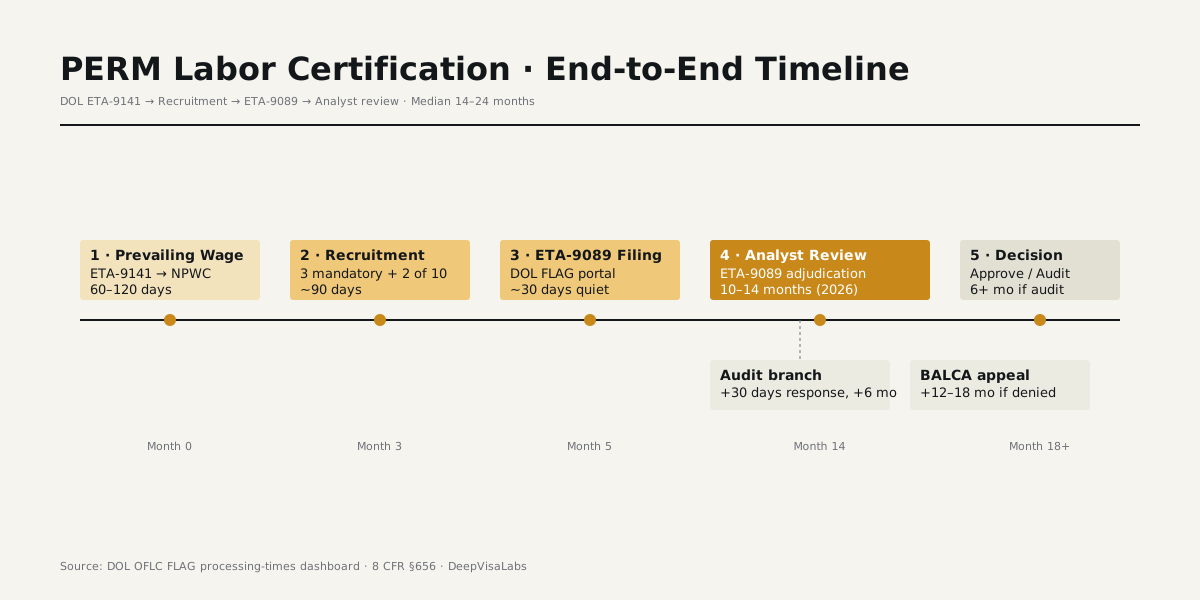
Current PERM Processing Time at a Glance
PERM (Program Electronic Review Management) is the U.S. Department of Labor's labor-certification step required before an EB-2 or EB-3 employer-sponsored I-140. Processing flows through four distinct branches at DOL's Office of Foreign Labor Certification (OFLC), each with its own queue.
Live windows from the DOL FLAG processing-times dashboard (2026 Q1):
- Standard analyst review: 9–12 months from filing
- Audited cases: 16–24 months including document-review window
- Supervised recruitment: add 6–12 months on top of audit timeline
- BALCA appeals: 24+ months to resolve
The Four PERM Processing Branches
Branch 1 — Standard Analyst Review
The default path. The Certifying Officer reviews the certified ETA-9089, recruitment results, and prevailing-wage attestation against 20 CFR Part 656. No audit notification is issued. Currently 9–12 months from filing per the FLAG dashboard. About 65–75% of cases follow this path.
Branch 2 — Audit Review
Roughly 25–35% of cases are selected for audit (random selection plus targeted triggers — restrictive job requirements, recent recruitment-process flags, employer audit history). Audited cases sit in a separate queue running 16–24 months from filing including the 30-day employer document-response window.
Branch 3 — Supervised Recruitment
Triggered after audit findings or quality-control review under 20 CFR §656.21. The Certifying Officer dictates a fresh recruitment plan with DOL oversight; adds 6–12 months on top of audit timeline. Most disruptive branch — many employers withdraw and refile rather than complete supervised recruitment.
Branch 4 — BALCA Appeals
The Board of Alien Labor Certification Appeals reviews PERM denials de novo. Current queue exceeds 24+ months to resolve. BALCA's docket has lengthened materially since 2020 due to staffing constraints and rising appeal volume.
Pre-PERM Gating: The Prevailing Wage Determination
ETA-9141 Filing and Wage-Center Queue
Before the PERM ETA-9089 can be filed, the employer must obtain a prevailing wage determination (PWD) from DOL's National Prevailing Wage Center via Form ETA-9141. PWD processing currently runs 4–8 months in 2026. The PWD step is invisible on the public processing dashboard but adds materially to total PERM duration.
PWD Validity Window and Wage-Level Disputes
PWD validity is 90 days to 1 year from issuance, with the validity period set at the employer's request. An unfavorable PWD wage level can force the employer to either (a) appeal the PWD via the Center for Foreign Labor Certification reconsideration process, (b) re-evaluate the position description and resubmit, or (c) accept the higher wage and proceed to recruitment. Recruitment cannot begin until the PWD is issued.
What Audit Selection Actually Involves
Audit Notification and 30-Day Response Window
If selected for audit, the Certifying Officer issues an audit notification letter. The employer has 30 calendar days from the audit notice to respond. Non-response or inadequate response leads to denial. Extension requests (15-day extensions) are sometimes granted for documented good cause.
Required Documents
- The complete recruitment file: tear sheets from newspaper ads, internal posting evidence, state workforce job order, three additional recruitment steps for professional positions (per 20 CFR §656.17(e)).
- The Recruitment Report: a written summary of recruitment results, U.S. worker applicants reviewed, and lawful, job-related reasons for rejection.
- The signed ETA-9089 with all supporting attachments.
- Evidence supporting the prevailing wage determination's continued validity at the time of recruitment and filing.
Re-Adjudication After Audit Response
After audit response submission, the case re-enters the audit-review queue for adjudication. Outcomes: certification, denial, or a referral to supervised recruitment. Audit-stage denials become the starting point for BALCA appeals.
Supervised Recruitment — The Worst-Case Branch
Triggers
Supervised recruitment is most often invoked when DOL suspects job-order or recruitment-process irregularities such as overly restrictive job requirements that appear designed to exclude U.S. workers. Common triggers: unusual education requirements, narrow language demands not justified by job, geographic restrictions, or recruitment ad text that disqualifies otherwise-qualified U.S. applicants.
What DOL Imposes
- Re-running the entire recruitment campaign under DOL oversight.
- The Certifying Officer specifies advertisement text, ad placement, and reporting requirements.
- Weekly recruitment-status reports to DOL.
- DOL screening of all U.S. worker applicants against the job description.
Adds 6–12 months to total PERM time. Many employers withdraw the original PERM at this stage rather than complete supervised recruitment, then refile a corrected PERM with a tighter job description — accepting the loss of original priority date.
BALCA Appeal Pathway
De Novo Standard of Review
BALCA reviews PERM denials de novo, meaning the Board considers the record afresh and is not bound by the Certifying Officer's findings of fact. The employer must file a request for review within 30 days of the denial under 20 CFR §656.26. The record on appeal is limited to the file before the Certifying Officer at the time of denial.
Time-to-Resolution
Current BALCA queue exceeds 24+ months from request-for-review to decision. Many cases sit in pre-decision review for 18+ months before substantive evaluation begins. Practitioners file BALCA appeals primarily to preserve priority date — not because rapid resolution is realistic.
Refile vs Wait Decision
Many employers refile a corrected PERM in parallel rather than wait on BALCA, accepting the loss of original priority date in exchange for a faster certification decision. The choice depends on (a) how far behind the priority date is in the visa-bulletin queue, (b) the strength of the BALCA appeal arguments, and (c) whether the underlying recruitment defects can be cured by a new filing.
Realistic End-to-End PERM Timeline (2026)
Putting all phases together for a typical EB-2 / EB-3 case in 2026:
- PWD (ETA-9141): 4–8 months.
- Recruitment + 30-day cooling period: ~3 months (60-day recruitment campaign + mandatory 30-day quiet period before filing).
- PERM filing → analyst-review certification (no audit): 9–12 months.
- Audit branch (if selected): add 7–12 months.
- Supervised recruitment (if ordered): add 6–12 months.
- BALCA appeal (if denied): 24+ months.
Plan for 15–22 months end-to-end for unaudited PERM cases (PWD through ETA-9089 certification). Audited cases typically land at 22–32 months. BALCA appeals push beyond 36 months; refiling a clean PERM in parallel is often the faster path to certification.
No Premium Processing for PERM — Acceleration Strategy
Unlike USCIS forms (I-129, most I-140 categories), DOL does not offer premium processing for PERM. The Form I-907 premium-processing service applies to USCIS adjudication only. The only effective acceleration strategies are at the filing-design stage.
Clean Filings to Minimize Audit Risk
Avoid overly restrictive job requirements (especially preferred-degree fields), document recruitment defensively, ensure ad text precisely matches the ETA-9089 job description. Roles with established SOC-mapping precedent and standard education/experience requirements have lower audit-selection rates.
Avoiding Supervised-Recruitment Triggers
Industries and roles with recent supervised-recruitment patterns warrant extra scrutiny at the recruitment-design stage. Tight coupling of job description, recruitment ad text, and applicant-screening criteria is the best defense — internal documentation should show good-faith U.S. worker recruitment, not pretextual rejection.
Bypass Paths (EB-1A / NIW / EB-5)
EB-1, EB-2 NIW, and EB-5 do not require PERM. For high-credentials petitioners, EB-1A or NIW eliminate PERM entirely — see NIW and EB-1 for self-petition pathways. EB-5 (investor) is a separate track with its own capital and job-creation requirements.
Cross-Pillar Reading
- PERM pillar hub · the broader DOL labor-certification process
- Labor certification overview · what PERM is and why EB-2/EB-3 require it
- PERM audit response · what to file when DOL audits the case
- Prevailing wage determination (ETA-9141) · the pre-PERM PWD step
- EB-2 advanced degree / exceptional ability · the green-card category PERM feeds into
- EB-3 skilled / professional / other · alternative EB-3 path through PERM
- National Interest Waiver · the EB-2 path that skips PERM entirely
- H-1B extension (AC21 §106(a)) · why PERM duration matters for H-1B 7th-year extensions
- Prevailing wage checker (interactive widget) · DOL OFLC level 1-4 by SOC + state
Bottom line
Verdict on PERM timing: the binding constraint is DOL workflow, not the visa bulletin. Build the I-140 strategy assuming 15–24 months from PWD to ETA-9089 certification.
Frequently asked questions
- When is the prevailing wage determination needed?
- Before filing PERM, the employer must obtain a prevailing wage determination (PWD) from DOL's National Prevailing Wage Center via Form ETA-9141. PWD processing currently runs 4–8 months and is the gating step.
- Does premium processing exist for PERM?
- No. DOL does not offer premium processing for PERM. The Form I-907 premium-processing service applies only to USCIS forms (I-129, most I-140 categories), not to DOL labor certification.
- What's the practical PERM timeline I should plan for?
- Total PERM duration in 2026 typically lands at 15–24 months. The bottleneck rotates between PWD issuance and analyst review depending on DOL workload swings.
- What is PERM and where does it sit in the green-card process?
- PERM is the U.S. Department of Labor's pre-USCIS step for employer-sponsored EB-2 / EB-3 green cards. It tests the U.S. labor market through prevailing-wage determination, recruitment, and a Form ETA-9089 application before the case ever reaches USCIS.
- How long does PERM analyst review take in 2026?
- DOL FLAG's processing-times dashboard puts standard PERM analyst review at roughly 9–12 months from filing as of 2026 Q1. The dashboard updates monthly at flag.dol.gov/processingtimes.