USCIS Receipt Number: Format, Service-Center Prefix Decode, ELIS vs Lockbox
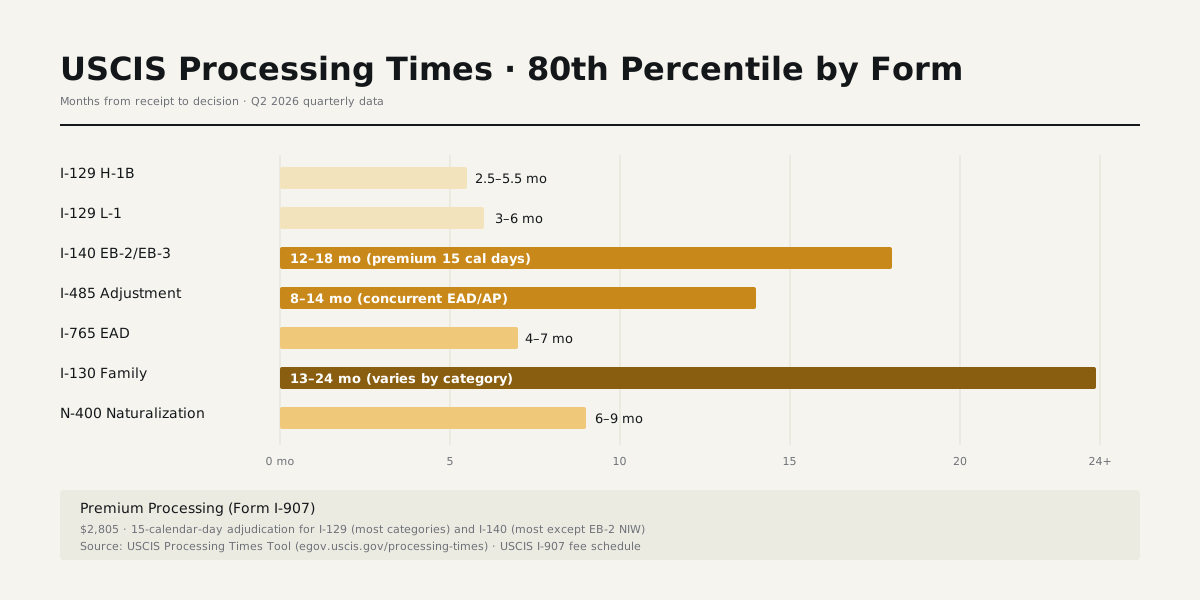
Current USCIS adjudication ranges are tabulated below across all major immigration forms. Numbers reflect the 80th-percentile completion time as of the last dashboard snapshot — 'outside normal processing time' (eligible for case inquiry) is set at the same upper-bound value.
The 13-Character Format
USCIS receipt numbers are 13 characters in format: 3-letter prefix + 2-digit fiscal year + 3-digit workday code + 5-digit serial. Example: EAC2210512345.
Each segment encodes specific information: the prefix tells which service center / lockbox handled intake, the fiscal year tells when the case was filed, the workday code identifies the day within the fiscal year, and the serial uniquely identifies the case within that day.
Service-Center Prefix Decode
The 3-letter prefix maps to the service center or lockbox that intook the filing:
- LIN — Lincoln (Nebraska Service Center)
- EAC — Vermont Service Center
- SRC — Texas Service Center
- WAC — California Service Center
- MSC — National Benefits Center
- IOE — ELIS electronic filing
- YSC — Potomac Service Center
The prefix doesn't necessarily indicate which center will adjudicate — USCIS transfers cases between centers to balance load.
Fiscal-Year Encoding
The 2-digit fiscal-year segment encodes the federal fiscal year (October 1 – September 30) when the case was received. Receipt format EAC23xxxxxxx indicates fiscal year 2023 (Oct 1, 2022 – Sept 30, 2023).
The 3-digit workday code (Julian day equivalent within the fiscal year) typically ranges 001–365. Day 001 is October 1, day 365 is September 30. Some receipts use slightly different conventions for the workday code.
ELIS Electronic Filings
Receipts starting with IOE indicate filings made through USCIS ELIS (Electronic Immigration System). Currently supported electronically: I-90 (green card replacement), I-130 (family-based), I-131 (advance parole), I-485 (adjustment of status), I-765 (EAD), N-400 (naturalization), among others.
Electronic filings often process faster than paper because of streamlined intake. Documents are uploaded directly to the case record rather than mailed.
Lockbox vs Service Center
USCIS uses lockboxes for paper intake — facilities operated by partner contractors that scan documents, deposit fees, and issue receipts. Lockbox prefixes (LIN, EAC, SRC, WAC, MSC) reflect the geographic intake routing, not necessarily the adjudicating center.
The actual adjudicating service center is determined by case type, classification, and current workload-balancing transfers. Adjudication can occur at a different center than the lockbox prefix suggests.
Cross-Pillar Reading
- USCIS Case Status Check · using receipt for status lookup
- Case Status Online · my.uscis.gov account features
- USCIS Processing Times · service-center-specific windows
Bottom line
USCIS processing times are population-level 80th-percentile windows, refreshed monthly. Match your form, classification, and service center precisely; ignore generic 'average' estimates that don't break out by service center.
Frequently asked questions
- How often does USCIS update processing times?
- Monthly refresh, around the 15th. Each update reflects completions from the prior month, so the displayed numbers are a rolling snapshot rather than a real-time view.
- What's the difference between case status and processing times?
- Two different tools: case status reports state changes for your specific receipt; processing times show statistical adjudication windows. They share the egov.uscis.gov domain but answer different questions.
- When can I file a case inquiry on USCIS?
- Eligible to file a case inquiry once your case is past the 'Outside Normal Processing Time' threshold — set at the upper bound of the published processing range for your specific form / classification / service center. File at egov.uscis.gov.
- Why does the same form have different processing times by service center?
- Service-center variation is substantial. USCIS can transfer cases between centers to balance load, but the processing-time table breaks out per-center because timing differs materially. Always read your case's service-center row.
- What is premium processing and which forms qualify?
- I-907 covers I-129, I-140 (most categories), I-539 F/M/J dependent extensions, and I-765 F-1 pre-completion OPT. Fees range from $1,685 to $2,805 in 2026. EB-2 NIW is the notable I-140 exclusion.