USCIS Processing Times by Form, Service Center, and Premium Processing SLA
USCIS processing times are 80th-percentile windows: 80% of cases complete within the upper bound. The dashboard publishes per form (I-129, I-140, I-485, I-765, I-131, I-130, N-400, I-90, I-539) and per service center, refreshed monthly.
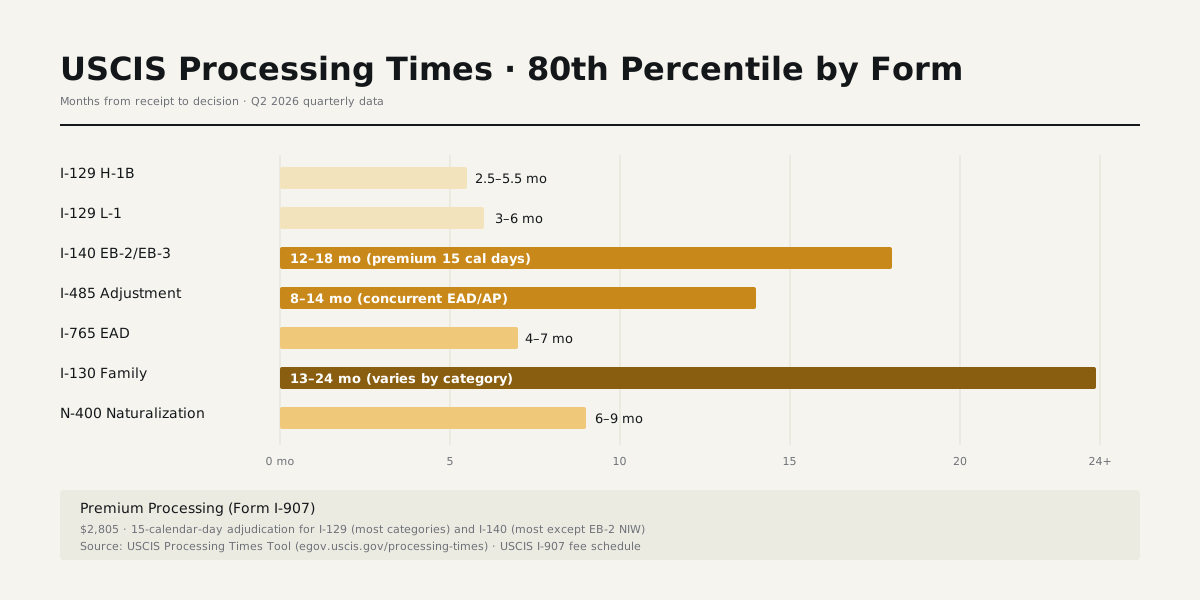
How to Read USCIS Processing Times
USCIS publishes processing times as 80th-percentile completion windows on the egov.uscis.gov/processing-times dashboard. The format and refresh cadence have remained consistent since the 2018 redesign of the public-facing tool.
80th-Percentile vs Median
Eighty percent of cases complete within the upper bound shown; the lower bound is the 50th-percentile (median) completion time. The 50th tends to run 30-40% faster than the 80th — meaning median wait is materially shorter than the published upper bound. There is no public 95th-percentile metric.
Dashboard Refresh Cadence
The dashboard refreshes monthly, around the 15th, with prior-month adjudication data — meaning the displayed numbers always lag real-time by 30-60 days. Service-center load shifts (often quarterly) can produce sudden swings between dashboard refreshes.
"Outside Normal Processing Time" Trigger
The "Outside Normal Processing Time" threshold is set at the same upper-bound value. Cases past that threshold are eligible to file a case inquiry through the egov.uscis.gov tools. Filing earlier doesn't accelerate adjudication, but filing once eligible can flag stuck cases for service-center attention.
I-129 — Petition for Nonimmigrant Worker
I-129 covers H-1B, L-1, O-1, TN, H-2B, and other employment-based nonimmigrant categories. Service centers handling I-129 are VSC (Vermont), CSC (California), and TSC (Texas) for select classifications. Premium processing under Form I-907 is available for most I-129 categories — see Premium Processing section below.
H-1B Specialty Occupation
H-1B I-129 standard processing runs 2.5–5.5 months. Cap-subject filings (April-June each year) compete for service-center capacity; cap-exempt and extension filings have shorter median windows.
L-1A and L-1B Intracompany Transferees
L-1A (manager/executive) and L-1B (specialized knowledge) processing runs 2.5–6.0 months. L-1 Blanket petitions (for qualifying employers with multiple anticipated transfers) have separate processing through consular posts.
O-1 and TN Standard Processing
O-1 (extraordinary ability) processing runs 1.5–5.0 months. TN (NAFTA / USMCA) processing runs 1.0–4.0 months and is also adjudicated at the port of entry for Canadian applicants.
| Classification | Service Centers | Range (months) |
|---|---|---|
| H-1B specialty occupation | VSC, CSC | 2.5–5.5 months |
| H-1B with premium processing (Form I-907) | VSC, CSC | 15 calendar days (premium) |
| L-1A intracompany transferee — manager/executive | VSC, CSC | 2.5–5.5 months |
| L-1B intracompany transferee — specialized knowledge | VSC, CSC | 2.5–6 months |
| O-1 extraordinary ability | VSC, CSC, TSC | 1.5–5 months |
| TN North American professional | VSC, TSC | 1–4 months |
I-140 — Immigrant Petition for Alien Worker
I-140 covers EB-1, EB-2 (advanced degree, exceptional ability, NIW), and EB-3 employment-based green-card petitions. Service centers are NSC (Nebraska) and TSC (Texas), with periodic transfers to balance backlog.
EB-1A vs EB-1B vs EB-1C Service Times
EB-1A (extraordinary ability) processing 8–14 months; EB-1B (outstanding researcher/professor) 9–14 months; EB-1C (multinational executive/manager) 12–18 months. EB-1C runs longer because of multinational-corporate-relationship documentation review. All three accept I-907 premium processing.
EB-2 Advanced Degree vs Exceptional Ability
EB-2 advanced-degree pathway processing 8–14 months; EB-2 exceptional-ability pathway runs in the same window. The two pathways share an adjudication queue but differ in evidentiary requirements (degree+5 years experience vs the 10-criteria exceptional-ability test).
EB-2 NIW — The Premium-Processing Exception
EB-2 NIW processing runs 12–22 months — and unlike all other I-140 categories, NIW remains explicitly excluded from premium processing. This adds 8–22 months of expected wait that I-907 cannot reduce. See EB-2 NIW for adjudication strategy.
EB-3 Skilled / Professional / Other
EB-3 processing 10–18 months. Service centers handle skilled-worker, professional, and "other worker" sub-classifications in the same queue. Premium processing extended to EB-3 in 2022.
| Classification | Service Centers | Range (months) |
|---|---|---|
| EB-1A extraordinary ability | NSC, TSC | 8–14 months |
| EB-1B outstanding researcher / professor | NSC, TSC | 9–14 months |
| EB-1C multinational executive / manager | NSC, TSC | 12–18 months |
| EB-2 advanced degree / exceptional ability | NSC, TSC | 8–14 months |
| EB-2 NIW (National Interest Waiver) | NSC, TSC | 12–22 months |
| EB-3 skilled / professional / other | NSC, TSC | 10–18 months |
| Premium processing (Form I-907) — most I-140 categories | NSC, TSC | 15 calendar days (premium) |
I-485 — Application to Register Permanent Residence or Adjust Status
I-485 is the in-country adjustment-of-status application following an approved I-130 (family) or I-140 (employment), or as part of a refugee/asylee adjustment. Service centers vary by case type. See Form I-485 instructions for category-by-category documentary requirements.
Employment-Based I-485 (EB-1, EB-2, EB-3)
Employment-based I-485 processing runs 10–18 months. The window depends on whether the underlying I-140 was filed concurrently or sequentially, and on whether the priority date was current at filing. Concurrent filings tend to track the underlying I-140 timeline.
Family-Based I-485 (Immediate Relatives)
Immediate-relative I-485 processing runs 11–18 months. Family-preference categories have separate timelines depending on F2A/F2B/F3/F4 sub-classification — see I-130 section below.
Asylee and Refugee Adjustment
Asylee adjustment 8–18 months; refugee adjustment 8–16 months. Asylees may apply for adjustment one year after asylum grant; refugees one year after admission.
| Classification | Service Centers | Range (months) |
|---|---|---|
| Employment-based (EB-1, EB-2, EB-3) | NBC, TSC, NSC | 10–18 months |
| Family-based — immediate relative of US citizen | NBC | 11–18 months |
| Asylee adjustment | NBC | 8–18 months |
| Refugee adjustment | NBC | 8–16 months |
I-765 — Employment Authorization Document (EAD)
| Classification | Service Centers | Range (months) |
|---|---|---|
| Initial EAD — F-1 OPT post-completion (c)(3)(B) | TSC, NBC | 1.5–4 months |
| STEM OPT 24-month extension (c)(3)(C) | TSC, NBC | 2–5 months |
| Pending I-485 adjustment EAD (c)(9) | NBC, TSC | 3–8 months |
| H-4 dependent EAD | VSC, TSC | 2–6 months |
I-130 — Petition for Alien Relative (family)
| Classification | Service Centers | Range (months) |
|---|---|---|
| Immediate relative — US-citizen spouse | NBC | 13–24 months |
| Immediate relative — US-citizen unmarried child U21 | NBC | 12–22 months |
| Family preference — F2A LPR spouse / minor child | NBC | 18–36 months |
| Family preference — F4 sibling of US citizen | NBC | 36–60 months |
I-90 — Replace Permanent Resident Card · I-131 — Travel Document · I-539 — Extend / Change Nonimmigrant Status · N-400 — Naturalization
| Form | Classification | Range (months) |
|---|---|---|
| I-90 | Replace lost/damaged green card | 8–14 months |
| I-90 | 10-year renewal of expired green card | 8–14 months |
| I-131 | Reentry permit — LPR | 12–18 months |
| I-131 | Refugee travel document | 6–13 months |
| I-131 | Advance Parole — pending I-485 | 4–9 months |
| I-539 | Change to F-1 / F-2 / M-1 / M-2 | 5–11 months |
| I-539 | Extend H-4 / L-2 dependent | 4–9 months |
| I-539 | Extend B-1 / B-2 visitor | 7–14 months |
| N-400 | Standard 5-year LPR pathway | 5–10 months |
| N-400 | 3-year LPR married to US citizen | 5–10 months |
| N-400 | Military naturalization | 4–8 months |
Premium Processing 2026 — Fees and SLAs
Premium processing (Form I-907) provides accelerated adjudication for an additional fee. Per the USCIS premium-processing program (April 2024 fee final rule), eligibility expanded substantially through 2022-2024 to cover most I-129 and I-140 categories plus selected I-539 and I-765 sub-categories.
15-Day SLA Categories (Most Common)
I-129 (H-1B / L-1 / O-1 / TN), I-140 (EB-1A / EB-1B / EB-2 advanced degree / EB-2 exceptional ability / EB-3) all run on a 15-calendar-day SLA. The clock pauses on RFE issuance and resumes on response.
30-Day and 45-Day SLA Categories
I-539 (F/M/J dependents), I-765 (F-1 pre-completion OPT) run on a 30-day SLA. EB-1C multinational manager I-140 runs on a 45-day SLA — the only I-140 category not on the 15-day track.
What Premium Processing Does and Does Not Cover
Premium processing accelerates adjudication only — it does not change the substantive standard of review. RFE rates are not lower with I-907; if anything, the compressed window can produce more RFEs as adjudicators look for any unresolved questions to satisfy the SLA. EB-2 NIW remains explicitly excluded from premium processing.
| Form / Classification | Premium Fee (2026) | SLA |
|---|---|---|
| I-129 (H-1B, L-1, O-1, TN) | $2,805 | 15 calendar days |
| I-129 R-1 | $1,685 | 15 calendar days |
| I-140 (most categories — excludes EB-2 NIW) | $2,805 | 15 calendar days |
| I-140 EB-1C multinational manager | $2,805 | 45 calendar days |
| I-539 F/M/J dependents | $1,965 | 30 calendar days |
| I-765 F-1 pre-completion OPT (c)(3)(A) | $1,965 | 30 calendar days |
Case Inquiry — When and How to File
Once your case is past the upper bound (80th-percentile) of its processing range, you become eligible to file a case inquiry through egov.uscis.gov/e-request.
Eligibility Window Calculation
Calculate eligibility: receipt date + upper-bound months. If today is past that date, you are eligible. The eligibility check on the e-request site won't accept earlier inquiries — premature attempts return "case is within normal processing time" without filing.
How to File the Inquiry
Visit egov.uscis.gov/e-request and select "Case Outside Normal Processing Time." Provide the receipt number and confirm the form / service center. Submission generates a tracking number; no fee applies.
What to Expect After Filing
USCIS responds within 30 days, typically with adjudication status, additional evidence requests, or referral to officer review. Case inquiries do not directly accelerate adjudication, but they flag stuck cases for service-center attention. Repeat inquiries are not productive — file once and wait for response. If 90+ days pass with no movement, federal-court mandamus litigation becomes a tactical option.
Cross-pillar reading
- USCIS Tools pillar hub · case status, receipt number, e-request
- Case Status Online — receipt-by-receipt tracking
- Receipt number format and decoding
- H-1B extension processing · current I-129 windows
- EB-2 NIW · I-140 NIW processing without premium
- PERM processing time · the DOL step before I-140
Bottom line
USCIS processing times are population-level 80th-percentile windows, refreshed monthly. Match your form, classification, and service center precisely; ignore generic 'average' estimates that don't break out by service center.
Frequently asked questions
- How do I read my receipt number?
- Receipt format: 3-letter prefix (LIN/EAC/SRC/WAC/MSC/IOE) + 10 digits. The prefix maps to lockbox or service center: LIN=Lincoln/Nebraska, EAC=Vermont, SRC=Texas, WAC=California, MSC=National Benefits Center, IOE=ELIS electronic.
- What is biometrics and when is it scheduled?
- Biometrics (fingerprints, photo, signature) are required for most USCIS adjustment, naturalization, and EAD applications. USCIS schedules the appointment at your local Application Support Center 4-8 weeks after filing receipt.
- What does the USCIS processing-time range mean?
- The published range is the time that 50% of cases (lower bound) and 80% of cases (upper bound) take to complete. 'Outside normal processing time' is set at the same upper-bound value — it's the threshold for filing a case inquiry.
- How often does USCIS update processing times?
- USCIS publishes monthly snapshots. Each refresh re-computes the 80th-percentile window from the prior month's completions; large adjudication-volume swings can move the number materially in a single update.
- What's the difference between case status and processing times?
- Two different tools: case status reports state changes for your specific receipt; processing times show statistical adjudication windows. They share the egov.uscis.gov domain but answer different questions.