OPT Extension: STEM 24-Month Add-On vs Cap-Gap (Different Mechanisms)
OPT extension in regulatory terms is the 24-month STEM OPT layered over the initial 12-month OPT — total 36 months of work authorization. Eligibility: STEM-designated CIP code, E-Verify-enrolled employer, completed I-983. Filing window opens 90 days before initial OPT EAD expires.
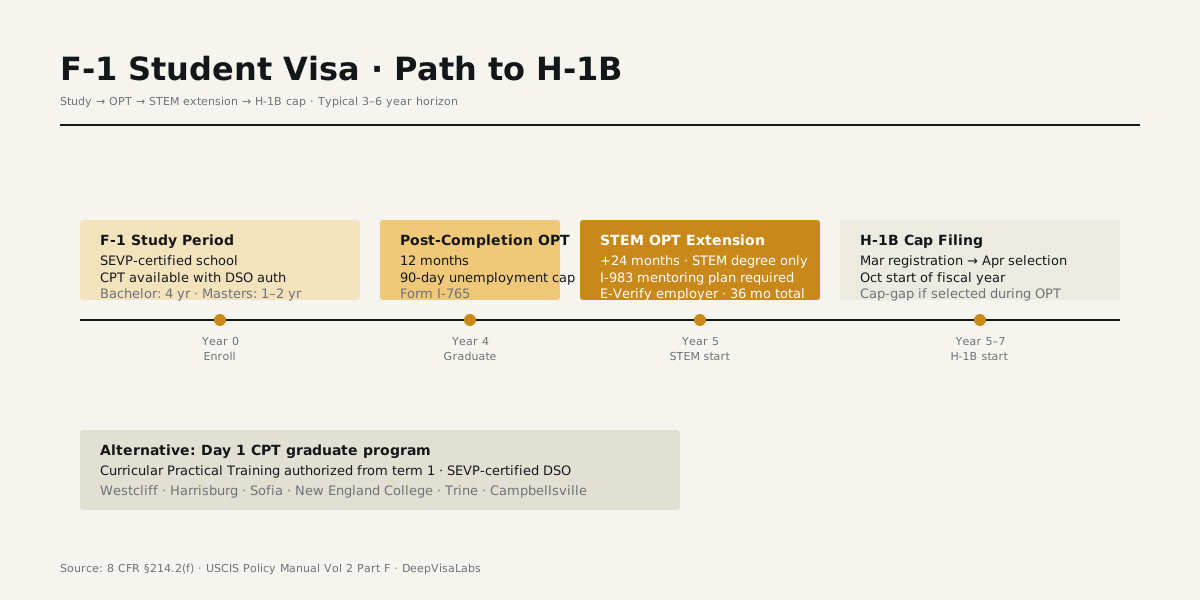
"OPT Extension" Has Two Common Meanings — Different Mechanisms
The phrase "OPT extension" is used loosely. Two distinct regulatory mechanisms can extend or bridge OPT employment authorization:
- STEM OPT 24-Month Extension — under 8 CFR §214.2(f)(10)(ii)(C). Adds 24 months to the standard 12-month post-completion OPT for students with STEM-designated CIP codes at E-Verify employers. This is what most people mean by "OPT extension" in technical terms.
- Cap-Gap Extension — under 8 CFR §214.2(f)(5)(vi). Automatic extension of F-1 status and OPT EAD through October 1 (or until the H-1B petition is approved/denied) for F-1 students with timely-filed cap-subject H-1B petitions.
These are different mechanisms. STEM extension is a separate USCIS filing for additional employment authorization. Cap-gap is automatic at H-1B receipt and bridges to October 1 — it does not add months to OPT.
STEM OPT Extension Eligibility
To qualify for the 24-month STEM OPT extension:
- Degree on the DHS STEM Designated Degree Program List. The DHS STEM-CIP list at studyinthestates.dhs.gov/stem-opt-hub identifies eligible CIP codes. Common STEM CIPs: 11.xxxx (computer science), 14.xxxx (engineering), 26.xxxx (biology), 40.xxxx (physical sciences). CIP code on your I-20 controls eligibility — not the program name.
- Currently in valid post-completion OPT. Pre-completion OPT does not qualify; you must be on the standard 12-month post-completion OPT.
- E-Verify-enrolled employer. Verify employer's E-Verify enrollment via the employer's own QR code or the DHS E-Verify employer search. Self-employment without an E-Verify employer-of-record does not qualify.
- Form I-983 Training Plan. Signed by the beneficiary and the employer's designated official. Documents training objectives, supervision, evaluation, and how the role advances the beneficiary's STEM field.
- Bachelor's, master's, or doctoral STEM degree. A second eligible STEM degree at a higher level can also unlock a fresh 24-month STEM extension period.
Filing Window and the 540-Day Auto-Extension
90-Day Pre-Expiration Window
File Form I-765 with category (c)(3)(C) in the 90-day window before your initial 12-month OPT EAD expires. Filings earlier than 90 days are rejected; filings after expiration are denied. The DSO must recommend STEM OPT in SEVIS within 60 days of the I-765 filing date.
540-Day Auto-Extension
Per the April 2024 DHS rule, timely-filed I-765 renewals (including STEM OPT extensions) trigger automatic work-authorization continuation for up to 540 days while the application is pending. Practical effect: your existing OPT EAD does not gap to the new STEM EAD because work authorization continues automatically.
What "Timely Filed" Means
Filed within the 90-day window before EAD expiration AND received by USCIS before the EAD expiration date. A filing rejected for procedural defects loses timely-filed status — re-filings after EAD expiration may not qualify for the 540-day auto-extension.
Form I-983 — The Centerpiece of the STEM Filing
Form I-983 is the STEM OPT Training Plan. It is the document USCIS reviews most closely. Vague or templated I-983s draw RFEs.
I-983 Components
- Section 1: student information, degree, CIP code.
- Section 2: employer information, E-Verify number.
- Section 3: training plan — objectives, methods, evaluation. This section drives RFE risk.
- Section 4: employer attestation about training, oversight, compensation.
- Section 5: student attestation.
- Section 6: evaluation cadence (12 and 24 months) — separate evaluations submitted to the DSO.
Material-Change Updates
Material changes during STEM OPT — new employer, new role, significant scope change — require an updated I-983 within 10 days. The DSO updates SEVIS. Failure to report material changes can result in SEVIS termination.
SEVIS Reporting Cadence
STEM OPT requires periodic SEVIS reports to the DSO:
- Address / employer-change reports: within 10 days of any change.
- 6-month validation report: confirms continued employment, training, and address.
- 12-month evaluation: I-983 Section 6 evaluation by the employer.
- 18-month validation: routine status check.
- 24-month final evaluation: I-983 Section 6 evaluation at end of STEM OPT period.
Missed reports can lead to SEVIS termination and loss of F-1 status.
Cap-Gap — A Different Bridge
Cap-gap is automatic, not applied for. It applies when a cap-subject H-1B petition is timely filed by an employer in March-April for an F-1 student in valid F-1 status (or post-completion OPT). If the H-1B is selected and approved with a change-of-status request, F-1 status and OPT EAD automatically extend through September 30 — bridging to the October 1 H-1B effective date.
Cap-gap is mechanically separate from STEM extension. A student can use both (STEM extension to bridge another cap cycle, then cap-gap when finally selected).
Bottom line
OPT extension only exists in one regulatory form — the STEM OPT 24-month extension. Plan it from the moment your F-1 starts: STEM-designated CIP, E-Verify employer, Form I-983 quality, and SEVIS reporting cadence determine whether the extension lands cleanly.
Frequently asked questions
- What happens if I'm unemployed during OPT?
- 90-day unemployment cap during OPT is cumulative. SEVP enforces via SEVIS reporting — DSOs must terminate SEVIS records when the cap is exceeded. STEM OPT adds 60 more days (150 total) for STEM extension period.
- Can I change employers during OPT?
- Yes — OPT is open work authorization. You can change employers without USCIS notification or new EAD. Update SEVIS via DSO with new employer details within 10 days of starting/leaving each role. Multiple concurrent jobs allowed.
- Are F-1 students subject to FICA on OPT/CPT wages?
- FICA exemption applies during F-1 non-resident-alien status. After the 5th calendar year, F-1 students typically become tax residents under SPT and FICA applies. OPT/CPT wages during the exempt period are FICA-free.
- Can I travel internationally on OPT or CPT?
- Yes for both, with documentation. OPT: carry valid passport, EAD, F-1 visa, I-20 with travel signature within 6 months, and proof of employment / job offer. CPT: same documents, with the I-20 showing CPT authorization endorsement. Re-entry depends on CBP officer review.
Sources
- https://studyinthestates.dhs.gov/stem-opt-hub
- https://www.uscis.gov/i-765
- https://www.uscis.gov/working-in-the-united-states/students-and-exchange-visitors/students-and-employment
- https://www.uscis.gov/working-in-the-united-states/students-and-exchange-visitors/optional-practical-training-extension-for-stem-students-stem-opt
- https://www.uscis.gov/sites/default/files/document/forms/i-983.pdf