Optional Practical Training (OPT): 12-Month Window, Cap Gap, and 90-Day Unemployment Limit
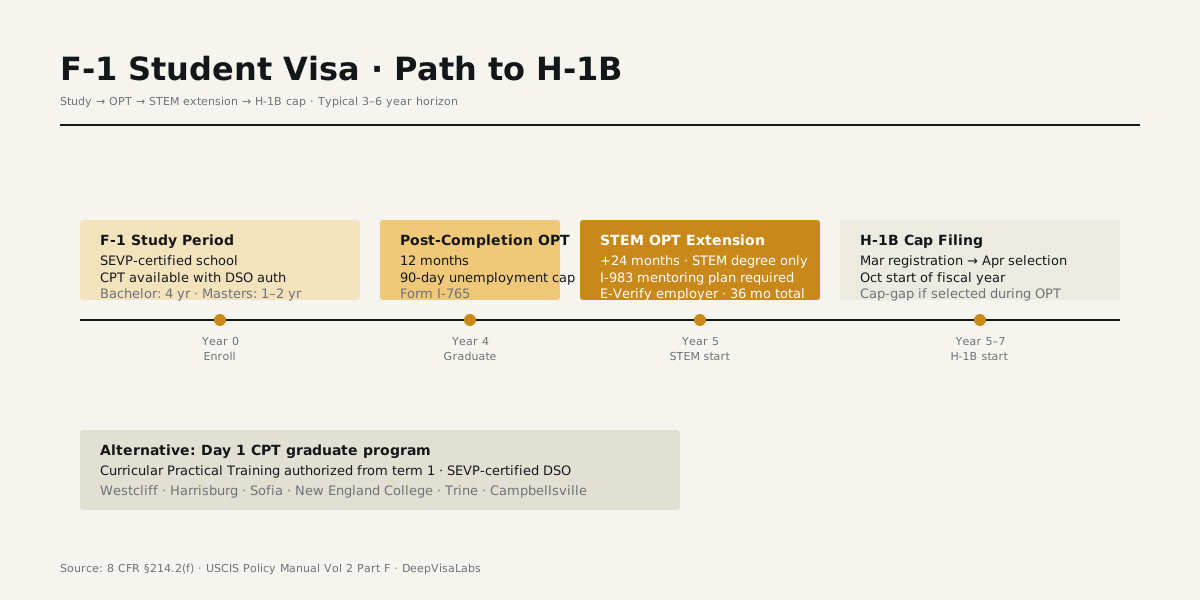
F-1 students get one 12-month OPT period per degree level. Filing window: 90 days before through 60 days after program completion. The 90-day unemployment cap during OPT is strict — SEVIS termination follows. STEM majors can apply for 24-month extension before initial OPT expires.
What OPT Is
Optional Practical Training (OPT) provides F-1 students with up to 12 months of work authorization in their field of study. Application via Form I-765 with category code (c)(3)(B) for post-completion OPT. SEVIS and DSO recommendation must precede the USCIS filing.
OPT is the primary bridge between F-1 student status and longer-term work authorization (H-1B, employer-sponsored). See SEVP OPT guidance.
Eligibility and Filing Window
Eligibility: F-1 student in valid status, has been a full-time student for at least 1 academic year, and is at or near program completion. Filing window: 90 days before program completion through 60 days after. The DSO must recommend OPT in SEVIS before the I-765 is filed.
USCIS processing currently takes 3–5 months. Filing earlier in the 90-day window is recommended to align EAD start date with employment timing.
Pre-Completion vs Post-Completion OPT
Pre-completion OPT (during studies) is part-time during academic terms (≤20 hrs/week) and full-time during breaks. Time used during pre-completion deducts from the 12-month post-completion OPT allocation — 1 month full-time pre-completion = 1 month less post-completion OPT.
Post-completion OPT (after graduation) is the more common path. Most students reserve the full 12 months for post-graduation employment.
The 90-Day Unemployment Limit
Post-completion OPT allows 90 cumulative days of unemployment over the 12-month period. STEM OPT extension adds 60 more days (150 cumulative including OPT period). Exceeding the limit triggers SEVIS termination — F-1 status ends and DHS can issue a Notice to Appear (NTA).
Days between jobs count; weekends and holidays count if you're not working. Tracking is critical because exceeding 90 days terminates F-1 status with no automatic recovery.
Cap-Gap Auto-Extension
F-1 students with timely-filed cap-subject H-1B petitions get an automatic extension of OPT EAD validity through September 30 (the day before the H-1B fiscal year start). The 2025 H-1B Modernization Rule expanded cap-gap to April 1 of the following fiscal year in some cases.
Cap-gap is automatic when (1) the H-1B petition is filed before OPT expires, and (2) the petition is selected. It eliminates the gap between OPT expiration and H-1B start date.
Travel and Reporting During OPT
International travel during OPT requires: valid F-1 visa stamp, current EAD, current I-20 with DSO travel signature within 6 months, and supporting employment evidence. CBP can refuse entry if continued employment can't be proven.
Employer changes during OPT: report to DSO within 10 days for SEVIS update. Multiple concurrent jobs allowed. The EAD is open work authorization — no employer-specific restrictions.
Cross-Pillar Reading
- STEM OPT 24-Month Extension · the natural follow-on for STEM degrees
- CPT — Curricular Practical Training · during-studies counterpart
- CPT vs OPT · decision guidance
- H-1B Lottery · the typical post-OPT transition
- USCIS Processing Times · I-765 windows
Bottom line
OPT is the bridge between F-1 study and H-1B / employer-sponsored long-term status. 12 months baseline + 24 months STEM = 36-month runway. Track unemployment days carefully; SEVIS reporting is strict; the EAD is the work-authorization document.
Frequently asked questions
- When should I apply for OPT?
- USCIS allows I-765 filing in the 90-day window before program completion through 60 days after. Filing earlier (90 days before) is recommended due to processing times of 3–5 months. EAD start date can be requested up to 60 days after completion.
- Can I do pre-completion OPT?
- Pre-completion OPT is rare in practice because it deducts from the post-completion 12-month allocation. Most students wait for post-completion OPT to maximize the 12-month window after graduation.
- Can I travel internationally on OPT or CPT?
- Yes for both, with documentation. OPT: carry valid passport, EAD, F-1 visa, I-20 with travel signature within 6 months, and proof of employment / job offer. CPT: same documents, with the I-20 showing CPT authorization endorsement. Re-entry depends on CBP officer review.
- What happens if I'm unemployed during OPT?
- OPT allows 90 cumulative days of unemployment over the 12-month period. STEM OPT allows 60 additional days (150 cumulative including OPT period). Exceeding the limit triggers SEVIS termination — F-1 status ends; DHS can issue NTA.
- Can I change employers during OPT?
- OPT permits unlimited employer changes. The EAD card is yours; employers verify via Form I-9. Update SEVIS through your DSO when you start or end employment — this is mandatory within 10 days, and missing reports can affect status.
Sources
- https://studyinthestates.dhs.gov/students/training-opportunities-in-the-united-states/optional-practical-training
- https://www.uscis.gov/working-in-the-united-states/students-and-exchange-visitors/optional-practical-training-opt-for-f-1-students
- https://www.uscis.gov/i-765
- https://www.ice.gov/sevis/practical-training
- https://egov.uscis.gov/processing-times/