EB-2 Priority Date: Current Cut-Offs by Country and Movement Trends
EB-2 priority date is listed as 'C' (current) for All Chargeability Areas in the visa bulletin — anyone with a valid priority date can file or be issued a visa this month.
How EB-2 Priority Date Is Established
For PERM-required EB-2 cases, the priority date is the date DOL accepted the PERM ETA-9089 filing. For PERM-exempt EB-2 NIW, the priority date is the I-140 receipt date. The priority date follows the beneficiary across employer changes via INA §204(j) portability once the I-140 is approved.
Priority dates are listed monthly on the State Department's visa bulletin in two charts — Final Action Dates and Dates for Filing.
Current EB-2 Cut-Offs by Country
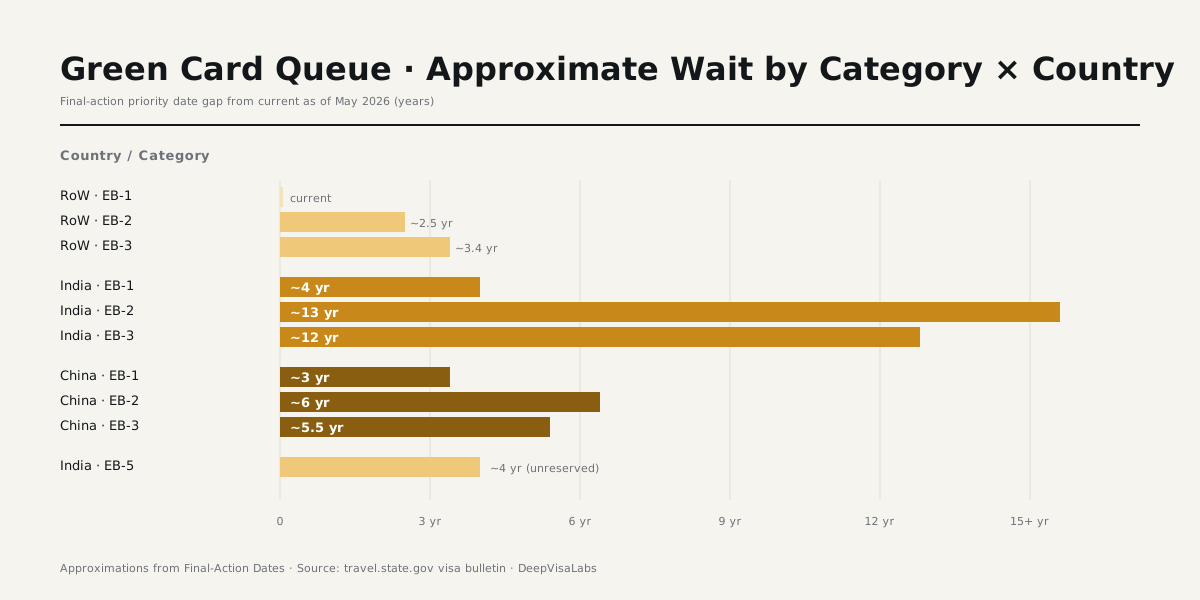
EB-2 cut-offs vary dramatically by chargeability area. The current visa bulletin shows EB-2 All Chargeability Areas at C. India and China face the deepest backlogs:
- All Chargeability / Worldwide: typically current or near-current
- India: backlogged to early 2010s, multi-decade waits projected
- China: backlogged 3–5 years
- Mexico, Philippines: typically aligned with worldwide
Per-country caps under INA §202 limit any single country to 7% of annual visa allocations, which drives the India / China retrogression.
Movement Trends
EB-2 cut-offs move based on rolling demand reported by USCIS adjustment-of-status filings and consular pipeline. Categories advance when supply exceeds demand; they hold or retrogress when demand outpaces statutory caps. Fiscal-year final quarter (July–September) often sees retrogression as annual numbers exhaust.
India EB-2 has shown only minimal forward movement over the last decade — the State Department's analyst commentary projects no meaningful advancement before legislative reform.
Cross-Chargeability Workaround
Under INA §202(b), spouses can charge to the country with the faster line. Common pairings: India-born + spouse from a country with a current EB-2 line allows the family to use the spouse's chargeability. Documentation requires the spouse's birth-certificate evidence at I-485 filing.
Cross-chargeability is the principal workaround for India / China backlogs short of legislative change.
What Counts as Current
"Current" (C) means visa numbers are immediately available — applicants with any priority date can move forward this month. When a date is listed (e.g., 15JUL14), only applicants with priority dates earlier than that cut-off qualify.
USCIS posts on its When to File page each month whether it accepts the Final Action Dates chart or the Dates for Filing chart for I-485 acceptance.
Cross-Pillar Reading
- EB-2 Green Card · the broader category
- EB-2 NIW · same priority-date queue, different I-140 path
- Visa Bulletin · current month's full table
- Visa Bulletin Predictions · forward-movement analysis
- Priority Date Tracker · interactive widget
Bottom line
Status reading: current. File when the I-140 is approved (or concurrently); USCIS adjudication is the binding constraint.
Frequently asked questions
- Can I file I-485 and I-140 concurrently?
- Concurrent filing is allowed once your priority date qualifies. It also gives access to a pending-AOS EAD valid for up to 5 years under USCIS's 2023 validity-extension policy.
- How does premium processing apply to EB-2 priority date?
- I-907 premium processing covers EB-1A, EB-1B, EB-1C, EB-2 (non-NIW), and EB-3 I-140s with a 15-calendar-day adjudication SLA. I-485 is not eligible for premium processing.
- What is the priority date in EB-2 priority date?
- Your priority date is fixed when the first qualifying filing was accepted: PERM for most EB-2/EB-3, the I-140 itself for EB-1 and EB-2 NIW, the I-526 for EB-5.
- Can I port my priority date to another I-140?
- Yes. INA §204(j) lets you keep your priority date on a new I-140 in the same or higher preference category, even after changing employers, as long as the original I-140 was approved (or pending and ultimately approved).
- What's the difference between adjustment of status and consular processing?
- AOS is the path for applicants already in valid US status; CP is the only option for applicants outside the US. Each has different timelines, document requirements, and ability to interfile new evidence.
Sources
- https://travel.state.gov/content/travel/en/legal/visa-law0/visa-bulletin.html
- https://www.uscis.gov/working-in-the-united-states/permanent-workers/employment-based-immigration-second-preference-eb-2
- https://www.uscis.gov/visabulletininfo
- https://flag.dol.gov/programs/perm
- https://www.uscis.gov/i-140