EB-2 Green Card: Advanced Degree, Exceptional Ability, and Priority Dates
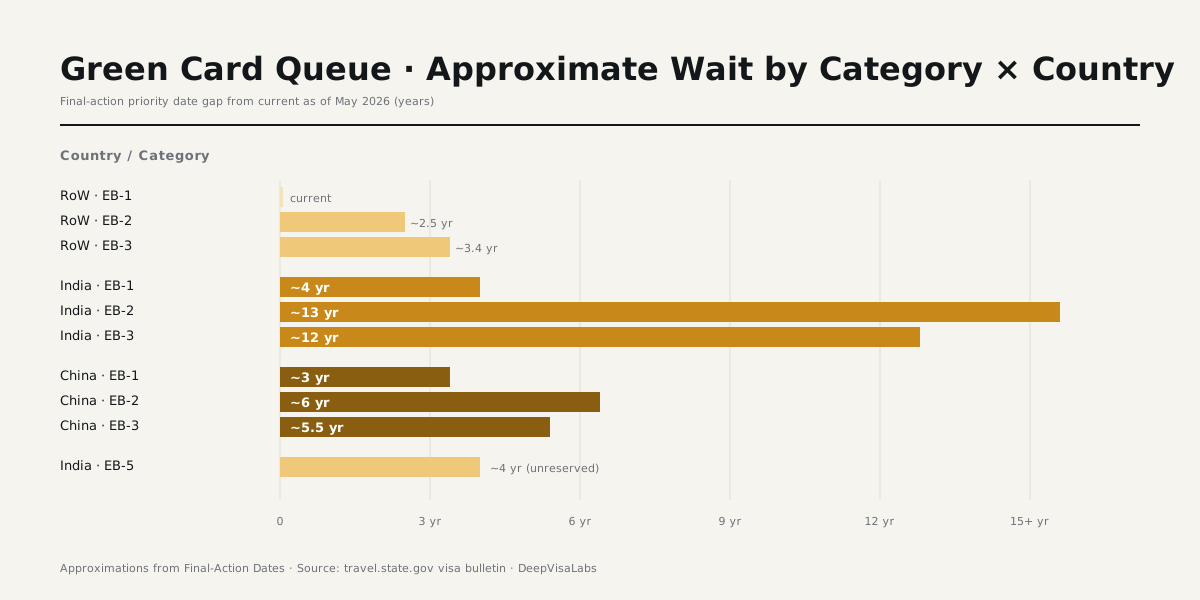
EB-2 is current for All Chargeability Areas this month, so the bottleneck is USCIS adjudication (8–14 months, 80th-percentile) rather than priority-date queue time.
What EB-2 Is and Who Qualifies
EB-2 is the second employment-based preference category for employer-sponsored green cards. It covers two pathways: advanced-degree professionals and exceptional-ability workers under USCIS guidance and USCIS Policy Manual Volume 6, Part F, Chapter 5.
The advanced-degree pathway requires a US master's degree or higher, or a US bachelor's plus 5+ years of progressive post-baccalaureate experience. The exceptional-ability pathway requires three of seven regulatory criteria — degree, 10+ years experience, license/certification, salary evidencing exceptional ability, professional association membership, recognition for achievements, or comparable evidence.
The PERM → I-140 → I-485 Sequence
Standard EB-2 (non-NIW) requires a certified PERM labor certification before the I-140 immigrant petition can be filed. The PERM filing date establishes the priority date that follows the case through the visa-bulletin queue. Total end-to-end timeline: PERM (15–24 months) + I-140 (8–14 months standard, 15 days premium) + visa-bulletin queue + I-485 (10–18 months).
EB-2 NIW (National Interest Waiver) is the exception that skips PERM entirely — see EB-2 NIW page for the Dhanasar 3-prong test and self-petition mechanics.
Current Priority-Date Status
EB-2 priority-date movement varies dramatically by chargeability area. The current visa bulletin shows EB-2 for All Chargeability Areas at C. India and China remain heavily backlogged due to per-country caps under INA §202: India is roughly a decade behind, China several years.
See EB-2 priority date trends for historical data and movement projections, and the live visa bulletin for the current month's full table.
Premium Processing for I-140
USCIS extended premium processing (Form I-907) to most I-140 categories starting May 2022 — including standard EB-2 advanced-degree and exceptional-ability petitions. Fee is $2,805; SLA is 15 calendar days. EB-2 NIW is the explicit exclusion.
USCIS quotes I-140 standard processing at 8–14 months (80th-percentile completion) per the processing-times tool.
EB-2 vs EB-3 Downgrade Strategy
India-born and China-born applicants stuck in EB-2 backlogs sometimes "downgrade" to EB-3 to escape retrogression — file a new I-140 in EB-3 with the same PERM, retain the original priority date under INA §204(j) portability. Effectiveness depends on the relative movement of EB-2 vs EB-3 lines in the relevant country.
The downgrade requires that the position qualifies for EB-3 (skilled worker / professional / other worker). Most EB-2 positions also satisfy EB-3 since EB-3's standard is lower. The original PERM remains valid; only the I-140 is re-filed in the new category.
Cross-Pillar Reading
- EB-2 NIW — National Interest Waiver · self-petition path skipping PERM
- EB-3 — Skilled Workers and Professionals · the comparison and downgrade target
- EB-1 — Extraordinary Ability and Multinational Manager · faster category for qualifying petitioners
- Form I-140 — Immigrant Petition · the core petition document
- PERM Labor Certification · the DOL pre-step for standard EB-2
- I-485 Adjustment of Status · final step once priority date is current
- Priority Date Tracker · interactive widget
Bottom line
Status reading: current. File when the I-140 is approved (or concurrently); USCIS adjudication is the binding constraint.
Frequently asked questions
- What is the priority date in EB-2?
- Priority date sets your place in the visa-bulletin queue. PERM-required cases use the PERM receipt date; EB-1A, EB-1B, EB-1C, EB-2 NIW, and EB-5 use the I-140 (or I-526) receipt date.
- Can I port my priority date to another I-140?
- Priority-date retention is automatic when the original I-140 is approved, regardless of whether the original employer withdraws it more than 180 days after approval. New PERM may be required, but the priority date carries.
- What's the difference between adjustment of status and consular processing?
- Adjustment of Status (I-485) is filed inside the United States; Consular Processing routes through the National Visa Center and a US embassy abroad. AOS unlocks a pending-EAD; CP issues a sealed immigrant visa for entry.
- What if EB-2 retrogresses while my I-485 is pending?
- Retrogression after I-485 filing means USCIS pauses adjudication. Pending-AOS EADs and advance parole remain valid; the I-485 simply waits for the priority date to become current again.
- Does EB-2 require a labor certification (PERM)?
- PERM is mandatory for EB-2 and EB-3 cases tied to an employer-specific job. EB-1A, EB-1B, EB-1C, and EB-2 NIW are PERM-exempt because the petitioner is the beneficiary or the role is too senior for a labor-market test.
Sources
- https://www.uscis.gov/working-in-the-united-states/permanent-workers/employment-based-immigration-second-preference-eb-2
- https://travel.state.gov/content/travel/en/legal/visa-law0/visa-bulletin.html
- https://www.uscis.gov/i-140
- https://www.uscis.gov/policy-manual/volume-6-part-f-chapter-5
- https://egov.uscis.gov/processing-times/