EB-2 NIW: Priority Date, Processing Time, and the Dhanasar Test
The EB-2 NIW category for All Chargeability Areas has no waiting line right now. Petitioners face a 12–22 months processing horizon at USCIS, plus medical exam and biometrics scheduling on top.
Looking for the concept overview? See What Is a National Interest Waiver →
What EB-2 NIW Is
The EB-2 National Interest Waiver is a sub-category of the EB-2 employment-based green card. It waives the labor-certification (PERM) and job-offer requirements that normally apply to EB-2, letting an applicant self-petition with USCIS via Form I-140 without an employer sponsor. The "national interest" standard is governed by USCIS's 2016 precedent decision Matter of Dhanasar, codified in USCIS Policy Manual Volume 6, Part F, Chapter 5.
Because EB-2 NIW skips PERM, the priority date equals the I-140 receipt date — not the date a labor certification was filed with DOL. That priority date sits in the EB-2 chargeability line at the visa bulletin alongside non-NIW EB-2 cases. As of the latest bulletin, EB-2 final action for All Chargeability Areas is C.
Current Visa-Bulletin Status and Priority Date
The priority-date column in the visa bulletin tells you whether your I-140 receipt date is "current" — that is, whether USCIS will adjudicate or issue a visa this month. Two charts apply:
- Final Action Dates. Cut-off the State Department uses to issue immigrant visas at consular posts. As of this build, EB-2 All Chargeability Areas is at C.
- Dates for Filing. Set monthly by USCIS to determine whether you may file Form I-485 (Adjustment of Status). USCIS publishes its choice between the two charts each month on its visa-bulletin guidance page.
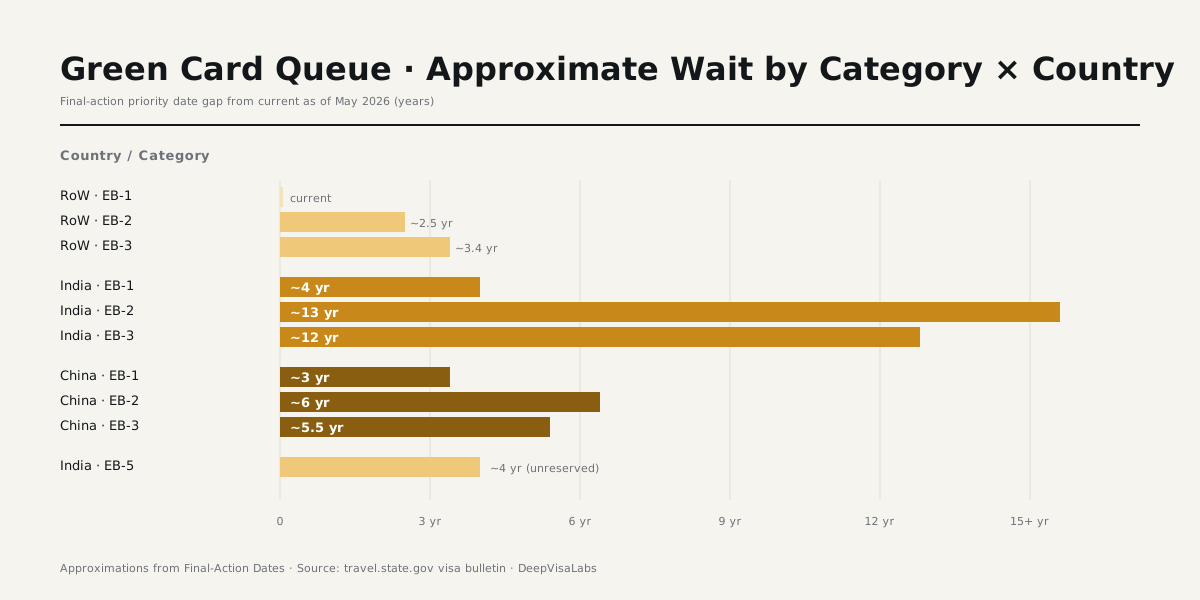
For India and China specifically, EB-2 NIW shares the chargeability backlog of regular EB-2 — currently ~10+ years for India and ~3-5 years for China. See EB-2 priority date trends for historical movement and projection.
The Dhanasar Three-Prong Test
USCIS evaluates every EB-2 NIW petition against the three prongs articulated by the Administrative Appeals Office in Matter of Dhanasar, 26 I&N Dec. 884 (AAO 2016) (EOIR full text).
Prong 1 — Substantial Merit and National Importance
The proposed endeavor must have value beyond the petitioner's specific employer or local geography. "Substantial merit" can be shown across STEM, healthcare, business, education, the arts, and other fields. "National importance" is judged on the endeavor's potential prospective impact, not just the petitioner's local impact — though local-scope work that has national implications (regulatory, technological, public-health) qualifies.
Prong 2 — Well-Positioned to Advance the Endeavor
USCIS looks at education, skills, knowledge, record of past success, model or plan for future activities, progress toward achieving the endeavor, and the interest of relevant users, customers, investors, or other stakeholders. This is where most EB-2 NIW petitions live or die — Prong 1 is usually defensible; Prong 2 needs concrete evidence that this petitioner (not the field generally) can deliver.
Prong 3 — Beneficial to Waive Job-Offer / PERM
Considers whether requiring a labor-market test (PERM) would be impractical given the petitioner's specific situation, and whether the United States would benefit from the contribution even without a specific job offer. Strong NIW cases use Prong 3 to argue that PERM's labor-market test cannot capture the unique national-interest value of the endeavor.
EB-2 NIW Eligibility Checklist
Before petitioning, the applicant must qualify for the underlying EB-2 category (not just NIW). EB-2 has two pathways under USCIS guidance:
Advanced-Degree Pathway
The position must require an advanced degree (master's or higher), and the petitioner must hold one. A US bachelor's degree plus 5+ years of progressive post-baccalaureate experience can substitute for a master's under 8 CFR §204.5(k)(2).
Exceptional-Ability Pathway
Demonstrated by satisfying at least three of the regulatory criteria: degree relating to the area of exceptional ability; 10+ years of full-time experience; license or certification; salary or remuneration evidencing exceptional ability; membership in professional associations; recognition for achievements and significant contributions; or other comparable evidence. Exceptional ability is a lower bar than EB-1A's "extraordinary ability" standard.
Evidence Quality (Preponderance Standard)
EB-2 NIW uses the "preponderance of the evidence" standard — more likely than not, not the higher "clear and convincing" standard. Petition letters typically include peer-recommendation letters (5-8), citation/h-index/altmetric documentation for academic petitioners, news coverage, patent filings, government funding records, and a detailed endeavor plan with measurable milestones.
Processing Time and Premium-Processing Status
USCIS quotes I-140 EB-2 NIW processing at 12–22 months (80th-percentile completion) per the current processing-times tool. The window varies by service center — Texas Service Center and Nebraska Service Center handle most I-140 caseload, with periodic transfers to balance backlog.
80th-Percentile Window Explained
USCIS's "80%" metric means 80% of petitions complete within the quoted upper bound. Median (50th-percentile) processing tends to run 30-40% faster than the 80th. There is no public 95th-percentile metric, but anecdotal AAO appeal data suggests outliers can extend 2-3× the upper window when supplemental Requests for Evidence (RFEs) trigger.
Why I-907 Premium Processing Is Excluded
USCIS extended Form I-907 Premium Processing to most I-140 categories starting May 2022 — but explicitly excluded EB-2 NIW. The agency cited the qualitative judgment required by Dhanasar's three-prong test as incompatible with 45-day adjudication. As of the current build, EB-2 NIW remains the only I-140 category without premium processing.
EB-2 NIW vs EB-1A vs Standard EB-2
EB-2 NIW competes directly with EB-1A (extraordinary ability) for petitioners who can self-petition without an employer. The choice depends on standard, queue, and evidence type.
Standard and Burden
- EB-1A. Sustained national or international acclaim demonstrated by a strict regulatory criteria list (10 criteria, must satisfy 3 + final merits). Higher evidence bar; rejection of any one of 3 criteria can collapse the petition.
- EB-2 NIW. Dhanasar's three-prong proportionality test. Lower evidence bar but more subjective — Prong 2 ("well-positioned") is the most contentious.
- Standard EB-2. Requires PERM + employer sponsorship. Predictable but slower (~12-24 months for PERM alone) and tied to a specific employer until I-485 portability under AC21 §106(c).
Priority-Date Queue Comparison
EB-1 generally has shorter chargeability queues than EB-2. For India and China, EB-1 has been current or near-current while EB-2 has retrogressed by years. Petitioners eligible for both should run the math: a slower-to-prepare EB-1A petition may still finish faster end-to-end than an EB-2 NIW with the priority-date queue stacked on top.
Premium Processing Availability
EB-1A and EB-1B are eligible for I-907; EB-2 NIW is not. This adds 8-22 months of expected wait for the I-140 alone.
Concurrent Filing: I-140 + I-485 + EAD Strategy
If your priority date qualifies under the chart USCIS uses for the current month, you can file Form I-485 (Adjustment of Status) concurrently with the I-140 — provided you are inside the United States in valid status. Concurrent filing has been allowed for EB-2 NIW since 2002.
Concurrent Filing Eligibility
Three gates: (1) priority date is current under USCIS's chart-of-the-month, (2) applicant is physically inside the US in valid nonimmigrant status, and (3) applicant is admissible (no inadmissibility bars). Applicants outside the US route through Consular Processing instead.
The Pending-AOS EAD and Advance Parole
Concurrent filing unlocks Form I-765 Employment Authorization Document (EAD) and Form I-131 Advance Parole. Under USCIS's 2023 validity-extension policy, pending-AOS EADs (category c)(9)) are now issued for up to 5-year validity periods, eliminating the renewal-cycle gaps that previously interrupted employment.
Country-Specific Backlogs
Visa-bulletin chargeability is determined by the principal applicant's country of birth, not citizenship. Three chargeability tiers face very different waits.
India EB-2 Backlog: 10+ Years
The India EB-2 final-action date has retrogressed to roughly the early 2010s as of mid-2020s, and recent Department of State analyst commentary projects no meaningful forward movement before further legislative reform. Cross-chargeability under INA §202(b) is the principal escape route — see below.
Cross-Chargeability Workaround (INA §202(b))
If the principal applicant's spouse was born in a country with a faster line, the family can charge to the spouse's country. Common pairings: India-born spouse + ROW (Rest of World)–born spouse can use ROW's typically-current EB-2 line. Documentation requires the spouse's birth-certificate evidence at I-485 filing.
China and Worldwide
China EB-2 typically retrogresses 3-5 years behind worldwide. All other chargeability areas ("Worldwide / All Chargeability Areas") are currently at C — see the live visa bulletin for the latest snapshot.
Cross-Pillar Reading
- National Interest Waiver — concept page · the NIW concept itself, separated from EB-2 mechanics
- EB-2 advanced degree / exceptional ability · the broader EB-2 category
- Form I-140 — Immigrant Petition for Alien Worker · the form itself
- I-485 Adjustment of Status · the next step once the priority date is current
- EB-2 Priority Date — historical and current · queue tracking
- Visa Bulletin — current priority dates · the chart that decides when you can file
- Priority Date Tracker (interactive widget) · check if your priority date is current
Bottom line
Current category. The visa-bulletin queue is not active, so total wait reduces to USCIS form processing plus medical / biometrics scheduling.
Frequently asked questions
- Can I port my priority date to another I-140?
- Yes. INA §204(j) lets you keep your priority date on a new I-140 in the same or higher preference category, even after changing employers, as long as the original I-140 was approved (or pending and ultimately approved).
- What's the difference between adjustment of status and consular processing?
- Adjustment of Status (I-485) is filed inside the United States; Consular Processing routes through the National Visa Center and a US embassy abroad. AOS unlocks a pending-EAD; CP issues a sealed immigrant visa for entry.
- What if EB-2 NIW retrogresses while my I-485 is pending?
- Retrogression after I-485 filing means USCIS pauses adjudication. Pending-AOS EADs and advance parole remain valid; the I-485 simply waits for the priority date to become current again.
- Does EB-2 NIW require a labor certification (PERM)?
- EB-2 (advanced degree / exceptional ability) and EB-3 require an approved PERM labor certification before filing the I-140. EB-1 (extraordinary ability / outstanding researcher / multinational manager) and EB-2 NIW skip PERM entirely.
- Can I file I-485 and I-140 concurrently?
- Concurrent filing is allowed once your priority date qualifies. It also gives access to a pending-AOS EAD valid for up to 5 years under USCIS's 2023 validity-extension policy.
Sources
- https://travel.state.gov/content/travel/en/legal/visa-law0/visa-bulletin.html
- https://www.uscis.gov/working-in-the-united-states/permanent-workers/employment-based-immigration-second-preference-eb-2
- https://www.uscis.gov/policy-manual/volume-6-part-f-chapter-5
- https://egov.uscis.gov/processing-times/