H-1B to Green Card: PERM, I-140, and AC21 Strategy
H-1B to green card for All Chargeability Areas has no queue this month. Eligibility is gated only by petition adjudication and medical / biometric scheduling, not by visa-number availability.
The Standard H-1B to Green Card Path
The mainline path from H-1B to permanent residence runs three sequential steps. First, the employer files PERM labor certification with the Department of Labor — typically taking 14–24 months end-to-end (PWD + recruitment + analyst review). Second, after PERM certifies, the employer files Form I-140 with USCIS, establishing the immigrant petition and the priority date. Third, when the priority date becomes current per the visa bulletin, the beneficiary files Form I-485 (Adjustment of Status) — or undergoes consular processing — to obtain the green card.
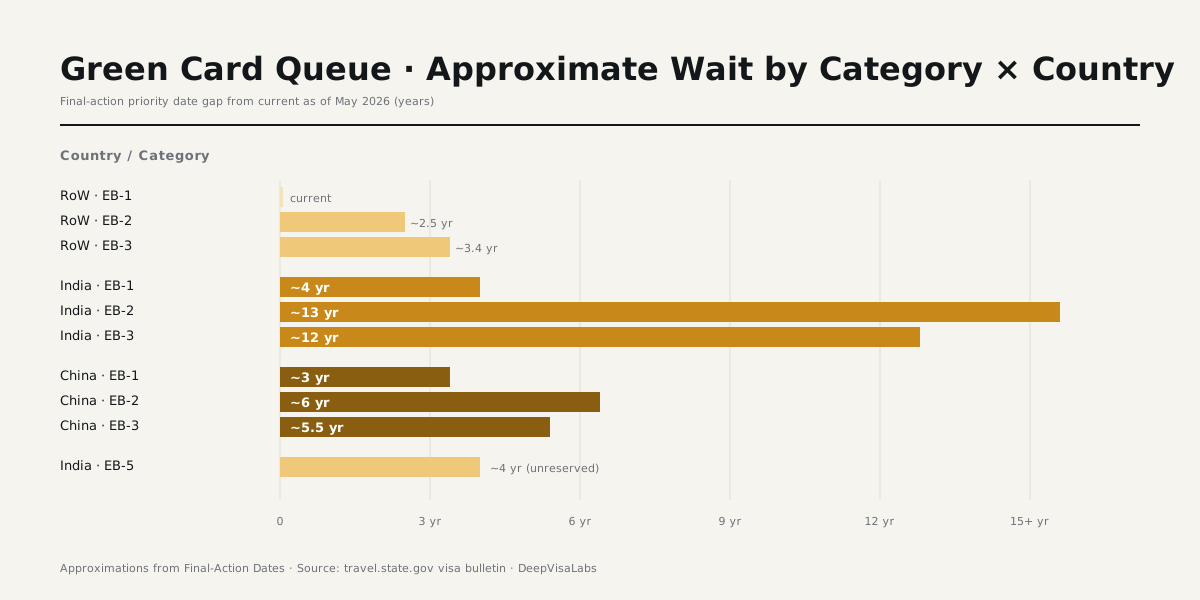
Total timeline depends almost entirely on country of birth. India-born beneficiaries in EB-2 / EB-3 currently face decade-plus waits; All Other beneficiaries can complete the cycle in 18–36 months. The H-1B 6-year cap and the AC21 extension provisions are designed to keep beneficiaries in valid status during the wait.
Choosing PERM Category: EB-2 vs EB-3
EB-2 (advanced degree or exceptional ability) requires a master's degree or higher, or a bachelor's degree + 5 years of progressive experience. EB-3 (skilled worker / professional / other worker) requires at least a bachelor's degree (skilled / professional sub-category) or 2 years of training (other worker).
PERM filing category affects priority-date queue length. For India-born beneficiaries, EB-2 has historically been faster than EB-3, but during 2020–2024 EB-3 India unexpectedly moved ahead of EB-2 India — triggering widespread "EB-3 downgrade" filings (refile I-140 in EB-3 with an existing PERM). The downgrade requires no new PERM and uses the same priority date.
Priority Date and Visa-Bulletin Reading
Priority date is the date the PERM application is filed (for EB-2 / EB-3) or the I-140 receipt date (for EB-1, EB-2 NIW, EB-5). It locks the beneficiary's place in the visa-bulletin queue. The Department of State publishes monthly cut-offs at travel.state.gov.
Visa-bulletin retrogression — when cut-off dates move backward — pauses I-485 adjudication for affected beneficiaries. EAD and advance parole continue to be valid; the I-485 simply waits. EB-2 India retrogression has been ongoing since 2008.
AC21 §104(c) — The 3-Year Extension
AC21 §104(c) provides 3-year H-1B extensions beyond the standard 6-year cap for H-1B beneficiaries with an approved I-140 whose priority date is not yet current. Each extension lasts 3 years; there is no statutory limit on the number of §104(c) extensions.
§104(c) is the workhorse extension for India-born EB-2 / EB-3 beneficiaries during the visa-bulletin backlog. The conditions: (1) approved I-140, (2) priority date is not current, and (3) the H-1B is otherwise eligible for extension. Per USCIS Policy Manual Volume 2 Part H Chapter 13, §104(c) extensions can be filed up to 6 months before H-1B expiration.
AC21 §106(a) — The 1-Year Extension
AC21 §106(a) provides 1-year H-1B extensions for beneficiaries whose underlying labor certification or I-140 has been pending 365+ days. Unlike §104(c), §106(a) doesn't require an approved I-140 — pending PERM or pending I-140 (over 365 days old) is sufficient.
§106(a) is the typical bridge during PERM audit or BALCA appeal — when the labor certification is technically pending but not approved. Extensions are 1 year at a time; once PERM is denied or I-140 is denied, §106(a) eligibility ends.
I-485 Filing: Adjustment of Status vs Consular Processing
Beneficiaries inside the US with current priority dates typically file I-485 (Adjustment of Status) with USCIS. Concurrent I-765 (EAD) and I-131 (Advance Parole) filings unlock employment authorization untied to H-1B and travel flexibility. AOS pendency provides AC21 §106(c) portability — change employers in same-or-similar occupations without losing the case.
Beneficiaries outside the US, or who prefer faster adjudication, can pursue consular processing through the National Visa Center and a US embassy / consulate. Consular processing usually adjudicates faster than AOS in 2026 but requires international travel and offers no portability protection.
EB-2 NIW Alternative
EB-2 National Interest Waiver bypasses PERM entirely. The beneficiary must demonstrate (a) the proposed endeavor has substantial merit and national importance, (b) they are well-positioned to advance the endeavor, and (c) on balance, waiving the PERM requirement benefits the US.
NIW is self-petitioned — no employer sponsorship required. The same priority-date rules apply (EB-2 India remains backlogged), but the NIW path lets the beneficiary file I-140 immediately without the 14–24 month PERM wait. NIW deep dive.
Cross-Pillar Reading
- PERM Labor Certification · the gating step
- H-1B Extension · AC21 §104(c) and §106(a) walkthroughs
- EB-1 India · cross-chargeability and EB-1C alternative
- EB-2 NIW · PERM-bypass option
- Visa Bulletin · monthly priority-date cut-offs
Bottom line
Verdict: priority date current — the queue is not the bottleneck. Adjudication time and form readiness are.
Frequently asked questions
- What's the difference between adjustment of status and consular processing?
- AOS keeps you in the US during adjudication and grants employment / travel authorization while pending. CP requires leaving the country for a consular interview, and timing is harder to predict because of NVC backlogs.
- What if H-1B to green card retrogresses while my I-485 is pending?
- Retrogression after I-485 filing means USCIS pauses adjudication. Pending-AOS EADs and advance parole remain valid; the I-485 simply waits for the priority date to become current again.
- Does H-1B to green card require a labor certification (PERM)?
- PERM is mandatory for EB-2 and EB-3 cases tied to an employer-specific job. EB-1A, EB-1B, EB-1C, and EB-2 NIW are PERM-exempt because the petitioner is the beneficiary or the role is too senior for a labor-market test.
- Can I file I-485 and I-140 concurrently?
- Yes — when your priority date is current under the chart USCIS is using that month, you can file the I-485 concurrently with the I-140 (or shortly after). Concurrent filing saves months and unlocks the I-765 EAD / I-131 advance parole.
- How does premium processing apply to H-1B to green card?
- Premium processing (Form I-907) is now available for most I-140 categories — adjudicated within 15 calendar days. EB-2 NIW is the notable exclusion: USCIS has not extended I-907 to NIW filings.