EB-1 India: Priority-Date Backlog and Cross-Chargeability Strategy
EB-1 India for Indian nationals cuts off at April 1, 2023 this month — only earlier priority dates qualify for filing or issuance.
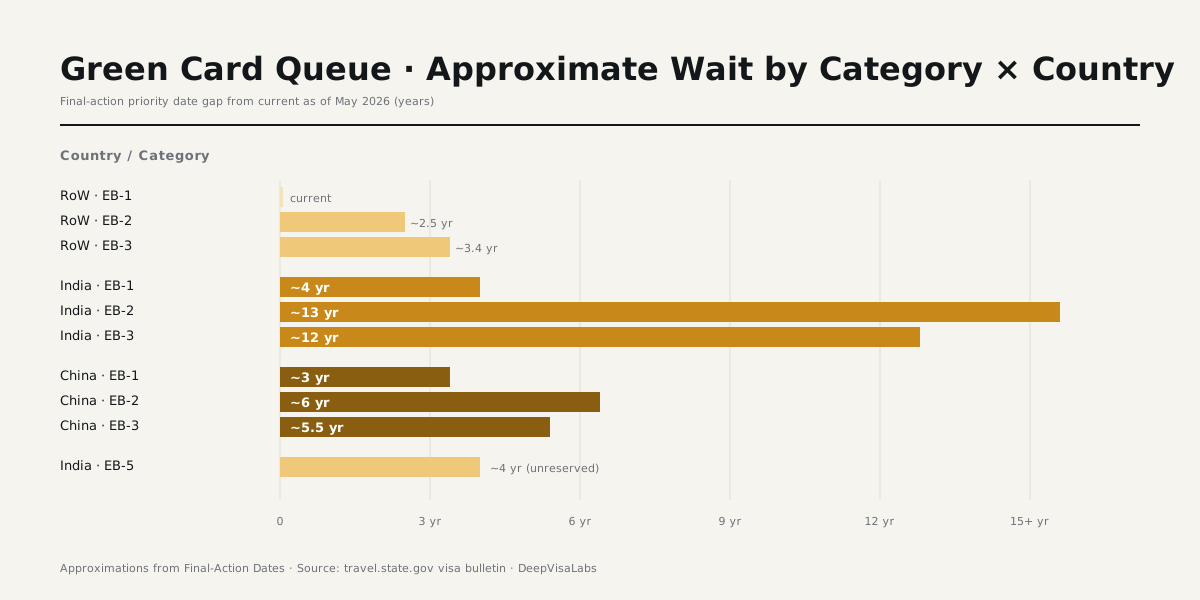
EB-1 India: The Backlog Reality
EB-1 (Priority Workers) is the first preference of the employment-based immigrant visa system. For India-born beneficiaries, EB-1 has been retrogressed since 2018, with cut-off dates moving back and forth between 2018 and 2022 priority dates. The current bulletin position is published monthly by the Department of State at travel.state.gov.
Despite the backlog, EB-1 India remains substantially faster than EB-2 India or EB-3 India, where priority dates have moved into the early 2010s. EB-1 India practitioners watch the bulletin closely — month-to-month cut-off swings of 6+ months are common as the Department of State balances global EB-1 demand against country quotas under USCIS Policy Manual Volume 6 Part F.
EB-1A vs EB-1B vs EB-1C for India-Born Beneficiaries
EB-1A (Extraordinary Ability) is self-petitioned and requires evidence of "sustained national or international acclaim" satisfying at least 3 of 10 regulatory criteria plus a final-merits review. EB-1A is the only EB category that does not require employer sponsorship.
EB-1B (Outstanding Researcher / Professor) requires employer sponsorship and a permanent research position at a university or qualifying research institution. Two of six regulatory criteria must be met. EB-1B does not require PERM but does require a permanent or tenure-track offer.
EB-1C (Multinational Manager / Executive) requires employer sponsorship and tracks the L-1A standard — at least 1 of the past 3 years in a managerial / executive role abroad with a qualifying corporate affiliate. Most L-1A beneficiaries pivot to EB-1C as their primary green-card path. L-1A walkthrough.
Cross-Chargeability Through Spouse's Country
Cross-chargeability under INA §202(b)(2) allows an India-born beneficiary married to a non-India-born spouse to use the spouse's country of birth for visa-bulletin chargeability. Practical effect: an India-born EB-1 beneficiary married to a Mexico-born spouse uses "All Other" chargeability — bypassing the India backlog entirely.
Cross-chargeability requires that both spouses be processing for green cards together. The spouse must derive their immigrant status from the principal beneficiary's I-140 — typically through concurrent I-485 filings. Cross-chargeability is widely underused; many practitioners fail to ask about spouse country of birth at the intake stage.
I-140 Filing and Premium Processing
EB-1 India petitions begin with Form I-140. Premium processing (Form I-907, $2,805) is available for EB-1A, EB-1B, and EB-1C — adjudication target is 15 calendar days. EB-2 NIW is the notable I-140 category that does not have premium processing as of 2026.
I-140 approval establishes the priority date for visa-bulletin purposes. For India-born beneficiaries, the strategy is typically to file I-140 with premium processing to lock in the priority date as early as possible — even though I-485 (adjustment of status) cannot be filed until the priority date is current.
Filing I-485 During the Backlog
USCIS publishes a monthly Adjustment of Status Filing Chart that determines whether to use the visa bulletin's "Final Action Dates" or "Dates for Filing" tables. When USCIS allows "Dates for Filing," India-born beneficiaries can file Form I-485 earlier than the Final Action Date — unlocking concurrent I-765 (EAD) and I-131 (advance parole) filings.
The strategic value of pending-I-485 status is significant: portability under AC21 §106(c) lets the beneficiary change employers in same-or-similar occupations without losing the green-card case, and the EAD provides employment authorization untied to H-1B sponsorship.
Priority-Date Retention
An approved I-140 priority date can be carried forward to subsequent I-140 filings in the same or higher preference category. India-born beneficiaries often file an EB-1 I-140 while an EB-2 or EB-3 I-140 is approved or pending — using the older priority date if the EB-1 case has a later filing date.
Priority-date retention is governed by 8 CFR §204.5(e). The original I-140 must remain approved (not revoked); withdrawal by the petitioning employer for "fraud or willful misrepresentation" can extinguish the priority date, but ordinary withdrawal does not.
Strategic Patterns for India-Born EB-1 Beneficiaries
The dominant pattern: file EB-1A self-petition during EB-2 wait if criteria are arguably met, in parallel with employer-sponsored EB-2 / EB-3. The self-petition route is independent of employer cooperation, and an EB-1A approval (when EB-1 India is more current than EB-2 India) can shave years off the timeline.
For L-1A beneficiaries, the EB-1C path is usually the cleanest — it tracks L-1A's evidentiary record, doesn't require PERM, and qualifies for premium processing. Most L-1A holders should consider EB-1C filing in years 2-3 of L-1A status.
Cross-Pillar Reading
- EB-1 Green Card · all chargeability areas overview
- EB-1 Priority Date · current bulletin reading
- L-1A Visa · the L-1A → EB-1C pipeline
- EB-2 NIW · alternative for India-born when EB-1 standards aren't met
- Visa Bulletin · monthly cut-off table
Bottom line
Verdict: backlogged. Cut-off is April 1, 2023; total wait stacks queue time + USCIS adjudication.
Frequently asked questions
- What's the difference between adjustment of status and consular processing?
- AOS keeps you in the US during adjudication and grants employment / travel authorization while pending. CP requires leaving the country for a consular interview, and timing is harder to predict because of NVC backlogs.
- What if EB-1 India retrogresses while my I-485 is pending?
- Retrogression after I-485 filing means USCIS pauses adjudication. Pending-AOS EADs and advance parole remain valid; the I-485 simply waits for the priority date to become current again.
- Does EB-1 India require a labor certification (PERM)?
- Most EB-2 and EB-3 applicants need PERM certification first; EB-1 and EB-2 NIW are explicit statutory exemptions.
- Can I file I-485 and I-140 concurrently?
- If your priority date is current, concurrent I-140 + I-485 filing is the standard playbook. The combo unlocks employment authorization (I-765) and travel document (I-131) eligibility while the case is pending.
- How does premium processing apply to EB-1 India?
- Premium processing (Form I-907) is now available for most I-140 categories — adjudicated within 15 calendar days. EB-2 NIW is the notable exclusion: USCIS has not extended I-907 to NIW filings.
Sources
- https://travel.state.gov/content/travel/en/legal/visa-law0/visa-bulletin.html
- https://www.uscis.gov/working-in-the-united-states/permanent-workers/employment-based-immigration-first-preference-eb-1
- https://www.uscis.gov/i-140
- https://www.uscis.gov/i-485
- https://www.uscis.gov/policy-manual/volume-6-part-f