I-485 Processing Time: Employment vs Family-Based Adjustment Windows
The I-485 processing time category for All Chargeability Areas has no waiting line right now. Petitioners face a 10–18 months processing horizon at USCIS, plus medical exam and biometrics scheduling on top.
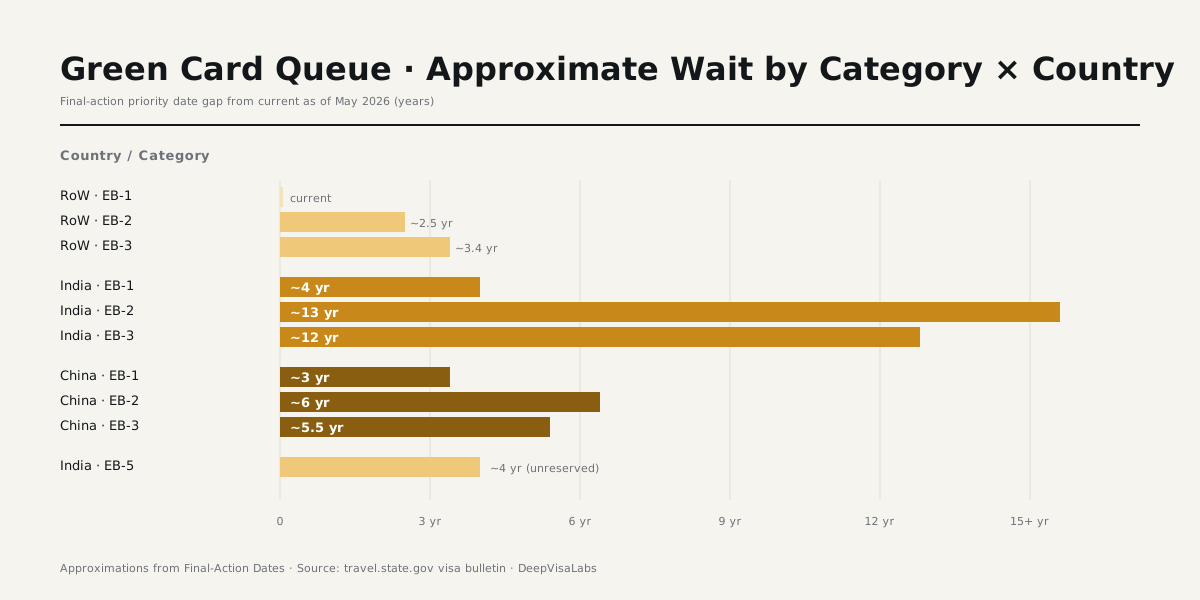
Current I-485 Processing Windows
USCIS publishes I-485 processing times by classification on the processing-times dashboard. Current 80th-percentile completion ranges:
- Employment-based (EB-1, EB-2, EB-3): 10–18 months
- Family-based — immediate relative of US citizen: 10–22 months
- Asylee adjustment: 12–28 months
- Refugee adjustment: 8–18 months
The dashboard updates monthly around the 15th based on prior-month completions, so the displayed numbers lag real-time by 30–60 days.
Service Centers vs Field Offices
USCIS routes I-485 cases to either service centers (NBC, NSC, TSC) for paper processing or to field offices for interview-required cases. Service-center cases generally process faster; field-office cases include the interview scheduling delay.
Field-office assignment is determined by the applicant's residence at filing. Heavily populated metro areas (NYC, LA, San Francisco, Chicago) face longer field-office waits than smaller jurisdictions.
Biometrics and Interview Cadence
Biometrics (fingerprints, photo, signature) are scheduled 4–8 weeks after filing receipt at a local Application Support Center. Some I-485 cases reuse prior biometrics, skipping the appointment.
Interview scheduling varies — most employment-based I-485s are interviewed at the local field office 8–18 months after filing. Some cases are interview-waived per USCIS policy.
What Slows I-485 Adjudication
Common slowdowns: priority-date retrogression after filing (USCIS holds case until current again), background-check delays (especially name-based FBI checks for common surnames), RFEs on derivative spouse / child eligibility, security advisory opinions for certain countries of birth or work history.
Premium processing is not available for I-485. Outside-Normal-Time inquiries unlock once the case passes the 80th-percentile upper bound — typically 18+ months after filing.
EAD and Advance Parole Timing
Concurrently-filed I-765 (EAD c-9) and I-131 (advance parole c-11) typically issue 3–8 months after filing receipt. Under USCIS's 2023 validity-extension policy, both are issued in multi-year validity windows reducing renewal burden during long I-485 pendencies.
Pending I-765 and I-131 cases benefit from the April 2024 540-day auto-extension rule for timely-filed renewals.
Cross-Pillar Reading
- Form I-485 · the application itself
- Adjustment of Status · concept overview
- I-140 Processing Time · prior-step processing
- USCIS Processing Times · all forms and service centers
- Visa Bulletin · priority-date status
Bottom line
Current category. The visa-bulletin queue is not active, so total wait reduces to USCIS form processing plus medical / biometrics scheduling.
Frequently asked questions
- Can I port my priority date to another I-140?
- Yes. INA §204(j) lets you keep your priority date on a new I-140 in the same or higher preference category, even after changing employers, as long as the original I-140 was approved (or pending and ultimately approved).
- What's the difference between adjustment of status and consular processing?
- Adjustment of Status (I-485) is filed inside the United States; Consular Processing routes through the National Visa Center and a US embassy abroad. AOS unlocks a pending-EAD; CP issues a sealed immigrant visa for entry.
- What if I-485 processing time retrogresses while my I-485 is pending?
- Retrogression after I-485 filing means USCIS pauses adjudication. Pending-AOS EADs and advance parole remain valid; the I-485 simply waits for the priority date to become current again.
- Does I-485 processing time require a labor certification (PERM)?
- PERM is mandatory for EB-2 and EB-3 cases tied to an employer-specific job. EB-1A, EB-1B, EB-1C, and EB-2 NIW are PERM-exempt because the petitioner is the beneficiary or the role is too senior for a labor-market test.
- Can I file I-485 and I-140 concurrently?
- Concurrent filing is allowed once your priority date qualifies. It also gives access to a pending-AOS EAD valid for up to 5 years under USCIS's 2023 validity-extension policy.