I-140 Processing Time: Standard vs Premium by Service Center and Category
The I-140 processing time category for All Chargeability Areas has no waiting line right now. Petitioners face a 8–14 months processing horizon at USCIS, plus medical exam and biometrics scheduling on top.
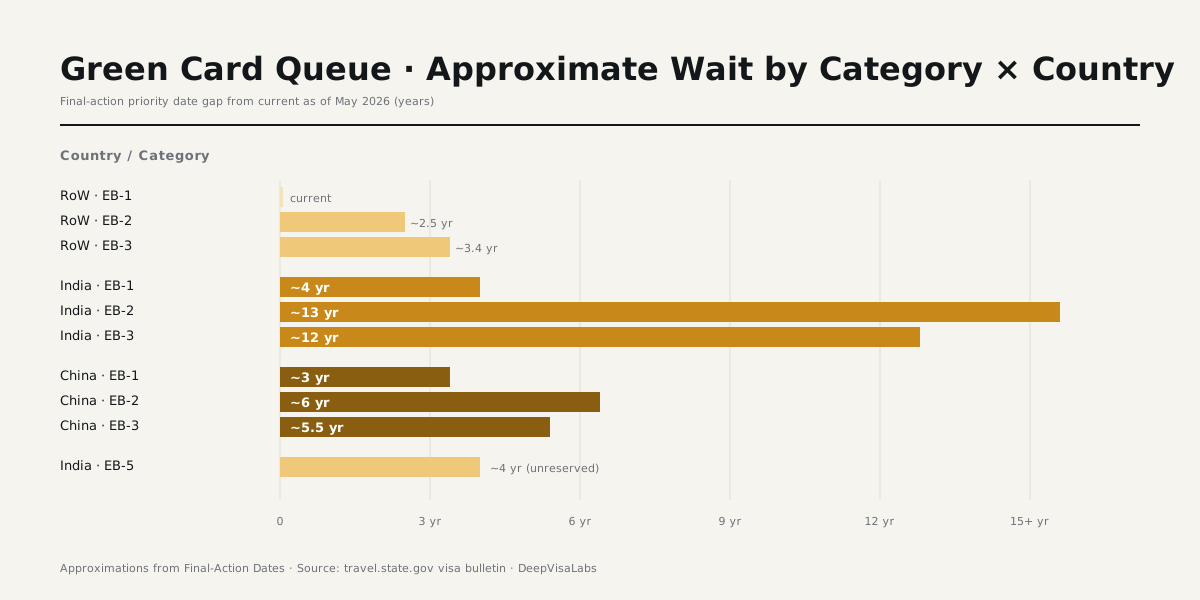
Current I-140 Processing Windows
USCIS publishes I-140 processing times by category and service center on the processing-times dashboard. Current 80th-percentile completion ranges:
- EB-1A / EB-1B / EB-1C: 8–14 months standard, 15 calendar days premium
- EB-2 (advanced degree / exceptional ability): 8–14 months standard, 15 calendar days premium
- EB-2 NIW: 8–22 months standard, no premium processing available
- EB-3 (skilled / professional / other worker): 8–14 months standard, 15 calendar days premium
Times update around the 15th of each month based on prior-month completions.
Premium Processing Coverage
Form I-907 (Premium Processing) applies to most I-140 categories at $2,805 fee for 15-calendar-day adjudication. RFEs pause the clock; resumption upon response. The 15-day SLA is reliably met when the case has clean documentation.
EB-2 NIW is the explicit exclusion. USCIS has not extended I-907 to NIW filings — the qualitative Dhanasar three-prong evaluation is incompatible with the 15-day SLA. NIW petitioners must wait standard processing (8–22 months at the 80th percentile).
Service-Center Variation
Texas Service Center (TSC) and Nebraska Service Center (NSC) handle most I-140 caseload. Periodic transfers between centers balance backlog. Variation between centers can exceed 6 months for the same EB category — always read your case's specific service-center row on the dashboard.
USCIS occasionally transfers cases to a different service center mid-pendency. Transfers don't reset the receipt date; they just change the adjudicating office.
Why Standard Processing Times Drift
USCIS reports the 80th-percentile (upper-bound) completion time. The dashboard reflects prior-month completions, so it lags real-time by 30–60 days. Workload swings — fee-rule effective dates, surge filings, RFE rates — can move the dashboard substantially in single updates.
Median completion (50th percentile) is typically 30–40% faster than the 80th. The dashboard does not publish 95th-percentile, but anecdotal evidence suggests outliers can extend 2–3× the 80th when complex RFEs trigger.
When to Use Premium Processing
Premium processing pays off when (a) the priority date is or will soon be current and the beneficiary wants concurrent I-485 filing, (b) the beneficiary plans international travel and needs an updated I-797, (c) AC21 §104(c) extensions require an approved I-140, or (d) the case has unusual evidence and the structured 15-day window helps RFE response timing.
Premium processing does not eliminate RFE risk — the 15-day clock pauses on RFE issuance and resumes on response. It just compresses the schedule.
Cross-Pillar Reading
- Form I-140 · the immigrant petition itself
- EB-2 Green Card · most common I-140 category
- EB-2 NIW · the no-premium-processing exception
- I-485 Processing Time · post-approval next step
- USCIS Processing Times · all forms and service centers
Bottom line
Current category. The visa-bulletin queue is not active, so total wait reduces to USCIS form processing plus medical / biometrics scheduling.
Frequently asked questions
- What is the priority date in I-140 processing time?
- Your priority date is fixed when the first qualifying filing was accepted: PERM for most EB-2/EB-3, the I-140 itself for EB-1 and EB-2 NIW, the I-526 for EB-5.
- Can I port my priority date to another I-140?
- Once an I-140 is approved, the priority date can be carried forward to a future I-140 in the same or higher preference. This is critical for India / China EB-2 / EB-3 applicants stuck in long backlogs.
- What's the difference between adjustment of status and consular processing?
- Adjustment of Status (I-485) is filed inside the United States; Consular Processing routes through the National Visa Center and a US embassy abroad. AOS unlocks a pending-EAD; CP issues a sealed immigrant visa for entry.
- What if I-140 processing time retrogresses while my I-485 is pending?
- Filing during a current window protects against later retrogression: if the priority date moves backward, USCIS holds the I-485 and processes it once the date is current. EAD / advance parole continue to renew.
- Does I-140 processing time require a labor certification (PERM)?
- EB-2 (advanced degree / exceptional ability) and EB-3 require an approved PERM labor certification before filing the I-140. EB-1 (extraordinary ability / outstanding researcher / multinational manager) and EB-2 NIW skip PERM entirely.