Form I-140 Immigrant Petition for Alien Worker: Filing, Evidence, and Premium Processing
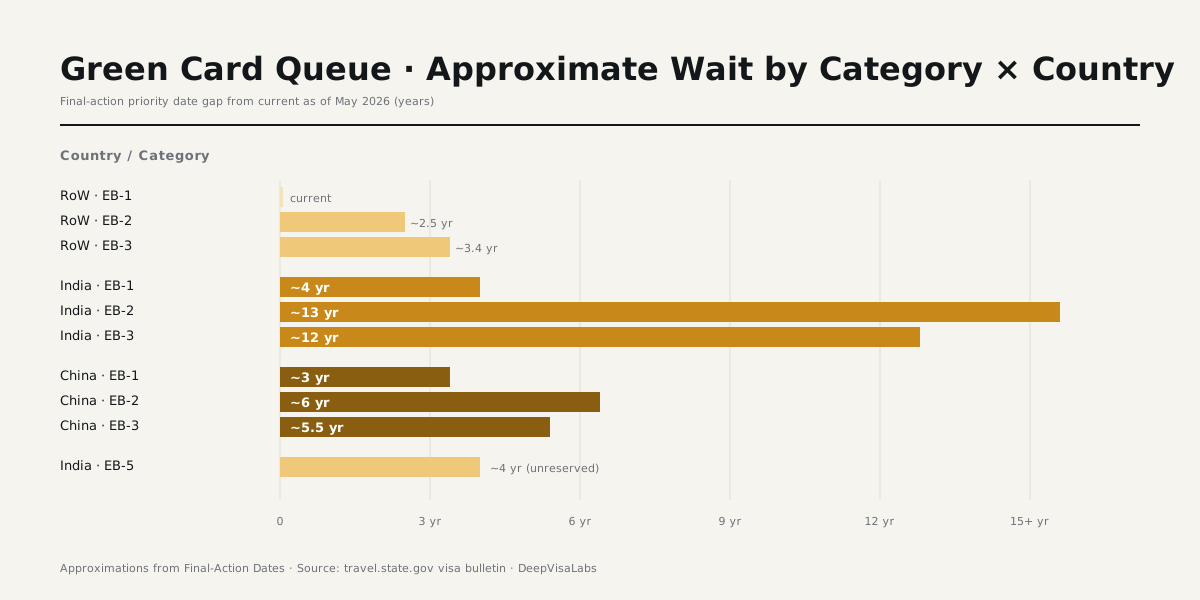
The Form I-140 category for All Chargeability Areas has no waiting line right now. Petitioners face a 8–14 months processing horizon at USCIS, plus medical exam and biometrics scheduling on top.
What I-140 Is
Form I-140 (Immigrant Petition for Alien Worker) is the primary employment-based immigrant petition. Filed by the petitioning employer (or self-petitioner for EB-1A and EB-2 NIW), it establishes that the beneficiary qualifies for one of the EB-1, EB-2, or EB-3 categories.
I-140 approval is necessary but not sufficient for green-card issuance — the priority date must also be current under the visa bulletin, and the beneficiary must complete I-485 (adjustment of status, if in US) or consular processing (if abroad).
I-140 by Preference Category
EB-1A: self-petition, no PERM, evidence of extraordinary ability across 3 of 10 criteria. EB-1B: employer petition, no PERM, outstanding researcher evidence. EB-1C: employer petition, no PERM, multinational executive/manager evidence. EB-2: employer petition, PERM required (except NIW), advanced degree or exceptional ability. EB-2 NIW: self-petition, no PERM, Dhanasar 3-prong test. EB-3: employer petition, PERM required, skilled worker / professional / other worker.
Evidence requirements vary substantially by category. See USCIS Policy Manual Volume 6, Part F for category-specific guidance.
Priority Date Establishment
Priority date is set when the underlying step is filed: PERM filing date for PERM-required categories (EB-2 standard, EB-3); I-140 receipt date for PERM-exempt categories (EB-1A, EB-1B, EB-1C, EB-2 NIW). Once established, priority date can be ported to a future I-140 in the same or higher preference under INA §204(j).
Priority-date portability is critical for India and China beneficiaries who change employers during long backlogs — they keep the original priority date even when refiling I-140 with a new employer.
Premium Processing
USCIS extended premium processing (Form I-907) to most I-140 categories at $2,805 fee for 15-calendar-day adjudication. Coverage: EB-1A, EB-1B, EB-1C, EB-2 advanced degree, EB-2 exceptional ability, EB-3 skilled / professional / other worker. Exclusion: EB-2 NIW — USCIS has not extended I-907 to NIW filings due to the qualitative judgment required by Dhanasar's three-prong test.
Standard I-140 processing currently runs 8–14 months per the USCIS dashboard.
Filing Fees and Forms
Standard I-140 filing fee is $715 per the 2024 USCIS fee rule. Add $2,805 for I-907 premium processing if elected. EB-5 uses I-526E ($11,160 fee) instead of I-140. Asylum-program fee and biometrics not applicable to I-140.
Required attachments vary by category — degree credentials, employment letters, peer-recommendation letters, awards documentation, certified PERM (where required). Consult the form-specific I-140 instructions for the exact evidence package.
What Happens After I-140 Approval
Approval establishes the beneficiary's eligibility for the immigrant category and locks the priority date. If priority date is current at the time of approval (or shortly after), the beneficiary can file I-485 concurrently or sequentially. If priority date is backlogged, the case waits for the visa bulletin to advance.
Approved I-140 also enables AC21 §104(c) 3-year H-1B extensions past the 6-year cap when the priority date is not current. This is a critical benefit for India / China EB-2 / EB-3 beneficiaries.
Cross-Pillar Reading
- I-140 Processing Time · current standard and premium windows
- EB-2 Green Card · most common I-140 category
- EB-3 Green Card · skilled / professional / other worker
- EB-1 Green Card · extraordinary ability and multinational
- EB-2 NIW · self-petition path without PERM
- PERM Labor Certification · pre-step for standard EB-2 / EB-3
- I-485 Adjustment of Status · next step after I-140 approval
Bottom line
Verdict: priority date current — the queue is not the bottleneck. Adjudication time and form readiness are.
Frequently asked questions
- What is the priority date in Form I-140?
- The priority date is the date USCIS / DOL accepted the underlying labor-certification or I-140 petition. For PERM-required categories, it is the PERM filing receipt date; for PERM-exempt EB-1A or EB-2 NIW, it is the I-140 receipt date.
- Can I port my priority date to another I-140?
- Priority-date retention is automatic when the original I-140 is approved, regardless of whether the original employer withdraws it more than 180 days after approval. New PERM may be required, but the priority date carries.
- What's the difference between adjustment of status and consular processing?
- AOS keeps you in the US during adjudication and grants employment / travel authorization while pending. CP requires leaving the country for a consular interview, and timing is harder to predict because of NVC backlogs.
- What if Form I-140 retrogresses while my I-485 is pending?
- USCIS can hold the I-485 in the queue if your priority date retrogresses after filing. Your case is not denied — it sits until the priority date is current again, at which point USCIS picks up adjudication.
- Does Form I-140 require a labor certification (PERM)?
- Most EB-2 and EB-3 applicants need PERM certification first; EB-1 and EB-2 NIW are explicit statutory exemptions.