EB-1 Lawyer: Vetting EB-1A, EB-1B, and EB-1C Petition Specialists
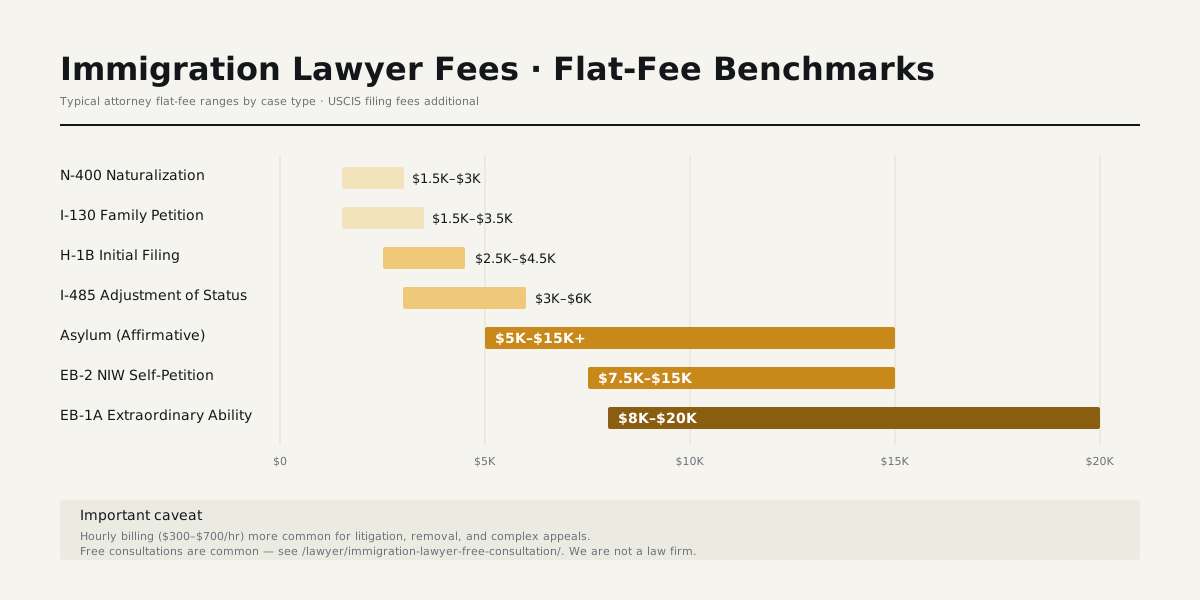
Most attorneys quote $6,000–$18,000 for EB-1 lawyer. The variance reflects firm size, geography, and whether the matter requires litigation or appeals — flat-fee structures dominate for routine filings, hourly for complex cases.
EB-1 Has Three Sub-Categories — Specialization Compounds
"EB-1 lawyer" is shorthand for three distinct petition types, each with a different evidence framework. A lawyer specialized in one sub-category is not necessarily competent in the others.
- EB-1A — Extraordinary ability. Self-petition; no employer sponsorship required. Standard: "extraordinary ability... that has been demonstrated by sustained national or international acclaim". 10-criteria evidence framework with USCIS final-merits determination.
- EB-1B — Outstanding professor or researcher. Employer-sponsored. Tenure-track or comparable permanent research position required. 6-criteria evidence framework focused on academic recognition.
- EB-1C — Multinational manager or executive. Employer-sponsored. The petitioner must have been employed abroad by a related entity for at least 1 of the prior 3 years in a managerial or executive capacity.
The 10-criteria EB-1A framework, the 6-criteria EB-1B framework, and the EB-1C qualifying-employment-abroad analysis are different bodies of practice. Ask which sub-category the attorney has filed most recently, and how many.
The 10-Criteria EB-1A Framework
USCIS uses a two-step analysis under USCIS Policy Manual Volume 6 Part F Chapter 2 and the EB-1 page:
- Step 1 — Quantitative review. Petitioner must satisfy at least 3 of 10 enumerated regulatory criteria (lesser awards, professional memberships, published material about the petitioner, judging the work of others, original contributions of major significance, scholarly articles, exhibitions, leading or critical role, high salary, or commercial success in the performing arts) — or, alternatively, a one-time achievement (Pulitzer / Olympic medal / Nobel-tier award).
- Step 2 — Final-merits determination. Per Kazarian v. USCIS (9th Cir. 2010), USCIS must then evaluate whether the totality of the evidence demonstrates extraordinary ability and sustained acclaim — not just count criteria boxes.
An EB-1A lawyer's pattern recognition is in step 2: which evidence frames each criterion most credibly, which expert letters carry weight, which published-material articles count, and how to position citation counts and h-index data for STEM petitioners.
What to Vet in an EB-1 Lawyer
- Recent EB-1 approvals in your sub-category. Ask for a count over the past 12-24 months. EB-1A specialists routinely have 50-200+ approvals; EB-1B and EB-1C specialists may have lower volume.
- Field fit. EB-1A pattern recognition transfers across STEM fields, but a chemistry-publications-focused specialist may not see acclaim signals as well in arts, athletics, or business.
- RFE response history. EB-1A RFEs cluster in three areas: criterion qualification (whether evidence "counts" for a specific criterion), final-merits sufficiency, and authorship credibility. Ask how the firm structures responses.
- Premium-processing decision authority. Premium processing is available for I-140; the lawyer's view on when to use it (typically yes, for visibility into RFE risk) should be explicit.
- Expert-letter strategy. The 5-7 expert letters that anchor most EB-1A petitions are the lawyer's craft. Ask for sample template structure (without identifying real prior clients).
EB-1B — Different Evidence Framework
EB-1B (outstanding professor or researcher) is employer-sponsored and uses a 6-criteria framework focused on academic recognition: major prizes, professional-association memberships requiring outstanding achievements, published material about the petitioner's work, original contributions, scholarly publications, and judging of others' work. The petitioner needs at least 3 years of teaching or research experience and a permanent (tenure-track or equivalent) job offer at a US university or qualifying private research entity.
EB-1B is more common for tenure-track faculty hires than for visiting research scientists; the "permanent" research-position requirement defeats most contract-research roles. An EB-1B specialist understands the qualifying-employer analysis and how to document the permanence requirement.
EB-1C — Managerial/Executive Capacity Analysis
EB-1C (multinational manager or executive) is employer-sponsored. The petitioner must have been employed abroad by a related entity for at least 1 of the prior 3 years in a managerial or executive role, and must be coming to the US to work for the related entity in a managerial or executive role. "Manager" and "executive" are defined narrowly: managing professionals, supervising other managers, exercising discretion over personnel decisions, or directing a major component or function of the organization.
EB-1C overlaps heavily with L-1A practice — the L-1A nonimmigrant analog uses essentially the same managerial/executive standard. An EB-1C lawyer typically has L-1A volume too, and the practical analysis is whether your role qualifies under the regulatory definition.
Cost Range and What to Expect
EB-1 attorney fees in 2026 typically span:
- EB-1A self-petition: $8,000–$20,000. Wide spread reflects evidence-package depth.
- EB-1B (employer-sponsored): $5,000–$10,000.
- EB-1C (employer-sponsored): $5,000–$10,000.
Government fees: I-140 base fee plus optional I-907 premium processing ($2,805). Per-country priority dates apply; check the current visa bulletin for EB-1 dates by country (India and China have meaningful retrogression in some periods).
Bottom line
Selection criteria for EB-1A / EB-1B / EB-1C immigrant petitions: documented prior approvals in the same form type, AILA membership (useful but not required), explicit scope and refund terms, and a single point of contact for case status.
Frequently asked questions
- What are red flags when choosing an immigration lawyer?
- Red flags: outcome guarantees, vague fee quotes, no written engagement letter, generic case descriptions that do not match your specific facts, and any individual not listed on a state bar directory who is preparing forms for compensation.
- Where can I find low-cost or pro-bono immigration help?
- Pro-bono immigration help is available through nonprofit legal-aid organizations (e.g. CLINIC, AILA pro-bono pairings, local legal-aid societies). EOIR maintains a list of recognized organizations and accredited representatives at justice.gov/eoir.
- How much does an immigration lawyer cost for EB-1 lawyer?
- Most US immigration attorneys quote flat fees for predictable form filings and hourly billing for litigation, appeals, or complex consular issues. Always ask for a written engagement letter listing what is and is not included.
- How do I know if an immigration attorney is licensed?
- Every US-licensed attorney is admitted to a specific state bar. Use the state bar's public lookup tool to confirm active status and check for any disciplinary history. EOIR-recognized representatives at non-profit organizations are a separate category.
- What questions should I ask before hiring?
- Specifics first: case-type volume, success rate (which can be hard to verify), engagement letter terms, communication policy, and which attorney or paralegal does the actual drafting. General experience claims are less informative than category-specific track records.
Sources
- https://www.uscis.gov/working-in-the-united-states/permanent-workers/employment-based-immigration-first-preference-eb-1
- https://www.uscis.gov/policy-manual/volume-6-part-f-chapter-2
- https://www.aila.org/
- https://travel.state.gov/content/travel/en/legal/visa-law0/visa-bulletin.html
- https://www.uscis.gov/i-140