EB-1A Lawyer: Vetting Extraordinary-Ability Specialists for I-140 Self-Petitions
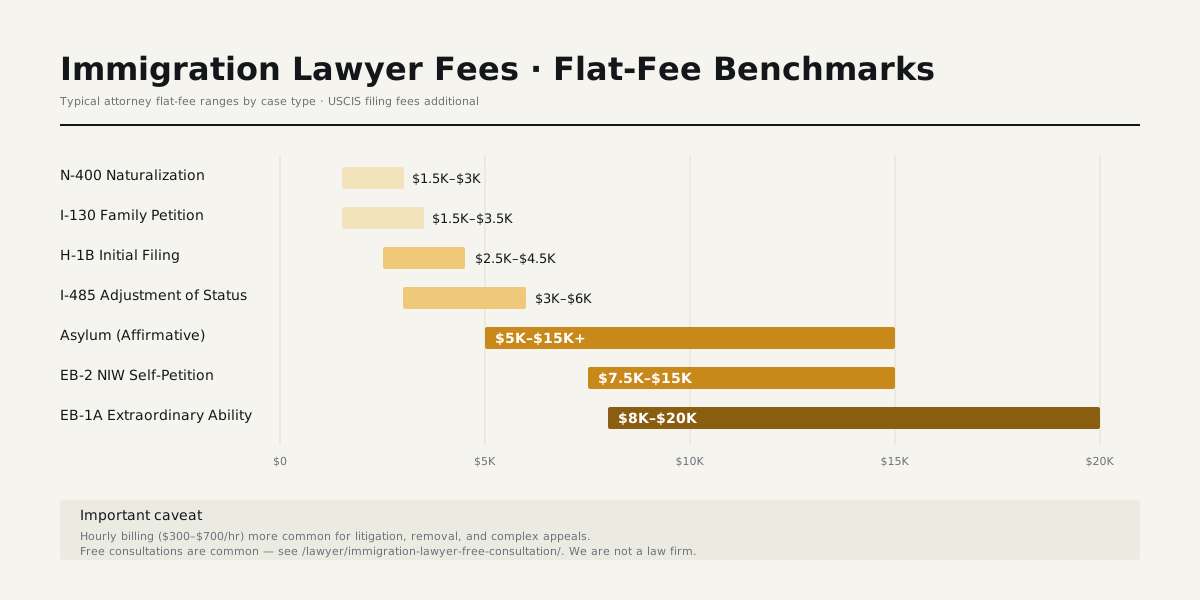
EB-1A lawyer typically runs $8,000–$20,000 in attorney fees, plus government filing fees that USCIS sets separately. The right fee structure depends on case complexity, urgency, and whether premium processing is in play.
What an EB-1A Lawyer Specifically Does
EB-1A is the extraordinary-ability self-petition for the EB-1 first-preference employment-based green card. It is filed on Form I-140 directly by the petitioner — no employer sponsorship, no PERM. The bar is high: USCIS requires evidence of "extraordinary ability... that has been demonstrated by sustained national or international acclaim" per USCIS Policy Manual Volume 6 Part F Chapter 2.
An EB-1A lawyer's craft is in three places: (1) packaging evidence to fit the regulatory criteria, (2) drafting the legal-argument memorandum, and (3) structuring the 5-8 expert letters that establish independent opinion of acclaim. The petition itself is short — it's the supporting evidence that runs 200-500 pages.
The Two-Step Kazarian Analysis
USCIS analysis follows the two-step framework from Kazarian v. USCIS, 596 F.3d 1115 (9th Cir. 2010):
Step 1: Criteria Threshold
The petitioner must satisfy at least 3 of the 10 enumerated regulatory criteria at 8 CFR 204.5(h)(3), or alternatively a one-time achievement (Pulitzer / Olympic medal / Nobel-tier award). The 10 criteria:
- Lesser nationally or internationally recognized prizes or awards.
- Membership in associations requiring outstanding achievement (judged by recognized national or international experts).
- Published material about the petitioner in professional publications or major media.
- Judging the work of others in the same or allied field.
- Original scientific, scholarly, artistic, athletic, or business contributions of major significance.
- Authorship of scholarly articles in professional journals or major media.
- Display of work at artistic exhibitions or showcases.
- Leading or critical role for organizations of distinguished reputation.
- High salary or remuneration relative to others in the field.
- Commercial success in the performing arts.
Step 2: Final-Merits Determination
USCIS then evaluates the totality of the evidence to determine whether the petitioner has actually demonstrated extraordinary ability and sustained acclaim. Counting boxes is not enough — the evidence has to qualitatively support the conclusion. This is where most EB-1A denials happen.
What Vetting an EB-1A Lawyer Actually Looks Like
- Approval volume in the past 12 months. Specialist firms file 100-300+ EB-1As/year. A firm with single-digit recent EB-1A volume is not specialized.
- Field fit. EB-1A patterns differ across STEM, business, arts, athletics. Ask whether the firm has filed in your specific field.
- RFE pattern recognition. Common EB-1A RFEs: insufficient evidence of major significance under criterion (v), authorship-only-not-impact under (vi), critical-role unsupported under (viii), high-salary-not-relative under (ix).
- Expert-letter strategy. The lawyer should explain how they recruit independent experts (not just thesis advisors), how they balance "personally-knew" vs "knew-by-reputation" letters, and how many letters typically anchor a strong petition.
- Premium-processing posture. EB-1A I-140 premium is widely available and recommended for visibility into RFE risk. A firm that defaults against premium without case-specific reasoning may be saving on workload.
- Federal-court mandamus practice. If priority date retrogression strands an approved I-140 case, do they handle subsequent I-485 mandamus litigation?
Evidence Package Structure
A strong EB-1A petition typically organizes evidence into:
- Legal-argument memorandum (the "brief") — 25-50 pages organizing how each criterion is met and why the totality establishes sustained acclaim.
- 5-8 expert letters — independent recognized experts attesting to the petitioner's standing in the field. Mix of personal-knowledge and reputation-only letters.
- Citation reports for academic petitioners — Google Scholar, Scopus, Web of Science, with comparative h-index data for the field.
- Media-coverage evidence — articles in nationally-known professional publications.
- Award documentation — selection criteria, jury composition, prize stature.
- Membership documentation — by-laws showing outstanding-achievement requirement.
- Salary evidence — comparative DOL or industry-survey data.
- Critical-role evidence — letters from organizations confirming the role and the organization's reputation.
Cost Range
EB-1A attorney fees in 2026 typically span $8,000-$20,000. The variance reflects:
- Evidence-package depth (50-page brief vs 30-page brief).
- Expert-letter coordination workload (firm-drafted vs petitioner-coordinated).
- Field complexity (STEM with citation analysis vs business with subjective acclaim).
- Phase structure (some firms separate strategy / drafting / filing into discrete phases).
Government fees: I-140 base + optional I-907 premium processing ($2,805). For petitioners with concurrent or sequential I-485, factor that adjustment-of-status filing separately.
EB-1A Pitfalls — What Specialists Catch
- Authorship without impact. Publishing in journals is not enough; cite-counts and downstream citations matter for criterion (vi).
- Internal awards counted as recognition. Awards from the petitioner's own employer don't count under criterion (i) without independent national or international stature.
- Membership in pay-to-join associations. Memberships in associations that don't require outstanding achievement (e.g. paid professional memberships) don't count under criterion (ii).
- Salary not contextualized. "$300K salary" needs comparative wage-survey data to establish that it's high relative to others in the field.
- Critical-role overstatement. Senior-engineer titles at well-known companies don't automatically establish critical-role; the actual role-impact-organization-reputation triangle has to be documented.
Bottom line
How to evaluate: match attorney experience to EB-1A extraordinary-ability self-petitions specifically — case-type approvals, engagement-letter clarity, communication cadence, and bar verification. We do not recommend lawyers; we describe what to look for.
Frequently asked questions
- What are red flags when choosing an immigration lawyer?
- Watch for: guaranteed-outcome promises (no attorney can guarantee a USCIS approval), opaque fee structures, refusal to provide a written engagement letter, pressure to sign on the first call, and any non-attorney 'consultant' who offers to file forms for a fee in states where that is unauthorized practice.
- Where can I find low-cost or pro-bono immigration help?
- Pro-bono immigration help is available through nonprofit legal-aid organizations (e.g. CLINIC, AILA pro-bono pairings, local legal-aid societies). EOIR maintains a list of recognized organizations and accredited representatives at justice.gov/eoir.
- How much does an immigration lawyer cost for EB-1A lawyer?
- Most US immigration attorneys quote flat fees for predictable form filings and hourly billing for litigation, appeals, or complex consular issues. Always ask for a written engagement letter listing what is and is not included.
- How do I know if an immigration attorney is licensed?
- Beyond bar verification, search the EOIR list of recognized organizations and accredited representatives if you are working with a non-profit. Be cautious of 'visa consultants' or 'notarios' who are not licensed attorneys — that practice is unauthorized in most states.
- What questions should I ask before hiring?
- Ask about prior approvals in the specific category you are filing — for EB-1A lawyer, that means specific case types, not 'years of immigration experience' broadly. Ask for the engagement letter, fee structure, refund policy, communication cadence, and who will actually handle the file.