EB-2 NIW Lawyer: Vetting Dhanasar Three-Prong Specialists
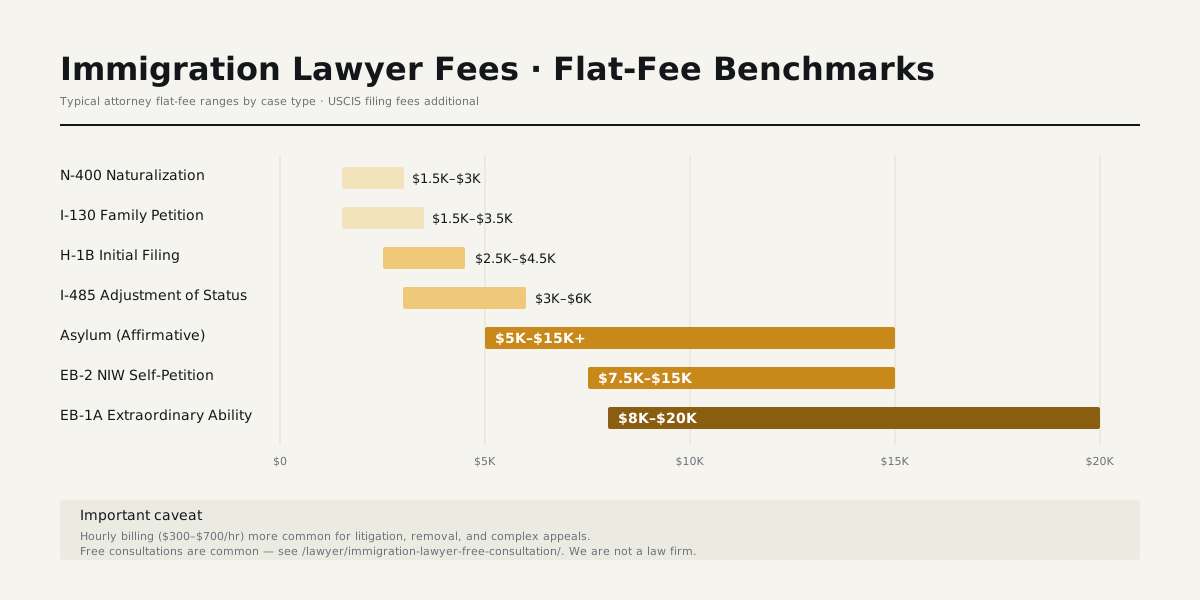
EB-2 NIW lawyer pricing clusters in the $5,000–$12,000 band for legal services alone. USCIS form fees (I-129 / I-140 / I-485) and any premium-processing surcharges are separate.
EB-2 NIW: A Self-Petition Path That Skips PERM
The EB-2 National Interest Waiver lets EB-2 applicants self-petition without an employer sponsor and without PERM labor certification. Eligibility runs through the three-prong test established in Matter of Dhanasar, 26 I&N Dec. 884 (AAO 2016) and codified in USCIS Policy Manual Volume 6 Part F Chapter 5.
An NIW lawyer's craft is in framing the proposed endeavor, documenting the petitioner's well-positioning, and arguing that waiving the labor-certification requirement benefits the United States. NIW is the most popular EB-2 path for STEM PhDs, physicians, entrepreneurs, and researchers who can't readily file EB-1A.
The Dhanasar Three-Prong Test
Per Matter of Dhanasar and USCIS Policy Manual:
- Prong 1 — Substantial merit and national importance. The proposed endeavor must have substantial merit (in business, science, technology, culture, health, or education) and broader implications beyond the petitioner's immediate work. STEM endeavors aligned with US-government strategic priorities (semiconductor design, AI safety, energy security, biomedical research) are well-positioned.
- Prong 2 — Well-positioned to advance. The petitioner must be well-positioned to advance the endeavor. Evidence: education, skills, knowledge, record of success, plans, progress toward the endeavor, and interest from potential customers, users, investors, or stakeholders.
- Prong 3 — Beneficial to waive labor certification. On balance, it benefits the United States to waive the requirements that the petitioner show specific job offers or PERM labor certification. The endeavor's national importance and the petitioner's well-positioning together justify proceeding without PERM.
USCIS issued a January 2022 policy update that explicitly recognized STEM-fields-aligned-with-US-priorities as strong NIW candidates, citing Critical and Emerging Technologies (CET) lists. Subsequent updates emphasized petitioner-driven endeavors and discouraged generic "research" framings.
What Vetting an NIW Lawyer Looks Like
- Recent NIW approvals in your field. NIW specialists file 100-500+ NIWs/year. STEM-PhD specialists, physician specialists, and entrepreneur specialists are different sub-practices.
- Endeavor-statement craft. The endeavor statement is 2-4 pages framing what the petitioner will do in the US, why it has national importance, and how it ties to recognized US priorities. Ask for de-identified template structure.
- Prong 2 evidence frameworks. Education + record of success + concrete plans + stakeholder interest. Different fields need different evidence (STEM = citations + patents; entrepreneurship = funding + LOI + product traction; physician = state-licensure + practice plans).
- RFE pattern recognition. Common NIW RFEs: prong 1 specificity ("how is your specific work nationally important"), prong 2 well-positioning ("evidence of plans and progress"), prong 3 balance ("why waive labor certification").
- Premium-processing posture. Premium processing for I-140 is available and typically recommended for NIW; cases without premium can sit 8-15 months in standard processing.
Endeavor-Statement Craft
The endeavor statement is the heart of an NIW petition. Specialists structure it as:
- Specific endeavor framing. Not "I will research AI" but "I will develop privacy-preserving federated-learning techniques for medical imaging at [employer]."
- National importance argument. Tie to recognized US priorities — CHIPS Act, IRA clean energy, BIOSECURE, NIST CET list.
- Implementation plan. What the petitioner will do, with whom, on what timeline, with what resources.
- Broader implications. Beyond the immediate work, what other organizations or fields benefit.
Generic "I will continue researching machine learning" framings draw RFEs. Specific endeavors with measurable outputs and named US-priority alignment generally don't.
Cost Range
EB-2 NIW attorney fees in 2026 typically span $5,000-$12,000:
- Lower end: high-volume specialists with templated evidence frameworks for STEM PhDs.
- Mid range: phase-based engagements with full strategy / drafting / filing scope.
- Upper end: complex cases requiring extensive expert-letter coordination, entrepreneurship cases with traction documentation, or physician cases with state-licensure overlay.
Government fees: I-140 base + optional I-907 premium processing ($2,805). India and China EB-2 priority dates retrogress; an approved I-140 may sit pending an available priority date for years.
NIW vs EB-1A — Choosing the Path
Most STEM PhDs and researchers face a strategic choice between NIW and EB-1A:
- NIW: lower bar (national importance + well-positioning), faster current priority dates for some countries, lower cost. But still subject to per-country EB-2 priority date retrogression.
- EB-1A: higher bar (extraordinary ability, sustained acclaim), but EB-1 priority dates are usually current or near-current, and the same evidence often supports both petitions.
Many petitioners file NIW first (faster approval, current cut-off for some countries) and EB-1A later when the evidence package matures. A specialist firm should walk through this strategy and not default to NIW or EB-1A without case-specific analysis.
Bottom line
How to evaluate: match attorney experience to EB-2 National Interest Waiver self-petitions specifically — case-type approvals, engagement-letter clarity, communication cadence, and bar verification. We do not recommend lawyers; we describe what to look for.
Frequently asked questions
- How do I know if an immigration attorney is licensed?
- Beyond bar verification, search the EOIR list of recognized organizations and accredited representatives if you are working with a non-profit. Be cautious of 'visa consultants' or 'notarios' who are not licensed attorneys — that practice is unauthorized in most states.
- What questions should I ask before hiring?
- Useful questions: how many cases of this exact type have you handled in the past year? What is the flat-fee scope? When and how do you communicate updates? What happens if the case is denied — do you handle MTRs / appeals?
- Are flat fees or hourly billing better?
- Most routine immigration filings use flat-fee structures. Hourly billing applies when scope is unpredictable — think federal-court litigation, complex EB-1A petitions, asylum cases, or removal defense.
- Can I file my immigration case without an attorney?
- Pro-se filing is fully legal. The cases that benefit most from attorney involvement are ones with prior denials, criminal-history issues, complex eligibility theories (NIW, asylum, EB-1A), or RFE responses requiring legal-argument drafting.
- What are red flags when choosing an immigration lawyer?
- Be cautious if the attorney guarantees approval, refuses to put fees and scope in writing, or pressures you to decide immediately. Also watch for 'notarios' or 'visa consultants' charging legal fees without a state bar license — that is unauthorized practice of law in most states.