Immigration Lawyer Fees: Flat-Fee vs Hourly + What USCIS Charges Separately
immigration lawyer fees pricing clusters in the $1,000–$12,000 band for legal services alone. USCIS form fees (I-129 / I-140 / I-485) and any premium-processing surcharges are separate.
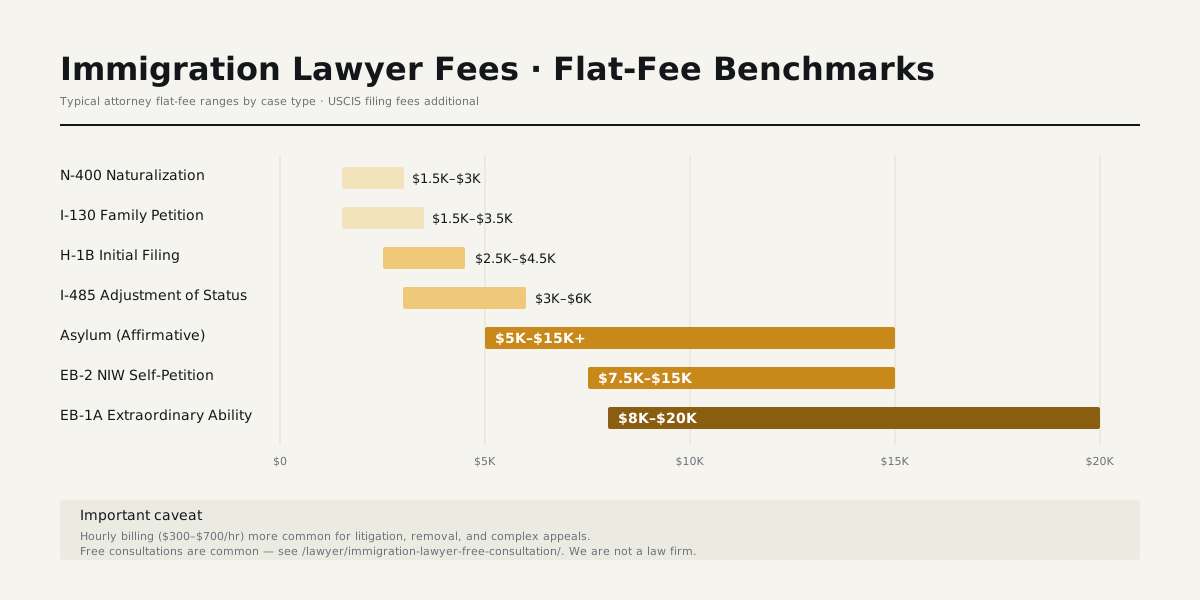
The Three Buckets of an Immigration Quote
Every immigration filing has three distinct fee buckets, and engagement letters that conflate them produce sticker shock at filing time.
- Attorney legal fees — paid to the firm for legal services. Negotiable, varies by firm.
- Government filing fees — paid directly to USCIS, DOL, or DOS. Listed on the USCIS filing-fees page; updated periodically through fee-rule revisions. Not negotiable.
- Optional government surcharges — premium processing (Form I-907), biometrics (where applicable), expedite requests. Discretionary by case.
A "$5,000 H-1B" might mean attorney fees only, or attorney + USCIS but not premium processing, or all-in. The engagement letter must distinguish.
Flat-Fee Billing — When It's the Right Model
Flat fees work when the workload is predictable. The standard immigration filings that lend themselves to flat fees:
- H-1B initial petition, H-1B extension, H-1B transfer.
- L-1A / L-1B initial.
- I-130 spouse, parent, sibling petitions.
- K-1 fiancé(e).
- I-485 adjustment of status.
- I-751 removal of conditions on conditional residence.
- N-400 naturalization (no complications).
- OPT I-765 EAD.
- PERM labor certification (per 20 CFR 656.12, employer pays).
What a Flat-Fee Engagement Letter Should Specify
- Scope of forms covered.
- Whether one RFE response is included or excluded (most firms include one; subsequent RFE responses bill hourly).
- Whether USCIS interview prep is included.
- Refund clause if the case is withdrawn before filing.
- Withdrawal-of-representation terms.
- Named attorney of record (not "our team").
Hourly Billing — When the Scope Is Genuinely Open
Hourly billing is appropriate when scope is unpredictable:
- EOIR removal proceedings — multiple master and individual hearings.
- BIA appeals from EOIR decisions.
- Federal-court litigation — mandamus actions for delayed adjudications, Administrative Procedure Act review of denials.
- NOIDs (Notices of Intent to Deny) requiring legal-argument drafting.
- Asylum cases with extensive country-conditions evidence packages.
- Complex EB-1A or EB-2 NIW with cross-disciplinary acclaim or expert-letter strategy.
Hourly Rate Ranges (2026)
Across the US immigration bar in 2026, hourly rates typically span:
- Associate attorneys: $200–$400/hour.
- Senior attorneys / partners: $400–$700/hour.
- Boutique specialists in EB-1A / NIW / federal-court litigation: $500–$900/hour.
- Paralegal time (when billed): $90–$180/hour.
An hourly engagement should also have a billing increment (typically 0.1 hour / 6 minutes), monthly invoicing, and a retainer trust-account deposit refundable against future hours.
Hybrid Phase-Based Billing
EB-1A, EB-2 NIW, and PERM-plus-I-140 packages are increasingly billed in phases, with a flat fee per phase and hourly billing for unforeseen events.
Typical EB-1A Phase Structure
- Phase 1 — Strategy / Research: $1,500–$3,000. Eligibility analysis, evidence-gap mapping.
- Phase 2 — Evidence Drafting: $4,000–$10,000. Expert letters, evidence packaging, supporting documentation.
- Phase 3 — I-140 Drafting and Filing: $2,000–$4,000.
- Phase 4 (contingent) — RFE response, NOID, federal-court mandamus: hourly billing per pre-quoted rate card.
Phase boundaries should be explicit in the engagement letter: what triggers movement from one phase to the next, and what's billable in between.
USCIS Filing Fees — The Numbers You Don't Negotiate
Government fees are set by regulation and adjusted periodically. The 2024 USCIS fee rule revised most amounts; confirm current numbers on the USCIS filing-fees page at filing time. Approximate 2026 amounts:
- Form I-129 (H-1B / L / O / TN base) — paper filing has a higher fee than online.
- Form I-140 — over $700.
- Form I-485 — over $1,400 (includes biometrics).
- Form I-589 (asylum) — currently no fee.
- Form I-907 premium processing — $2,805 for most categories.
- Form I-130 — over $675 paper / $625 online.
- Form N-400 — over $700 paper / $640 online.
- Form I-765 OPT — over $470 online.
- ACWIA training fee (H-1B) — $750 (small employers) or $1,500 (25+ employees).
- Anti-fraud fee (H-1B, L-1) — $500.
- Asylum-program fee (H-1B, L, O on I-129) — $600 (or $300 for small employers; $0 for nonprofits).
For employment-based cases, several fees are by regulation paid by the employer (ACWIA, anti-fraud, asylum-program); the engagement letter should specify which party writes which check.
Engagement-Letter Checklist
Before signing, the engagement letter should answer:
- Total flat fee (or hourly rate + retainer).
- Exactly which forms are covered.
- RFE / NOID response inclusion.
- USCIS interview prep inclusion.
- Government fees paid by which party.
- Premium-processing decision authority and fee responsibility.
- Refund clause.
- Withdrawal-of-representation clause.
- Communication-cadence commitment.
- Named attorney of record.
- Adjacent work rate card (NOID, BIA appeal, federal-court litigation).
Anything not in writing is not part of the deal. Refusal to commit terms in writing is itself a red flag.
Bottom line
Selection criteria for fee structures for US immigration filings: documented prior approvals in the same form type, AILA membership (useful but not required), explicit scope and refund terms, and a single point of contact for case status.
Frequently asked questions
- How much does an immigration lawyer cost for immigration lawyer fees?
- Attorney fees vary widely by case complexity and geography. Routine filings (H-1B, I-130, OPT EAD) are typically flat-fee in the low thousands; complex EB-2 NIW, EB-1A, or asylum cases run higher and may include phase-based billing.
- How do I know if an immigration attorney is licensed?
- Beyond bar verification, search the EOIR list of recognized organizations and accredited representatives if you are working with a non-profit. Be cautious of 'visa consultants' or 'notarios' who are not licensed attorneys — that practice is unauthorized in most states.
- What questions should I ask before hiring?
- Ask about prior approvals in the specific category you are filing — for immigration lawyer fees, that means specific case types, not 'years of immigration experience' broadly. Ask for the engagement letter, fee structure, refund policy, communication cadence, and who will actually handle the file.
- Are flat fees or hourly billing better?
- Flat fees are common for predictable form filings (H-1B, I-130, naturalization) where the workload is bounded. Hourly billing is standard for litigation, appeals, RFE responses with novel issues, and consular matters with unpredictable complications.
- Can I file my immigration case without an attorney?
- Yes — many forms (I-130, N-400, I-90, I-765 for OPT) are filed pro se by applicants every day. USCIS publishes form instructions designed for self-filers. The trade-off is research time and the risk that a procedural mistake triggers an RFE or denial.