Immigration Lawyer: How to Vet Bar Status, Specialization, and Fee Scope
For immigration lawyer, the right attorney is one with documented case-type experience, clear scope-of-services in the engagement letter, and a transparent fee structure. We do not recommend specific attorneys; we describe how to evaluate them.
What an Immigration Lawyer Does — and What Most People Hire One For
"Immigration lawyer" covers a broad practice area. A US-licensed immigration attorney is admitted to a state bar, operates under that state's professional-conduct rules, and handles matters before the United States Citizenship and Immigration Services (USCIS), the Department of Labor's Office of Foreign Labor Certification, the Department of State (consular processing), and the Executive Office for Immigration Review (EOIR — the immigration courts).
The work falls into roughly five buckets, and most attorneys specialize in one or two of them rather than all five:
- Employment-based immigration. H-1B, L-1, O-1, E-3, TN, EB-1A, EB-1B, EB-2, EB-2 NIW, EB-3, PERM labor certification, prevailing-wage challenges, AC21 portability.
- Family-based immigration. I-130 spouse / parent / sibling petitions, K-1 fiancé(e), adjustment of status (I-485), consular processing, conditional-residence removal (I-751).
- Humanitarian. Affirmative asylum (I-589), refugee processing, U-visa for crime victims, T-visa for trafficking, VAWA self-petitions, Special Immigrant Juvenile Status, TPS.
- Removal defense. EOIR court representation, master and individual hearings, cancellation of removal under INA §240A, withholding of removal, Convention Against Torture claims, bond hearings, BIA appeals.
- Naturalization and citizenship. N-400, derivation of citizenship, certificates of citizenship (N-600), denaturalization defense.
A lawyer who has filed 200 H-1Bs in the past three years is not necessarily the right fit for an asylum hearing or an EB-1A petition with cross-cultural acclaim evidence. The first vetting question is almost always specialization fit, not credentials.
Verifying Bar Admission and Discipline History
Every US-licensed attorney is admitted to a specific state bar (or the District of Columbia bar). Before any payment, verify two things on the state bar's public lookup tool: active status and any public disciplinary record.
Where to Look
Each state bar publishes a member-search page. Examples: California State Bar, New York State Unified Court System, State Bar of Texas. The look-up returns admission date, current status (active / inactive / suspended / disbarred), and a link to any disciplinary actions on record.
EOIR Recognition for Non-Lawyers
Some immigration help comes from non-attorneys: EOIR-recognized organizations and accredited representatives are non-profits whose staff are authorized to practice immigration law without a bar license. Their authority is limited to specific organizations; they cannot represent clients privately for a fee. EOIR maintains the official roster.
Notarios and "Visa Consultants"
"Notario público" in many Latin American countries means an attorney; in the US, a notary public is a witness-of-signatures with no legal-advice authority. People charging fees to "fill out immigration forms" while not licensed attorneys (and not EOIR-accredited) are engaged in the unauthorized practice of law in most states. The ABA Fight Notario Fraud initiative documents the harm.
Specialization Fit Beats General Experience
"15 years of immigration experience" is a vague signal. The signal that matters is case-type volume: how many cases of your form type the attorney has filed in the past 12-24 months, and the approval pattern for that subset.
Questions That Surface Specialization
- How many (your case type) have you filed in the past 12 months? In the past 5 years?
- What's your approval pattern on that case type, and what are the typical reasons for RFE or denial in your practice?
- Will you personally draft my filing, or is paralegal-led with attorney review at the end?
- How many cases like mine are currently active in your office? (workload signal)
- Which USCIS service center or consular post handles cases like mine, and what's your recent throughput experience there?
Specialization Maps
For complex employment cases (EB-1A, EB-2 NIW, O-1) and humanitarian cases (asylum, U-visa, VAWA), specialization compounds: pattern recognition across 100+ similar petitions translates directly into evidence-strategy choices that a generalist would miss. For routine filings (H-1B extension, I-130 spouse, naturalization N-400) a competent generalist can be cost-effective.
Fee Structure: Flat-Fee, Hourly, or Hybrid
US immigration attorneys typically use one of three fee structures, sometimes blended:
Flat Fee (Most Common for Form Filings)
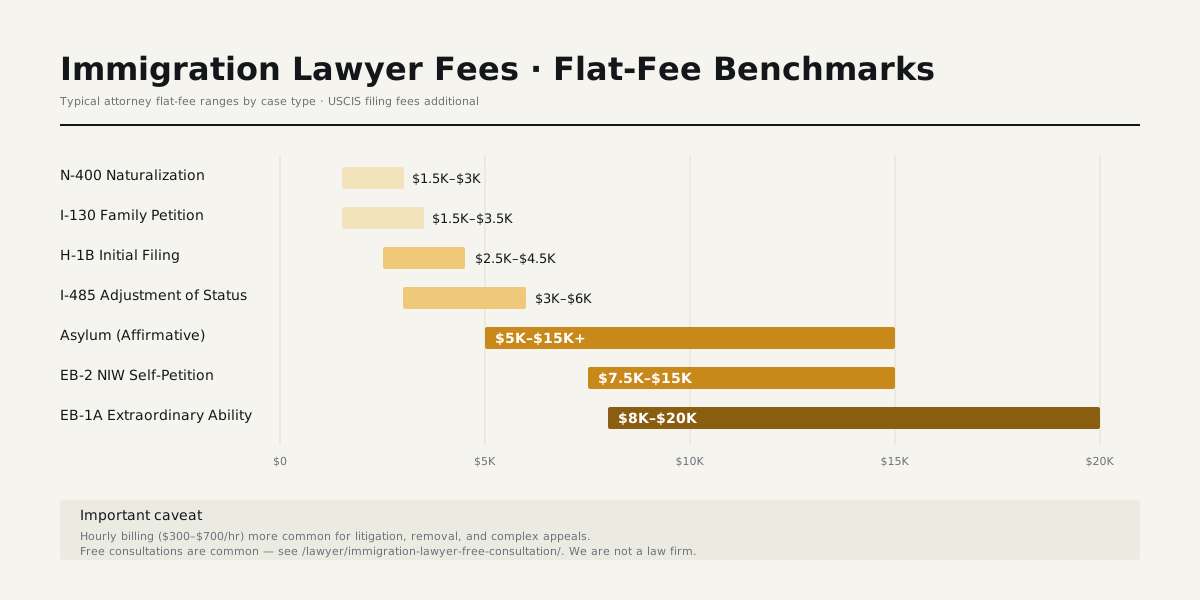
Predictable filings — H-1B initial, H-1B extension, I-130 spouse, I-485 adjustment, naturalization N-400 — are usually flat-fee. The engagement letter should specify what's included (e.g. one RFE response, one USCIS interview prep) and what triggers additional billing (e.g. NOID response, BIA appeal). Government filing fees (USCIS / DOL) are separate and paid directly to the agency on Form G-1450 or the online USCIS account.
Hourly (Litigation, Appeals, Complex Eligibility)
Removal defense, BIA appeals, federal-court litigation, and unusually complex EB-1A or asylum cases run hourly because scope is unpredictable. Hourly rates for immigration attorneys typically span $250-$700/hour by geography and seniority.
Hybrid Phase-Based
EB-2 NIW, EB-1A, and PERM-plus-I-140 packages are increasingly billed in phases: a flat fee per phase (research / endeavor statement / I-140 drafting), with hourly billing for unforeseen events (NOID, federal-court litigation). The engagement letter should be explicit about phase boundaries and the trigger events that move from one phase to the next.
Engagement-Letter Red Flags
The engagement letter is the contract. Anything not in writing is not part of the deal.
- "Outcome guarantee" language. No US-licensed attorney can guarantee a USCIS approval. Outcome promises violate professional-conduct rules in every state.
- No scope definition. "Handle the case" is not scope. The letter should list specific deliverables: forms to file, supporting documents to draft, RFE responses included or excluded, premium-processing decision authority.
- No fee schedule for adjacent work. What if USCIS issues a NOID? What if a Notice of Appeal is needed? Adjacent work hourly rate or flat-fee should be in the original letter.
- No refund clause. If the case is withdrawn before filing, what portion of the flat fee is refunded? If the firm withdraws representation, what's owed?
- No identified attorney of record. Who, by name, is responsible for the file? "Our team" is not an answer.
Alternatives to Hiring a Private Attorney
Pro Se Filing (Self-Representation)
Many forms — N-400, I-130, I-90, I-765 OPT — are filed pro se by applicants every day. USCIS form instructions are written for self-filers. The trade-off is research time and the risk that a procedural mistake triggers an RFE or denial. For straightforward cases without prior denials, criminal history, or complex eligibility issues, pro se is a real option.
EOIR-Recognized Non-Profits
Catholic Charities, the Catholic Legal Immigration Network (CLINIC), the International Rescue Committee, the American Friends Service Committee, and many regional non-profits hold EOIR recognition. Their accredited representatives can file most non-litigation cases at low or no cost. Asylum, U-visa, T-visa, and SIJS cases are common case types.
Law-School Immigration Clinics
Most law schools in major cities run immigration clinics. Cases are handled by supervised law students with faculty oversight; they tend to take complex cases (asylum, SIJS, deportation defense) at no fee. The trade-off is timeline — student turnover means a one-semester case may need re-staffing.
Lead-Gen Platforms with Pre-Screening
Platforms like Boundless and Lawfully pre-screen attorneys for active bar status and case-type experience. They are not law firms; they refer to attorney partners, who carry independent malpractice coverage. Read each platform's vetting policy and fee structure before relying on the directory.
Communication Cadence and File Ownership
Immigration cases run for months or years. Communication norms matter as much as legal skill:
- Response-time SLA — 24-48 business hours is standard; over a week is a red flag.
- Update cadence — proactive USCIS-status updates monthly vs reactive on-request.
- Attorney of record vs paralegal-only contact — for a complex case, paralegal-only contact post-engagement is a downgrade.
- Language fit — many firms have multilingual paralegals and attorneys; if your case turns on translated affidavits or non-English evidence, language fit reduces friction.
Cross-Pillar Reading
- Lawyer pillar hub · evaluation framework across specializations
- Immigration lawyer cost · 2026 fee benchmarks by case type
- Immigration lawyer fees · flat-fee vs hourly vs hybrid
- Free consultation · scope, what to bring, signal value
- EB-2 NIW lawyer · Dhanasar specialists
- Asylum lawyer · affirmative vs defensive cases
- Deportation defense lawyer · EOIR removal proceedings
- Best immigration lawyer near me · why geography is the wrong frame
Bottom line
Decision framework: bar status verified, case-type volume in general US immigration matters, written fee scope, transparent communication policy. Skip outcome guarantees and unverifiable success rates.
Frequently asked questions
- Where can I find low-cost or pro-bono immigration help?
- Try EOIR-recognized organizations first; many large cities also have law-school clinics that take on complex cases at low or no cost. The American Bar Association's pro-bono directory is another starting point.
- How much does an immigration lawyer cost for immigration lawyer?
- Attorney fees vary widely by case complexity and geography. Routine filings (H-1B, I-130, OPT EAD) are typically flat-fee in the low thousands; complex EB-2 NIW, EB-1A, or asylum cases run higher and may include phase-based billing.
- How do I know if an immigration attorney is licensed?
- Verify bar admission through the state bar association's online directory in the state where the attorney practices. The American Immigration Lawyers Association (AILA) member directory at aila.org is also a useful (but non-exclusive) starting point.
- What questions should I ask before hiring?
- Specifics first: case-type volume, success rate (which can be hard to verify), engagement letter terms, communication policy, and which attorney or paralegal does the actual drafting. General experience claims are less informative than category-specific track records.
- Are flat fees or hourly billing better?
- Flat fees are common for predictable form filings (H-1B, I-130, naturalization) where the workload is bounded. Hourly billing is standard for litigation, appeals, RFE responses with novel issues, and consular matters with unpredictable complications.