E-3 Visa: Australian Specialty Workers, 10,500 Cap, and Spouse Work Authorization
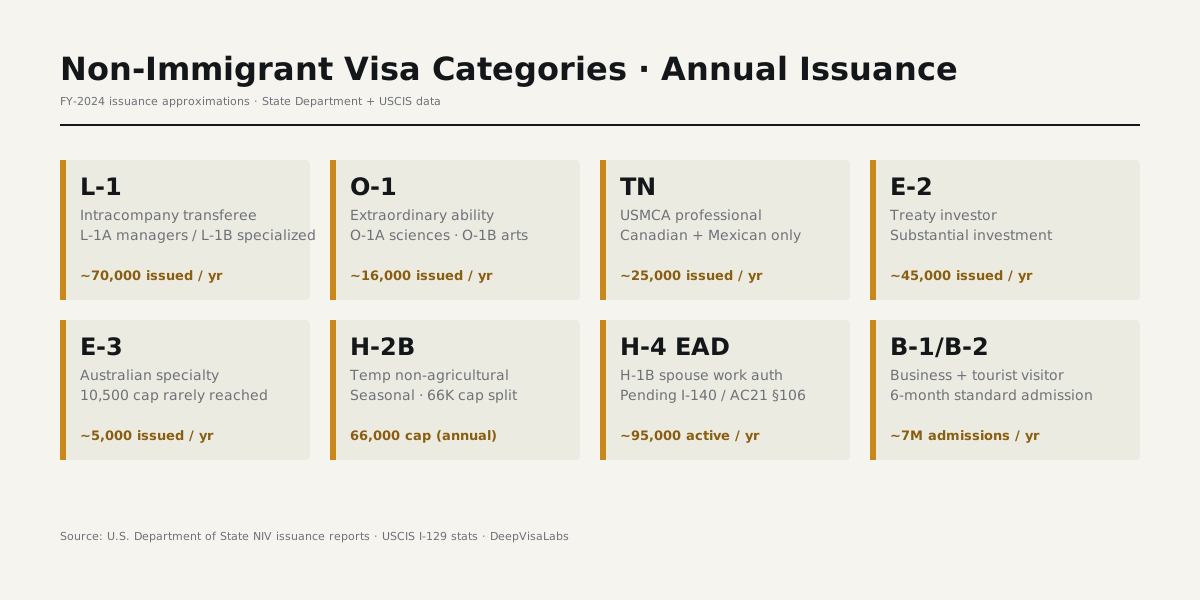
E-3 is the specialty-occupation visa exclusively for Australian nationals. Annual cap of 10,500 (rarely reached), LCA-based wage compliance like H-1B, biennial renewals (no maximum stays). E-3D spouses get unrestricted work authorization without separate EAD application.
What the E-3 Visa Is
E-3 is a specialty-occupation visa exclusively for Australian nationals. Created by the US-Australia Free Trade Agreement of 2005, it parallels H-1B in structure but with significantly more favorable mechanics. See USCIS E-3 guidance.
E-3 fits the same use cases as H-1B (specialty-occupation employment) but applies only to Australian citizens.
The 10,500 Annual Cap
E-3 has a separate annual cap of 10,500 (not subject to H-1B's 65,000 + 20,000 cap). The cap has rarely been reached in recent years — typical annual usage runs 5,000–8,000. There's no lottery; petitions are processed first-come-first-served until the annual cap is hit.
If the cap is exhausted in a fiscal year, additional petitions queue for the next fiscal year. This is structurally rare — Australian E-3 demand has historically remained below cap.
LCA and Specialty-Occupation Requirements
Like H-1B, E-3 requires a certified Labor Condition Application from DOL FLAG. The position must be a specialty occupation (typically requiring a US bachelor's degree or equivalent in a specific field). Wage compliance and posting requirements mirror H-1B.
The beneficiary must be an Australian citizen and must hold the credentials matching the specialty. Permanent residents of Australia who aren't citizens don't qualify.
Application Process
Two paths: (1) consular processing — apply at a US consulate (typically Sydney or Melbourne) with DS-160 + LCA; (2) change of status / extension via Form I-129 with USCIS while in valid US status.
Consular processing is the standard initial path. The DS-160 form, certified LCA, and employer support letter are the core documents. Premium processing is not available for consular E-3 issuance but is available for I-129 E-3 filings with USCIS.
Validity and Renewals
E-3 initial validity is up to 2 years; renewals are 2-year increments and are renewable indefinitely. There is no statutory maximum cumulative time — Australians can hold E-3 status for 20+ years if employment continues.
Each renewal requires a fresh LCA and extended employer attestations. The renewal can be done either via consular processing on the next entry or via I-129 extension with USCIS.
E-3D Spouse Work Authorization
E-3D (E-3 dependent) spouses receive automatic work authorization upon admission — no separate EAD application required. This is a structural advantage over H-4 dependents, who need an I-765 EAD with eligibility conditions.
E-3D children under 21 receive E-3 dependent status but not work authorization. E-3D spouses can work for any employer, multiple employers concurrently, or be self-employed — open work authorization.
Why E-3 Beats H-1B for Australians
For qualifying Australian beneficiaries, E-3 is structurally better than H-1B: lower competition (10,500 cap rarely full), automatic spouse work authorization, indefinite renewals (no 6-year cap), no lottery, year-round filing. The only advantage of H-1B for Australians is dual-intent recognition under §214(h), but E-3 dual intent is increasingly accepted.
Most Australian beneficiaries should pursue E-3 over H-1B. The H-1B lottery selection rate (~25–30%) makes the path comparison even more lopsided.
Cross-Pillar Reading
- H-1B Extension · alternative for non-Australians
- L-1 Visa · multinational transferee alternative
- O-1 Visa · extraordinary-ability alternative
- TN Visa · USMCA professional alternative
- H-1B Sponsorship · LCA mechanics (parallel for E-3)
Bottom line
Verdict: E-3 dominates H-1B for Australian beneficiaries. Lower competition (10,500 cap rarely full), automatic spouse work authorization, indefinite renewals. The path is structurally easier than H-1B; only Australian citizenship gates eligibility.
Frequently asked questions
- Does E-3 allow dual intent?
- INA §214(b) presumes nonimmigrant intent for most categories; INA §214(h) carves exceptions for H-1B and L-1. Other categories must demonstrate intent to depart at the end of authorized stay — though pursuing immigration through I-140/I-485 doesn't automatically disqualify.
- Can my spouse work on E-3?
- Work-authorization for spouses varies. L-2 and E-3D/E-2 spouses: automatic. O-3, TN-D, H-4 (H-2B): no general work authorization. Spousal benefit is a significant differentiator between categories.
- Is premium processing available for E-3?
- For E-3 petitions filed via I-129, premium processing is available. Cost: $2,805. SLA: 15 calendar days. RFE issuance pauses the clock; resumption upon response.
- What evidence does USCIS expect for E-3?
- Standard package: Form I-129, certified LCA (where required), beneficiary credentials, employer support letter, qualifying corporate relationship docs (L-1), advisory opinion (O-1), or treaty-country citizenship proof (E-2/E-3). Each category has its own evidence framework in 8 CFR §214.2.
- Who can sponsor a E-3 visa?
- E-3 sponsorship rules vary by category — some require employer sponsorship (L-1, H-2B), others can be agent-petitioned (O-1), some are self-sponsored at the port (TN for Canadians) or based on individual qualification (E-2 investor).
Sources
- https://www.uscis.gov/working-in-the-united-states/temporary-workers/e-3-specialty-occupation-workers-from-australia
- https://travel.state.gov/content/travel/en/us-visas/employment/specialty-occupations-e3.html
- https://flag.dol.gov/programs/lca
- https://www.uscis.gov/i-129
- https://egov.uscis.gov/processing-times/