FBAR (FinCEN Form 114): $10K Threshold, BSA E-Filing, and Penalty Tiers
The FBAR threshold is $10,000 aggregate across all foreign accounts during the year. Filing is annual via the BSA E-Filing System; the due date is April 15 with an automatic extension to October 15.
What FBAR Is
FBAR — FinCEN Form 114, "Report of Foreign Bank and Financial Accounts" — is a Treasury Department filing required of US persons with foreign accounts whose aggregate value exceeded $10,000 at any point during the calendar year. Filed with FinCEN, separately from the IRS tax return.
See FinCEN FBAR guidance. The legal authority is the Bank Secrecy Act, not the Internal Revenue Code — FBAR is a financial-reporting requirement, not a tax requirement.
The $10,000 Aggregate Threshold
The trigger is $10,000 in aggregate foreign account value at any point during the calendar year. Aggregate means summed across all foreign accounts — a $6,000 account plus a $5,000 account triggers FBAR even though neither alone exceeds $10,000.
"At any point" is strict — even one day's peak balance over $10,000 triggers reporting for the full year. Filers with fluctuating balances should track high-water marks throughout the year.
Who Counts as a US Person
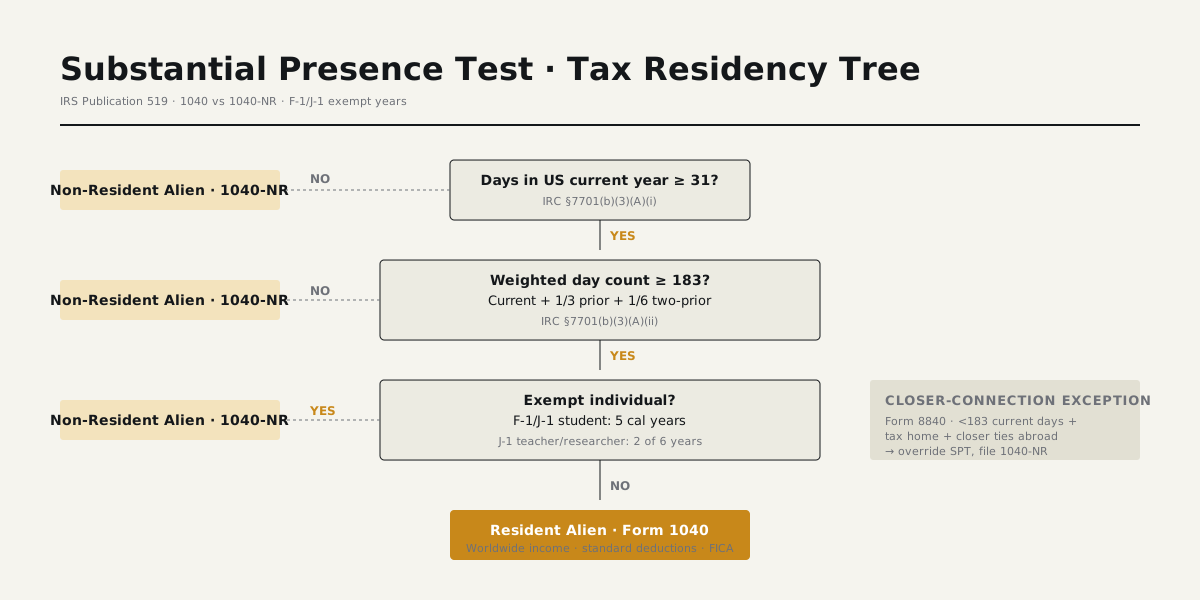
FBAR's reach extends to "US persons": US citizens, green-card holders, and SPT-residents (those who pass the Substantial Presence Test). Pure non-resident aliens are typically not US persons for FBAR purposes — they're outside the filing requirement.
NRAs become US persons when they pass SPT, transition from 1040-NR to 1040 filing, and gain FBAR obligation. F-1 students typically become US persons in their 6th calendar year. Days in NRA status do not count for FBAR purposes.
What Counts as a Foreign Account
Reportable accounts include: foreign bank accounts (checking, savings, time deposits), foreign mutual funds (especially Indian mutual funds, which are often passive foreign investment companies), foreign brokerage accounts, foreign retirement accounts (some excluded under treaty; varies), foreign-issued life insurance with cash value.
Not reportable: US accounts, foreign branches of US banks, accounts held in your own name at US institutions even if the underlying assets are foreign-currency-denominated.
Filing Process and Deadlines
FBAR is filed via the BSA E-Filing System. Due date is April 15 with an automatic extension to October 15 (no Form 4868 needed). The extension is automatic for FBAR — no separate action required.
Filers report each foreign account separately with: account number, type, financial institution, country, and maximum value during the year. Joint accounts can be reported once per filer.
Penalty Tiers
FBAR penalties are severe and tier into willful vs non-willful:
- Non-willful: up to $10,000 per violation per year (subject to inflation adjustment)
- Willful: greater of $129,210 (2024) or 50% of account balance, per violation per year
- Criminal (egregious): up to $500,000 fine and 10 years imprisonment
The IRS has reduced-penalty programs (Streamlined Filing Compliance Procedures, Delinquent FBAR Submission Procedures) for filers correcting prior non-willful failures.
FATCA Form 8938 vs FBAR
Form 8938 (FATCA — Foreign Account Tax Compliance Act) is a separate IRS filing also covering foreign accounts. It has higher thresholds ($50,000+ for single filers in US; higher for joint or non-US-resident) and is filed with the IRS tax return rather than FinCEN.
Many filers must do both FBAR (over $10,000 aggregate) and 8938 (over $50,000 single). Software like Sprintax or H&R Block handles 8938; FBAR requires separate FinCEN filing.
Cross-Pillar Reading
- Substantial Presence Test · FBAR triggers when SPT-resident
- Form 1040-NR · NRA filing (no FBAR for pure NRAs)
- Sprintax Tax Software · 1040-NR / Form 8938 prep
- H-1B Tax Calculator · take-home estimator
Bottom line
Practical guidance: nail down resident-vs-non-resident status (SPT result + treaty tie-breaker), then map US-source effectively-connected income onto 1040-NR. FDAP income flows on Schedule NEC at 30% (or treaty-reduced rate).
Frequently asked questions
- What is the difference between Form 1040 and 1040-NR?
- Form 1040 is for US tax residents (citizens, green-card holders, and substantial-presence-test residents); 1040-NR is for non-resident aliens. NRAs cannot take the standard deduction (except India treaty students), cannot file head of household, and have limited credits.
- How does the substantial presence test work?
- The substantial presence formula runs across 2023, 2024, and 2025. Exempt individuals — F-1 / J-1 students for the first 5 calendar years, J-1 / Q-1 trainees / teachers / researchers for the first 2 of the past 6 — do not count their days.
- Are F-1 / J-1 students subject to FICA tax?
- Students on F-1 / J-1 / M-1 / Q-1 are FICA-exempt during the period they are non-resident aliens. Once they pass SPT and become tax residents (commonly the 6th calendar year for F-1), FICA applies on subsequent wages.
- What if FICA was withheld in error from my OPT or CPT wages?
- First request a refund directly from your employer. If the employer cannot or will not refund, file Form 843 (Claim for Refund and Request for Abatement) with the IRS, attaching Form 8316, your I-94, EAD, and employer correspondence showing the refund request.
- What is the India treaty Article 21(2)?
- India treaty Article 21(2) provides that students and business apprentices from India may use the standard deduction worksheet for their 1040-NR — $15,750 single in 2025. The election is made on Schedule A of 1040-NR.
Sources
- https://www.fincen.gov/report-foreign-bank-and-financial-accounts
- https://bsaefiling.fincen.treas.gov/
- https://www.irs.gov/businesses/small-businesses-self-employed/report-of-foreign-bank-and-financial-accounts-fbar
- https://www.irs.gov/forms-pubs/about-publication-519
- https://www.fincen.gov/sites/default/files/shared/FBAR%20Line%20Item%20Filing%20Instructions.pdf