Sprintax for Non-Resident Tax Filing: Pricing, Coverage, and Alternatives
Sprintax is the IRS-authorized tax-prep software widely used by F-1 / J-1 / non-resident filers because TurboTax does not support Form 1040-NR. It computes 1040-NR, 8843, and treaty claims; many universities provide a license code for enrolled international students.
What Sprintax Is
Sprintax is the IRS-authorized tax-prep software widely used by F-1 / J-1 / non-resident alien filers. It's purpose-built for Form 1040-NR filings, which TurboTax and H&R Block don't support. Sprintax computes 1040-NR, Form 8843, and treaty claims.
Many universities provide a free Sprintax license code for enrolled international students through their International Student Office. Without a code, individual filers pay $50–80 for federal + state.
Coverage and Pricing
Sprintax handles federal 1040-NR filing for $50.95 (typical 2026 pricing) with state filings as add-ons (~$45 per state). Form 8843 is included free for filers with no income who need only the SPT exempt-individual statement.
FICA refund Form 843 + Form 8316 is supported. Treaty claims (India Article 21(2), China Article 19, etc.) are handled automatically based on country / visa status inputs.
Sprintax vs TurboTax
TurboTax does not support 1040-NR. Filing 1040 (resident return) when you should file 1040-NR creates IRS issues: incorrect tax computation, lost FICA-exempt status during F-1 years, missed treaty benefits, and potential audit / amended-return requirements.
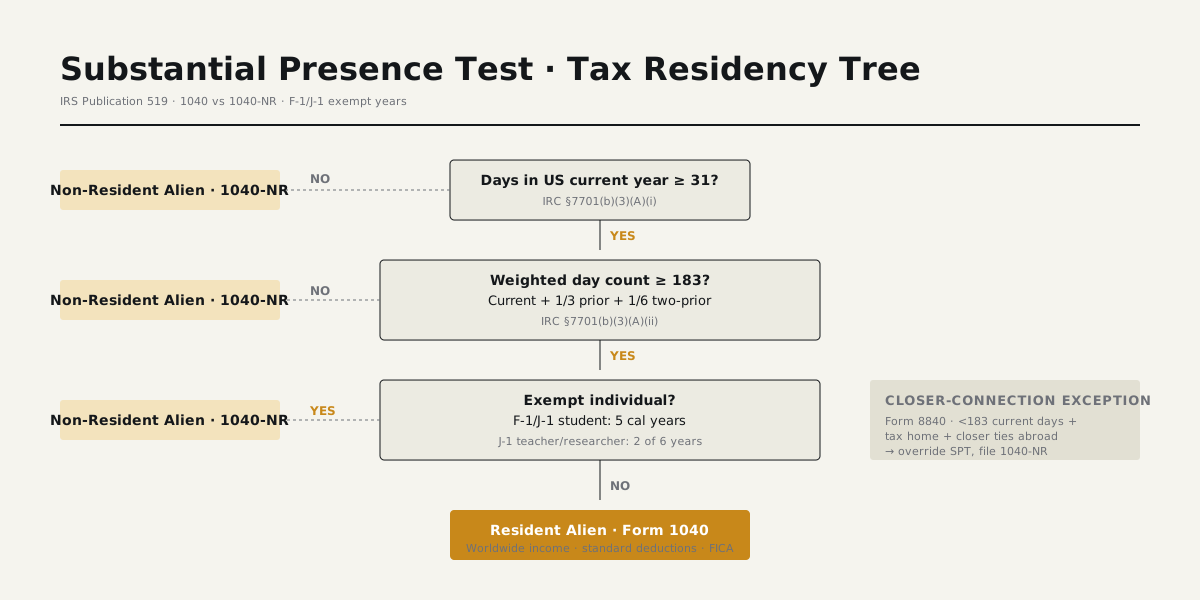
F-1 students in their first 5 calendar years are typically non-residents and must file 1040-NR. Using TurboTax in this period is incorrect filing — switch to Sprintax or another non-resident-capable product.
GLACIER Tax Prep Alternative
Some universities provide GLACIER Tax Prep instead of (or in addition to) Sprintax. GLACIER is similarly purpose-built for non-resident filers and handles 1040-NR, 8843, and treaty claims. It's typically free when provided by the school.
Functionally, Sprintax and GLACIER cover the same territory. The choice is usually determined by which one your university licenses. Quality is comparable.
When Sprintax Isn't Enough
Sprintax handles the standard NRA filing flow but not edge cases: dual-status returns (residents during part of the year), complex treaty interactions, foreign-account reporting (FBAR / Form 8938), or significant capital-gains income with cost basis from foreign brokers.
For complex situations, work with a CPA experienced in international tax. Sprintax can produce an initial return that the CPA reviews, or you can file directly with CPA preparation.
Cross-Pillar Reading
- Form 1040-NR · the underlying form Sprintax prepares
- Substantial Presence Test · resident vs non-resident determination
- FBAR (FinCEN Form 114) · foreign-account reporting
- H-1B Tax Calculator · in-house take-home estimator
Bottom line
Bottom line: confirm your residency status (SPT or treaty) first, then walk through Form 1040-NR and any treaty form (8833) line by line. Software like Sprintax or GLACIER Tax Prep is built for the non-resident path.
Frequently asked questions
- Do I need to file FBAR as a non-resident alien?
- FBAR triggers when you are a US person — defined more broadly than just citizens. Becoming a US tax resident (via SPT) makes you a US person for FBAR. Days you held NRA status do not count toward FBAR.
- What is the deadline for tax year 2025?
- For non-resident aliens, the 2025 return is due April 15, 2026 if you had W-2 wages subject to US withholding, and June 15, 2026 otherwise. Form 4868 grants an automatic six-month extension to October 15, 2026. Form 8843 follows the same deadline as 1040-NR (or April 15 / June 15 for 8843-only filers).
- Who needs to file Form 1040-NR?
- You file 1040-NR if you are an NRA with US-source effectively-connected income, or if you have US-source FDAP income that was not fully withheld. Estate, trust, and partnership rules also have specific 1040-NR filing requirements.
- What is the difference between Form 1040 and 1040-NR?
- Residents (1040) and non-residents (1040-NR) follow different rule sets: 1040-NR has restricted standard deduction, no head-of-household, limited child / earned-income credits, and a separate schedule for FDAP withholding.
- How does the substantial presence test work?
- SPT counts 2025 days fully, prior-year days at one-third weight, and second-prior-year days at one-sixth. If the sum reaches 183 and you had at least 31 days in 2025, you are a US tax resident — unless you qualify as an exempt individual.