Substantial Presence Test (SPT): 31-Day + 183-Day Formula and Exempt Individuals
The Substantial Presence Test counts US days across three years: all of 2025, one-third of 2024, and one-sixth of 2023. If the weighted total is 183 or more (and you were present at least 31 days in 2025), you are a US tax resident for 2025.
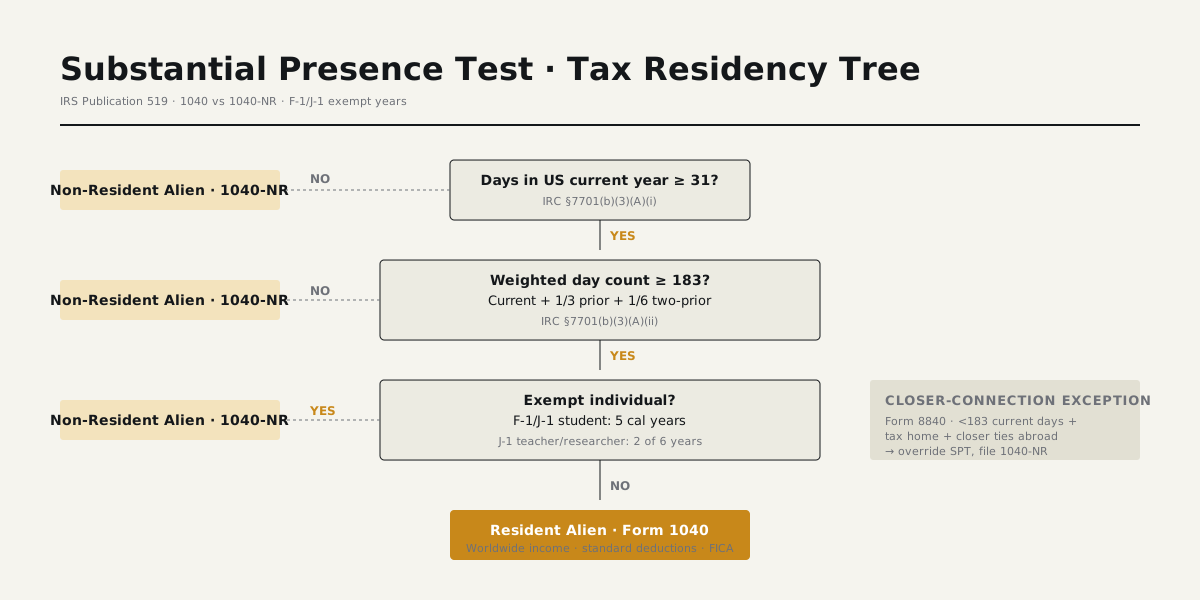
What the SPT Determines
The Substantial Presence Test determines whether a foreign national is a US tax resident or non-resident alien for a given tax year. Per IRS guidance, residents file Form 1040 on worldwide income; non-residents file 1040-NR on US-source effectively-connected income.
SPT is a counting test — it doesn't depend on visa status directly, though some visa holders are "exempt individuals" whose days don't count.
The Two-Prong Test
To meet SPT, both prongs must be satisfied:
- At least 31 days physical presence in the United States in the current year
- Weighted three-year total ≥ 183 days: full days in current year + (days in prior year / 3) + (days in second-prior year / 6)
If both prongs are met, the filer is a US tax resident for that year. Otherwise, non-resident alien status applies.
Exempt Individuals
Some individuals' days don't count toward SPT, regardless of physical presence. Per IRS exempt-individual rules:
- F-1 students: exempt for the first 5 calendar years
- J-1 / Q-1 students: exempt for the first 5 calendar years
- J-1 / Q-1 trainees / teachers / researchers: exempt for the first 2 of the past 6 calendar years
- Foreign government / international organization workers: exempt as long as in qualifying status
Exempt status requires filing Form 8843 even with no income — the form documents the exempt-individual claim.
Worked Example — F-1 Student
Sara is on F-1 from August 2021 through December 2026. Her exempt-individual period: 2021, 2022, 2023, 2024, 2025 (5 calendar years). Days in 2026 are no longer exempt.
For tax year 2026: she has 365 days physical presence (still in F-1). 2025 doesn't count (exempt). 2024 doesn't count (exempt). SPT calculation: 365 (2026) + 0 (2025 exempt) + 0 (2024 exempt) = 365 ≥ 183. Sara becomes a US tax resident in 2026.
Implications of Becoming a Tax Resident
Once SPT is met, the filer transitions from 1040-NR to 1040. Key impacts: worldwide income (not just US-source) becomes taxable, FICA exemption ends (Social Security + Medicare apply on subsequent wages), FBAR filing may be required if foreign accounts exceed $10,000.
Year of transition can be split: dual-status filer files both 1040-NR (for non-resident portion) and 1040 (for resident portion), or makes a §6013(g)/(h) election. See IRS Publication 519 for transition-year rules.
Treaty Tie-Breaker
Bilateral tax treaties may override SPT result. Most US tax treaties include a "tie-breaker" provision determining residency when both countries claim the filer. Tie-breaker tests look at: permanent home availability, center of vital interests, habitual abode, and citizenship.
Treaty tie-breaker can let an SPT-resident filer claim non-resident status for treaty purposes — typically used by short-term assignees who don't intend to remain in the US long-term.
Cross-Pillar Reading
- Form 1040-NR · non-resident filing form
- Sprintax Tax Software · NRA filing tool
- FBAR · triggered when SPT-resident
- H-1B Tax Calculator · take-home estimator with FICA toggle
Bottom line
Verdict: Substantial Presence Test is governed by IRS Publication 519 and the Form 1040-NR instructions. Treaty claims and exempt-individual status can shift outcomes meaningfully — verify against the instructions for the relevant tax year.
Frequently asked questions
- What is the India treaty Article 21(2)?
- Article 21(2) of the US–India Income Tax Treaty lets Indian students and business apprentices in the US claim the standard deduction on Form 1040-NR — $15,750 for single filers in tax year 2025 (2026 filing season). Other NRAs cannot take the standard deduction.
- Do I need to file FBAR as a non-resident alien?
- FBAR triggers when you are a US person — defined more broadly than just citizens. Becoming a US tax resident (via SPT) makes you a US person for FBAR. Days you held NRA status do not count toward FBAR.
- What is the deadline for tax year 2025?
- Non-resident filers: April 15, 2026 if you had W-2 wages, June 15, 2026 otherwise. Extensions via Form 4868 are automatic. FBAR (FinCEN 114) is also April 15 with auto-extension to October 15.
- Who needs to file Form 1040-NR?
- Form 1040-NR is required for non-resident aliens engaged in a US trade or business (including most W-2 wages), and for those with US-source income that needs treaty exemption claims. Students in exempt status still file Form 8843 even with no income.
- What is the difference between Form 1040 and 1040-NR?
- 1040 covers worldwide income for US residents; 1040-NR covers only US-source effectively-connected income (and certain FDAP) for non-residents. Filing status options, deductions, and credits differ substantially.
Sources
- https://www.irs.gov/individuals/international-taxpayers/substantial-presence-test
- https://www.irs.gov/forms-pubs/about-publication-519
- https://www.irs.gov/individuals/international-taxpayers/exempt-individuals-students
- https://www.irs.gov/forms-pubs/about-form-8843
- https://www.irs.gov/forms-pubs/about-form-1040-nr