H-1B Tax Filing: Resident vs Non-Resident, FICA, State Tax, and Treaty Election
H-1B tax filing sits inside the non-resident tax framework: 1040-NR for income tax, 8843 for exempt individuals, treaty claims via 8833, and FBAR (FinCEN 114) for foreign accounts above $10,000.
H-1B Tax Status: Almost Always Resident
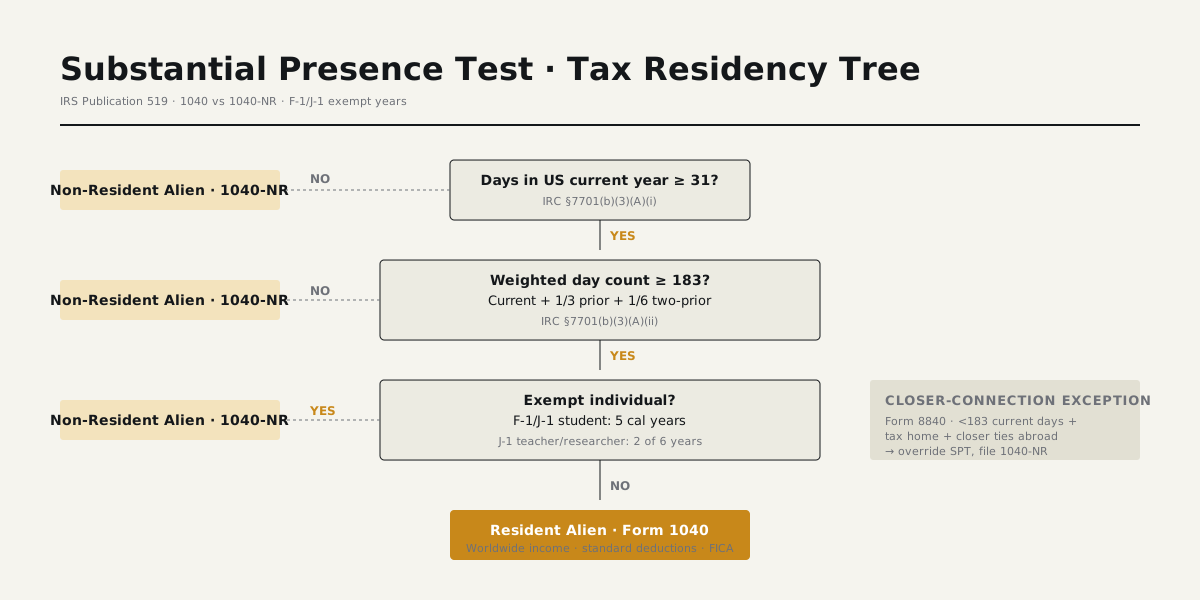
For US federal tax purposes, H-1B holders are classified by the substantial presence test, not by visa category. Once an H-1B beneficiary meets substantial presence — 31+ days in the current year and 183+ weighted days over 3 years — they are US tax residents. Most H-1B holders meet the test in their first full calendar year of US presence and remain residents for the duration of H-1B status.
Resident-alien H-1B holders file Form 1040 (not 1040-NR), report worldwide income, and qualify for the standard deduction, all credits, and head-of-household status. The full IRS Publication 519 explains the alien-tax framework.
The First-Year Dual-Status Wrinkle
H-1B beneficiaries arriving mid-year often file dual-status returns for their first year. Example: arrival on October 1 with 90 days remaining in the calendar year — even with carryover days, substantial presence may not be met by December 31 of arrival year. The beneficiary files 1040-NR for the arrival year covering only US-source income while present.
The First-Year Choice election under IRC §7701(b)(4) lets a beneficiary who would otherwise be NRA in the arrival year elect to be treated as a resident from the date of US presence onward — provided substantial presence is met in the following year. The election triggers worldwide-income reporting from the election date but unlocks resident-tax benefits (standard deduction, joint filing if married).
Full FICA Liability
H-1B beneficiaries are subject to full FICA tax — Social Security (6.2% on wages up to the annual wage base, $168,600 for 2025) and Medicare (1.45% on all wages, plus 0.9% Additional Medicare Tax above $200,000 for single filers). Unlike F-1 / J-1 nonresident students, H-1B beneficiaries do not qualify for the FICA exemption under IRC §3121(b)(19).
Employer-paid FICA mirrors the employee portion (6.2% + 1.45%). The combined 15.3% FICA burden is automatically withheld and reported on Form W-2 Box 4 (Social Security) and Box 6 (Medicare). H-1B holders generally cannot recover FICA paid via tax filing — the FICA tax is independent of income tax.
State Tax Residency
State income tax residency is governed by state-specific rules, not federal substantial presence. Most states use a "domicile + statutory residency" test: domicile (intent to make the state your permanent home) plus 183+ days of physical presence in the state. H-1B holders working full-time in California, New York, or other high-tax states typically owe state income tax on their full wages.
States with no income tax: Alaska, Florida, Nevada, New Hampshire (interest/dividends only), South Dakota, Tennessee, Texas, Washington, Wyoming. Beneficiaries working remotely in low-tax or no-tax states may reduce state tax liability — but employer payroll setup and state-source rules can complicate the picture.
Joint Filing for Married H-1B Holders
Married H-1B beneficiaries can file jointly with their spouse if both are US tax residents (or if the NRA spouse elects to be treated as a resident under IRC §6013(g)/(h)). Joint filing typically reduces overall tax via the joint standard deduction ($31,500 for tax year 2025) and lower marginal brackets compared to married-filing-separately.
Joint filing requires both spouses to report worldwide income — which affects beneficiaries with foreign-source income (rental income, interest, dividends, foreign business income). Foreign tax credit (Form 1116) typically prevents double taxation, but the reporting overhead is significant.
Tax Treaty Benefits for H-1B
Most US tax treaties have "saving clauses" that limit treaty benefits for residents to specific articles only. The student / trainee articles (commonly used by F-1 / J-1) typically do not apply to H-1B beneficiaries who became US tax residents under substantial presence.
Treaty benefits that may still apply to H-1B residents: tie-breaker rules for dual-residency situations (e.g., when a beneficiary is also tax-resident in their home country), reduced withholding on certain types of foreign-source income, and Social Security totalization agreements (for beneficiaries from countries with US Social Security totalization treaties — Germany, UK, Japan, India, etc.). Per IRS treaty page.
Foreign Account Reporting (FBAR + Form 8938)
H-1B residents with foreign financial accounts exceeding $10,000 in aggregate value at any point during the year must file FBAR (FinCEN Form 114) annually with FinCEN — separate from the IRS tax return. FBAR is filed via the BSA E-Filing System and is due April 15 with automatic extension to October 15.
Form 8938 (Statement of Specified Foreign Financial Assets) is filed with the tax return and applies to H-1B residents with foreign assets exceeding $50,000 (single) or $100,000 (joint) at year-end, or higher thresholds at any point during the year. FBAR and Form 8938 are independent filings; both apply when thresholds are met.
Practical Filing Software
H-1B residents can use TurboTax, H&R Block, FreeTaxUSA, or any standard 1040 tax-prep software. Sprintax — typically used by F-1 / J-1 nonresidents for 1040-NR — is not necessary for H-1B residents, though Sprintax does support 1040 filings for the dual-status arrival-year scenario.
For complex situations — first-year dual-status, treaty positions, foreign-source income, FBAR / Form 8938 obligations — most beneficiaries benefit from professional preparation by a CPA familiar with international tax. The IRS offers Free File for AGI under $84,000 in 2025 via irs.gov.
Cross-Pillar Reading
- Tax Pillar · all immigration-tax topics
- Substantial Presence Test · day-counting walkthrough
- Non-Resident Alien · 1040-NR flip side
- FBAR · foreign account reporting threshold and filing
- H-1B Visa · category and immigration overview
Bottom line
Bottom line: confirm your residency status (SPT or treaty) first, then walk through Form 1040-NR and any treaty form (8833) line by line. Software like Sprintax or GLACIER Tax Prep is built for the non-resident path.
Frequently asked questions
- Do I need to file FBAR as a non-resident alien?
- Generally no. FBAR (FinCEN Form 114) applies to US persons — citizens, residents (including SPT-residents), and certain entities — with foreign accounts exceeding $10,000 in aggregate. NRAs are typically not US persons for FBAR purposes.
- What is the deadline for tax year 2025?
- Non-resident filers: April 15, 2026 if you had W-2 wages, June 15, 2026 otherwise. Extensions via Form 4868 are automatic. FBAR (FinCEN 114) is also April 15 with auto-extension to October 15.
- Who needs to file Form 1040-NR?
- You file 1040-NR if you are an NRA with US-source effectively-connected income, or if you have US-source FDAP income that was not fully withheld. Estate, trust, and partnership rules also have specific 1040-NR filing requirements.
- What is the difference between Form 1040 and 1040-NR?
- Residents (1040) and non-residents (1040-NR) follow different rule sets: 1040-NR has restricted standard deduction, no head-of-household, limited child / earned-income credits, and a separate schedule for FDAP withholding.
- How does the substantial presence test work?
- SPT counts 2025 days fully, prior-year days at one-third weight, and second-prior-year days at one-sixth. If the sum reaches 183 and you had at least 31 days in 2025, you are a US tax resident — unless you qualify as an exempt individual.
Sources
- https://www.irs.gov/publications/p519
- https://www.irs.gov/individuals/international-taxpayers/substantial-presence-test
- https://www.irs.gov/forms-pubs/about-form-1040
- https://www.irs.gov/individuals/international-taxpayers/tax-treaties
- https://www.irs.gov/businesses/small-businesses-self-employed/foreign-students-and-scholars