Non-Resident Alien Tax Status: Substantial Presence, 1040-NR, and Treaty Benefits
non-resident alien affects how non-resident aliens compute and file US tax for 2025. The core decision tree starts with the Substantial Presence Test (resident vs. non-resident), then layers Form 1040-NR rules, treaty claims, and information-reporting forms.
What Non-Resident Alien Status Means
For US federal tax purposes, individuals are classified as either US tax residents (citizens, lawful permanent residents, or those meeting the substantial presence test) or non-resident aliens. The classification determines which form to file (1040 for residents, 1040-NR for non-residents), what income is taxed, what deductions are allowed, and which treaty benefits apply.
The authoritative source is IRS Publication 519: U.S. Tax Guide for Aliens. NRA tax treatment differs from resident treatment in several material ways: only US-source income is taxed (not worldwide), no standard deduction (with India treaty exception), limited credits, no head-of-household filing status, and certain FICA exemptions for F-1 / J-1 / M / Q nonresident students.
The Substantial Presence Test
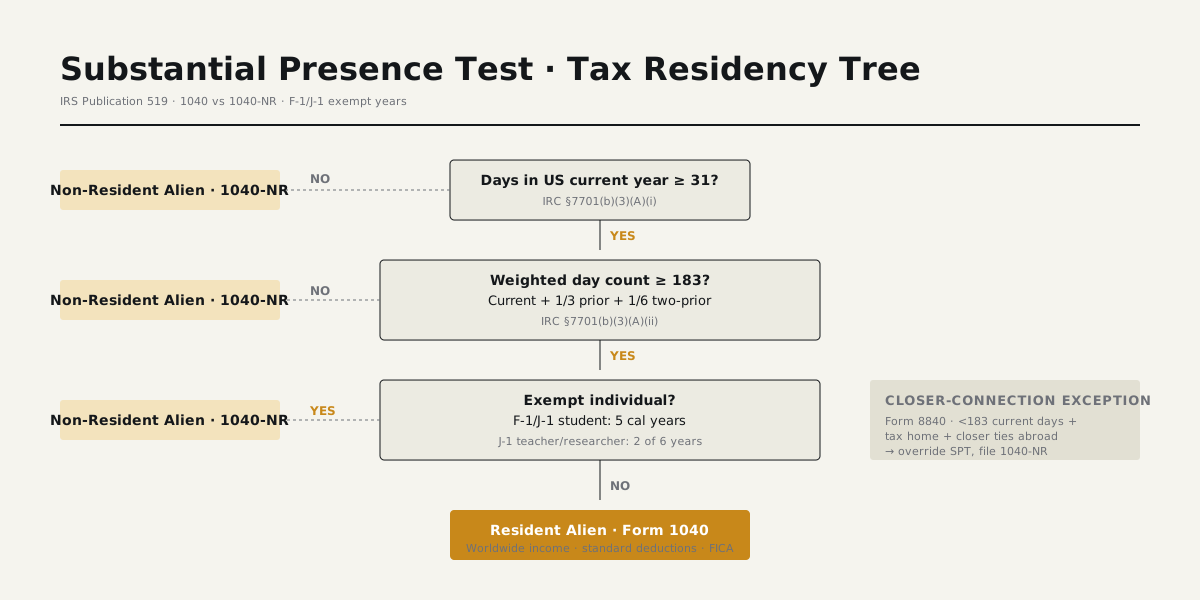
The substantial presence test is the primary residency determination for individuals without green cards. Under IRC §7701(b)(3), an individual is a US tax resident if they are physically present in the US for: (a) at least 31 days during the current year, AND (b) at least 183 days over a 3-year period weighted as follows — full days in the current year + 1/3 of days in the prior year + 1/6 of days in the year before that.
Example: 130 days in 2025 + 90 days in 2024 + 90 days in 2023 = 130 + 30 + 15 = 175 weighted days. Below 183 — non-resident for 2025. The test runs annually and one's status can change year-to-year. Beneficiaries who have been in the US for several years on H-1B or L-1 status almost always meet the test and are tax residents.
F-1 / J-1 Exempt Individual Status
F-1 / J-1 students and certain J-1 / Q-1 trainees, teachers, and researchers are "exempt individuals" — their days in the US do not count toward substantial presence for a fixed initial window. F-1 / J-1 students are exempt for the first 5 calendar years; J-1 / Q-1 teachers and trainees are exempt for the first 2 of the past 6 years.
Per IRS Foreign Students and Scholars page, the exempt-individual rule means F-1 students typically file 1040-NR for the first 5 years of US presence regardless of how many days they spend in the country. After 5 years, the substantial presence test applies normally.
Form 1040-NR Filing
Non-resident aliens file Form 1040-NR instead of Form 1040. Key 1040-NR differences:
- Only US-source effectively-connected income (ECI) is taxed at graduated rates
- FDAP income (interest, dividends, royalties) is taxed at a flat 30% (or treaty rate)
- No standard deduction (India treaty exception: students can claim $15,750 for tax year 2025)
- No head-of-household filing status
- No Earned Income Tax Credit
- Must include Schedule OI (information on visa status, days present in US)
Due dates: April 15 if the NRA had US-source W-2 wages; June 15 otherwise (with automatic extension to October 15 via Form 4868).
FICA Exemption for F-1 / J-1
F / J / M / Q nonresident students working on-campus, in CPT, or in OPT are exempt from FICA (Social Security and Medicare) tax under IRC §3121(b)(19). The exemption applies as long as the student remains in nonresident-alien status — typically the first 5 years for F-1 / J-1 students.
Employers sometimes erroneously withhold FICA from F-1 / J-1 students. The student can claim a refund by (1) requesting refund from the employer first, or (2) filing Form 843 with the IRS if the employer refuses. Documentation: Form W-2 showing FICA withheld, statement that the employer was asked for refund.
US Tax Treaty Benefits
The US has tax treaties with 60+ countries. Treaties typically provide reduced withholding rates on FDAP income (interest, dividends, royalties), exemption for student / trainee scholarships up to specific thresholds, exemption for short-term teacher / researcher income, and tie-breaker rules for dual-residency situations.
The most-used student treaty articles: India Article 21 (standard deduction for students), China Article 20 (up to $5,000 per year exemption), South Korea Article 21 (exemption for compensation up to $2,000 per year). Beneficiaries claim treaty benefits via Form 8233 (compensation) or Form W-8BEN (passive income), and report the position on Schedule OI of 1040-NR. Per IRS tax treaties page.
Dual-Status Tax Years
Beneficiaries who change residency status mid-year file dual-status returns: 1040-NR for the nonresident period and 1040 for the resident period. The two are stapled together with "Dual-Status Return" written on top. Each return covers only the income and deductions attributable to its respective period.
Common dual-status patterns: F-1 student finishing the 5-year exempt window mid-year (becomes resident on day 1 of year 6 if substantial presence is met), H-1B beneficiary arriving mid-year and meeting substantial presence by year-end, departing nonresident who leaves the US after meeting substantial presence earlier in the year.
State Tax Considerations
State taxation of NRAs varies by state and does not always align with federal rules. Most states tax NRAs based on physical presence and source-of-income rules independent of federal substantial presence. California, New York, and Massachusetts have particularly complex state-source rules; Florida, Texas, Washington, and Nevada have no state income tax.
NRAs working in California or New York typically face full state tax on US-source wages, even when the federal return is 1040-NR. State-source income rules do not have a treaty-benefit overlay — federal treaty exemptions do not flow through to state returns.
Cross-Pillar Reading
- Tax Pillar · all immigration-tax topics
- Substantial Presence Test · day-counting walkthrough
- Form 1040-NR · filing instructions and treaty election
- H-1B Tax Filing · resident-alien tax for H-1B holders
- Sprintax Review · NRA tax-prep software
Bottom line
Verdict: this filing is governed by IRS Publication 519 and the Form 1040-NR instructions. Treaty claims and exempt-individual status can shift outcomes meaningfully — verify against the instructions for the relevant tax year.
Frequently asked questions
- What is the deadline for tax year 2025?
- Non-resident filers: April 15, 2026 if you had W-2 wages, June 15, 2026 otherwise. Extensions via Form 4868 are automatic. FBAR (FinCEN 114) is also April 15 with auto-extension to October 15.
- Who needs to file Form 1040-NR?
- Form 1040-NR is required for non-resident aliens engaged in a US trade or business (including most W-2 wages), and for those with US-source income that needs treaty exemption claims. Students in exempt status still file Form 8843 even with no income.
- What is the difference between Form 1040 and 1040-NR?
- Residents (1040) and non-residents (1040-NR) follow different rule sets: 1040-NR has restricted standard deduction, no head-of-household, limited child / earned-income credits, and a separate schedule for FDAP withholding.
- How does the substantial presence test work?
- You meet SPT for 2025 if you were physically present in the US at least 31 days in 2025 AND the weighted three-year total (full 2025 days + 1/3 of 2024 + 1/6 of 2023) is at least 183. Days as an exempt individual (F / J / Q / certain government workers) do not count.
- Are F-1 / J-1 students subject to FICA tax?
- Students on F-1 / J-1 / M-1 / Q-1 are FICA-exempt during the period they are non-resident aliens. Once they pass SPT and become tax residents (commonly the 6th calendar year for F-1), FICA applies on subsequent wages.
Sources
- https://www.irs.gov/publications/p519
- https://www.irs.gov/forms-pubs/about-form-1040-nr
- https://www.irs.gov/individuals/international-taxpayers/substantial-presence-test
- https://www.irs.gov/individuals/international-taxpayers/foreign-students-and-scholars
- https://www.irs.gov/individuals/international-taxpayers/tax-treaties