L-1A Visa: Managerial / Executive Intracompany Transferee Standard
The L-1 intracompany transferee visa lets multinational employers transfer managers/executives (L-1A, up to 7 years) or specialized-knowledge employees (L-1B, up to 5 years) to a US office. Requires 1 of the past 3 years in continuous employment with the foreign affiliate. Dual intent is allowed.
Managerial / Executive Standard
L-1A is the executive / managerial branch of the intracompany-transferee program. The beneficiary must function in a "managerial capacity" or "executive capacity" both abroad and in the US — language defined in USCIS Policy Manual Volume 2, Part L.
"Managerial capacity" means primarily directing the management of the organization, a department, sub-division, function, or component. First-line supervisors only qualify if they supervise professional employees. "Executive capacity" means primarily directing the management at a high level with broad latitude in decision-making and only general supervision from higher-level executives, the board, or stockholders.
USCIS scrutinizes the actual day-to-day functions, not titles. A "manager" who spends most of the day on hands-on technical work generally fails the standard, even with direct reports.
Function Manager — The "No Direct Reports" Path
An L-1A beneficiary need not supervise other employees if they primarily manage an essential function within the organization. The function-manager standard requires the role to manage an indispensable function at a senior level within the organizational hierarchy and to operate with discretion over its day-to-day operations.
This is the path used for senior individual contributors at smaller US offices — but USCIS issues frequent RFEs asking for organizational charts, budget authority evidence, and clear separation between the beneficiary's strategic work and tasks performed by lower-level staff or vendors.
Qualifying Foreign Employment
The beneficiary must have been continuously employed by a qualifying foreign affiliate for at least 1 of the past 3 years immediately preceding the petition or US entry. The foreign role must have been in a managerial, executive, or specialized-knowledge capacity (for L-1A specifically, the role must be managerial or executive, not specialized knowledge).
Time spent in the US under other nonimmigrant categories tolls the 3-year lookback but does not count toward the 1-year foreign employment requirement. The qualifying corporate relationship — parent / subsidiary / branch / affiliate — is documented through ownership and control evidence on Form I-129 (L Classification Supplement).
The 7-Year Cumulative Cap
L-1A beneficiaries get an initial period of stay of up to 3 years (1 year for new-office L-1A), with extensions in 2-year increments up to a maximum of 7 years cumulative. After 7 years, the beneficiary must remain outside the US for a full year before becoming eligible for a new L-1 (or H-1B) period.
Time spent on H-1B and L-1 is aggregated under the recapture rules. Days physically outside the US during L-1A status — documented through I-94 records and travel stamps — can be recaptured to extend the 7-year cap. Form I-129 recapture filings should include a day-by-day spreadsheet of foreign travel.
New-Office L-1A — The 1-Year Initial Cap
When the US entity has been operational for less than 1 year at the time of filing, USCIS classifies the petition as a "new-office" L-1A. Initial approval is limited to 1 year. Extensions beyond year 1 are only granted on evidence of substantive business activity — typically revenue, hiring, lease commitments, and a reasonable projection of supporting an executive / managerial role.
New-office L-1A is the most RFE-prone L-1 sub-type. The standard fact pattern that fails: a one-person US office where the beneficiary is the sole employee, with no demonstrable plan to hire subordinate staff that the beneficiary will manage.
Premium Processing and Filing Fees
L-1A I-129 petitions are eligible for premium processing under Form I-907 at a $2,805 fee, providing a 15-business-day adjudication commitment. Premium does not improve the consular interview wait time — it only accelerates USCIS adjudication of the I-129 petition.
Standard I-129 base fee, the $500 anti-fraud fee, and the asylum program fee tier apply. Blanket L petitions filed by qualifying multinationals (Form I-129S consular processing) follow a parallel path that bypasses the I-129 stage at USCIS.
EB-1C: The L-1A to Green Card Path
L-1A maps cleanly to EB-1C for multinational managers and executives — no PERM labor certification required. The EB-1C standard largely tracks L-1A's managerial / executive definitions, which is why L-1A is sometimes called "EB-1C with training wheels."
Practitioners typically advise spending the first 1 year in L-1A consolidating evidence — organizational chart at time of filing, direct reports' CVs, budget authority documents — and filing the EB-1C I-140 in years 2-3. Dual intent is explicitly authorized for L-1 under INA §214(h), so EB-1C and concurrent or subsequent I-485 do not jeopardize L-1A renewals.
L-2 Spouse Work Authorization
L-2 spouses receive automatic work authorization upon admission as L-2S (USCIS 2022 policy update). No separate EAD application is required — the I-94 with L-2S annotation suffices for I-9 employment verification. This is a meaningful differentiator from H-4, where an EAD is required and limited to spouses of H-1B beneficiaries with approved I-140s.
L-2 children under 21 receive dependent status but no work authorization; they need a separate change of status (typically to F-1) before working.
Cross-Pillar Reading
- L-1 Visa Overview · L-1A vs L-1B side-by-side
- L-1B Visa · specialized-knowledge standard
- EB-1 Green Card · EB-1C immigrant path for multinational managers
- O-1 Visa · alternative for individuals with extraordinary ability
- USCIS Processing Times · current I-129 service-center windows
Bottom line
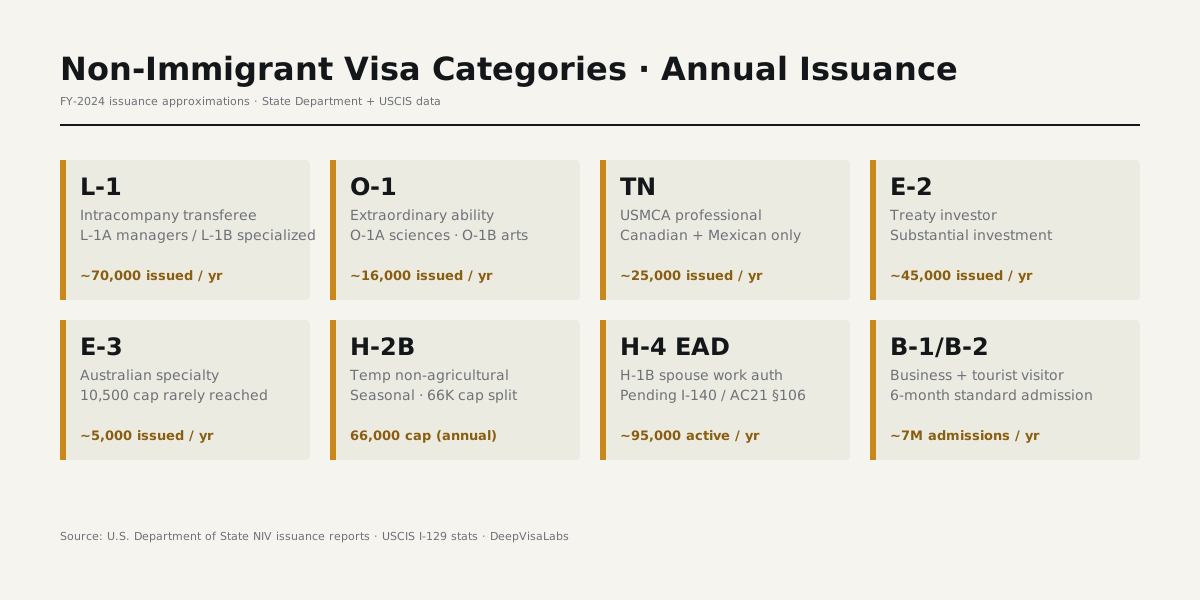
L-1A sits in the broader non-immigrant work-visa landscape. Each category has distinct eligibility, evidence, and validity-period rules — read the USCIS Policy Manual chapter and 8 CFR §214.2 sub-section before filing.
Frequently asked questions
- Who can sponsor a L-1A visa?
- Petitioning eligibility for L-1A depends on the role and beneficiary's relationship to the US entity. Most categories are employer-petitioned; some allow agent or self-petition arrangements.
- How long is the L-1A validity period?
- Each non-immigrant category has its own validity rules — see the USCIS Policy Manual or 8 CFR for the specific category's maximum stay and renewal patterns.
- Does L-1A allow dual intent?
- Dual-intent doctrine: L-1 and H-1B explicitly allowed; O-1 implicitly accepted; TN, E-3, H-2B require strict nonimmigrant intent. E-2 historically nonimmigrant but practitioners increasingly file AOS without issue.
- Can my spouse work on L-1A?
- Automatic spouse work authorization is one of the bigger underrated benefits — L-2 and E-3D both qualify. O-3, TN-D, and H-2B's H-4 spouses do not get general work authorization.
- Is premium processing available for L-1A?
- Premium processing (Form I-907) covers I-129 petitions for L-1A (where applicable) at $2,805 fee for 15-calendar-day adjudication. TN port-of-entry processing for Canadians does not need premium because adjudication is on-the-spot. E-2/E-3 visa stamping at consulates is separate from I-129 premium processing.
Sources
- https://www.uscis.gov/working-in-the-united-states/temporary-workers/l-1a-intracompany-transferee-executive-or-manager
- https://www.uscis.gov/i-129
- https://www.uscis.gov/policy-manual/volume-2-part-l
- https://www.uscis.gov/i-907
- https://travel.state.gov/content/travel/en/us-visas/employment/temporary-worker-visas.html