National Interest Waiver (NIW): Dhanasar Standard, Evidence, and Petitioner Profiles
National Interest Waiver is current for All Chargeability Areas this month, so the bottleneck is USCIS adjudication (12–22 months, 80th-percentile) rather than priority-date queue time.
Looking for current priority-date status and processing times? See EB-2 NIW Priority Date and Processing Time →
What the National Interest Waiver Does
The National Interest Waiver (NIW) is a statutory waiver under INA §203(b)(2)(B) that lets EB-2 applicants skip both the labor-certification (PERM) and job-offer requirements that normally apply to the EB-2 employment-based green card. Instead of requiring an employer to test the U.S. labor market, USCIS grants a waiver when the petitioner's proposed work is in the national interest of the United States.
Procedurally, NIW means the petitioner files Form I-140 directly with USCIS — without a PERM ETA-9089, without an employer signature, without prevailing-wage determination from DOL. The priority date for the visa bulletin queue becomes the I-140 receipt date, not a PERM filing date.
Statutory Basis: INA §203(b)(2)(B) and the Dhanasar Standard
NIW is rooted in a single statutory clause — INA §203(b)(2)(B) — that authorizes the Attorney General (now USCIS, post-Homeland Security Act 2002) to waive the EB-2 job-offer requirement when "in the national interest." The clause leaves "national interest" undefined; USCIS interprets it through binding agency precedent.
Pre-Dhanasar: The NYSDOT Three-Part Test (1998-2016)
From 1998 to 2016, USCIS evaluated NIW petitions under Matter of New York State Department of Transportation, 22 I&N Dec. 215 (Acting Assoc. Comm'r 1998). NYSDOT required (1) intrinsic merit in an area of substantial intrinsic merit, (2) national-in-scope benefit, and (3) that requiring labor certification adversely affects the national interest. Critics argued NYSDOT's third prong was internally circular and made approval rates unpredictable.
Why USCIS Replaced NYSDOT in 2016
The Administrative Appeals Office reframed NIW analysis in Matter of Dhanasar, 26 I&N Dec. 884 (AAO 2016) (EOIR full text). The AAO explicitly designated Dhanasar as binding precedent, vacating NYSDOT. The new framework was meant to clarify the third prong by reframing it as a proportionality test rather than a "national interest harm" showing.
The Dhanasar Three-Prong Test
USCIS now evaluates every NIW petition against the three Dhanasar prongs. All three must be satisfied; failing any one collapses the petition.
Prong 1 — Substantial Merit and National Importance
The proposed endeavor must have value beyond a single employer or local geography. Importance can be national in scope (regulatory, technological, public-health, economic) or have national impact even if implemented locally. Dhanasar specifically clarified that "the endeavor's prospective impact" is what matters — not just the applicant's track record.
Prong 2 — Well-Positioned to Advance the Endeavor
Demonstrated by education, experience, prior achievements, plan articulation, progress toward goals, and interest from relevant users / customers / stakeholders. This is where most NIW petitions are won or lost. USCIS expects evidence that this petitioner (not the field generally) can deliver the endeavor described in Prong 1.
Prong 3 — On Balance, Beneficial to Waive Job-Offer / PERM
Weighs whether requiring a labor-market test would be impractical given the petitioner's specific role, and whether the United States would benefit from waiving traditional EB-2 procedural requirements. Strong NIW arguments here show that PERM cannot capture the unique national-interest contribution — for instance, when the petitioner is self-employed, when the role doesn't fit DOL's SOC categories, or when the timeliness of impact would be lost in a multi-year PERM process.
Evidence Categories That Move NIW Petitions
Endeavor Articulation
A clear written description of the proposed endeavor, why it matters at the national level, the petitioner's specific plan to advance it, and the expected impact. The endeavor description anchors all three Dhanasar prongs — vague endeavor descriptions are the most common reason for Prong 1 RFEs.
Petitioner Credentials
Advanced degrees, exceptional-ability evidence (10 categories under 8 CFR §204.5(k)(3)(ii)), publications, citations, presentations, awards, professional memberships. Credentials drive Prong 2.
Independent Recommendation Letters
5–8 letters from independent experts (not co-authors, supervisors, or family) attesting to the national importance and the petitioner's positioning. USCIS heavily weighs independent letters over collegial ones — letters from collaborators receive lower evidentiary weight.
Tangible Progress
Patents, deployed products, regulatory filings, signed contracts, federal/state grants, news coverage, citation metrics — anything that shows the endeavor is already advancing under the petitioner. Prong 2 evidence is most credible when paired with measurable outputs.
National-Impact Citations
Government policy documents (Executive Orders, agency reports, congressional testimony) that map the petitioner's field to national priorities like CHIPS Act, Inflation Reduction Act, AI Executive Order, climate policy, or biosecurity. Prong 1 evidence is strongest when tied to specific federal policy citations.
Who Successfully Files NIW: Petitioner Profiles
Successful NIW petitioners cluster into a handful of recognizable profiles. The Dhanasar standard is broad enough to accommodate non-academic petitioners, contrary to the perception that NIW is "only for researchers."
STEM Researchers and PhD Faculty
The most common NIW profile. Typical evidence package: 10-30 peer-reviewed publications, h-index ≥ 5, citations in higher-impact journals, conference proceedings, grant funding (NIH, NSF, DARPA), independent letters from non-collaborator faculty.
Tech Industry Practitioners
Engineers, ML researchers, and product leaders at named tech companies. Evidence shifts toward patents, deployed product impact metrics, conference talks (industry conferences count), open-source contributions with adoption metrics, and letters from industry-recognized engineers at independent organizations.
Healthcare Professionals
Physicians, nurse practitioners, public-health researchers. Evidence: clinical trial leadership, FDA approvals or pathway involvement, hospital appointments at academic centers, AHRQ/CDC/NIH advisory roles, peer-reviewed clinical research.
Founders and Entrepreneurs
Increasingly common post-2018. Evidence: venture funding rounds, employee count, revenue traction, government contracts, IP filings, news coverage in established business media. Founders generally need stronger Prong 3 evidence (showing PERM cannot work for self-employed petitioners).
Processing Time and Premium-Processing Status
USCIS quotes I-140 EB-2 NIW processing at 12–22 months (80th-percentile completion), per the current processing-times tool. Service centers handling I-140 NIW are NSC and TSC.
80th-Percentile Window in Practice
USCIS's "80%" metric means 80% of petitions complete within the quoted upper bound. Median (50th-percentile) processing tends to run 30-40% faster. RFE-triggered cases typically extend 6-12 months beyond the upper window. Mandamus litigation (federal-court suits to compel adjudication) becomes a tactical option past 12-18 months from filing.
Why I-907 Premium Processing Is Excluded
Form I-907 Premium Processing was extended to most I-140 categories starting May 2022 — but USCIS explicitly excluded NIW. The agency cited the qualitative judgment required by Dhanasar's three-prong test as incompatible with 45-day adjudication. As of the current build, NIW remains the only I-140 category without premium processing.
Once I-140 is approved, the priority date becomes the I-140 receipt date. If your priority date is current under the chart USCIS is using, Form I-485 (Adjustment of Status) can be filed concurrently with I-140 or shortly thereafter — see the visa bulletin for the chart-of-the-month determination.
Common RFE Triggers and Response Strategy
Most NIW Requests for Evidence target Prongs 2 and 3 — Prong 1 is usually the easiest to defend with policy citations.
Prong 2 RFEs (Most Common)
USCIS frequently asks for additional evidence that the petitioner — specifically, not the field — is well-positioned. Common RFE language: "the record does not establish that this beneficiary is well-positioned to advance the proposed endeavor." Response: tighten the record on petitioner's specific contributions, add letters that distinguish the petitioner from collaborators, document measurable progress and milestones tied to the endeavor.
Prong 3 RFEs (Specific Showing Required)
Less common but harder to overcome. RFE language: "the record does not show that on balance it would be beneficial to the United States to waive the job-offer requirement." Response: argue why PERM is impractical (self-employment, role doesn't map to SOC, time-sensitive impact), and cite federal-policy documents tying the endeavor to national priorities.
RFE Response Strategy
RFEs allow up to 87 days to respond. Response strategy: (1) explicitly address every USCIS concern by specific reference, (2) submit new independent letters where weakness was on Prong 2, (3) avoid repeating already-submitted evidence — supplement, don't restate, and (4) consider supplemental detailed declaration from the petitioner addressing each prong specifically.
NIW vs EB-1A: Decision Framework
NIW and EB-1A both let applicants self-petition without PERM, but the eligibility bars and the queue lengths differ.
Standard Comparison
- EB-1A. Sustained national or international acclaim demonstrated by 10 regulatory criteria under 8 CFR §204.5(h)(3) — must satisfy 3 + a final-merits determination.
- NIW. Dhanasar three-prong proportionality test under INA §203(b)(2)(B). Lower evidence bar but more subjective.
- Premium processing. EB-1A is eligible for I-907; NIW is not.
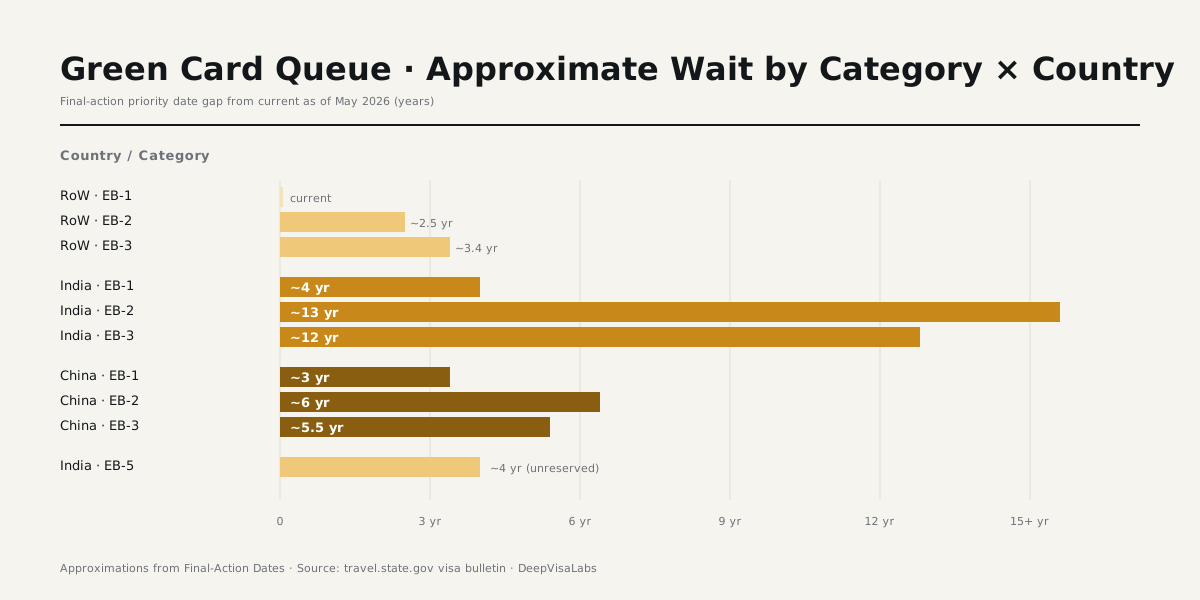
- Priority-date queue. EB-1 generally has shorter queues. For India and China, EB-1 has been current or near-current while EB-2 has retrogressed by years.
Parallel Filing Strategy
It is common to file NIW and EB-1A in parallel for high-credentials petitioners. They are independent petitions; approval of one does not affect the other. The downside is doubled filing fees and attorney costs. The upside is locking in two priority dates and hedging against any single-petition denial.
Cross-Pillar Reading
- EB-2 NIW — full priority-date and processing matrix · live priority-date data and concurrent-filing strategy
- EB-2 (advanced degree / exceptional ability) · the broader EB-2 category
- EB-1 — Extraordinary Ability, Outstanding Researcher, Multinational Manager · alternative self-petition path
- Form I-140 — Immigrant Petition for Alien Worker · the form itself
- I-485 Adjustment of Status · next step once priority date is current
- Visa Bulletin — current priority dates · the chart that decides when you can file
Bottom line
Current category. The visa-bulletin queue is not active, so total wait reduces to USCIS form processing plus medical / biometrics scheduling.
Frequently asked questions
- What's the difference between adjustment of status and consular processing?
- AOS keeps you in the US during adjudication and grants employment / travel authorization while pending. CP requires leaving the country for a consular interview, and timing is harder to predict because of NVC backlogs.
- What if National Interest Waiver retrogresses while my I-485 is pending?
- Filing during a current window protects against later retrogression: if the priority date moves backward, USCIS holds the I-485 and processes it once the date is current. EAD / advance parole continue to renew.
- Does National Interest Waiver require a labor certification (PERM)?
- PERM is mandatory for EB-2 and EB-3 cases tied to an employer-specific job. EB-1A, EB-1B, EB-1C, and EB-2 NIW are PERM-exempt because the petitioner is the beneficiary or the role is too senior for a labor-market test.
- Can I file I-485 and I-140 concurrently?
- Concurrent filing is allowed once your priority date qualifies. It also gives access to a pending-AOS EAD valid for up to 5 years under USCIS's 2023 validity-extension policy.
- How does premium processing apply to National Interest Waiver?
- I-907 premium processing covers EB-1A, EB-1B, EB-1C, EB-2 (non-NIW), and EB-3 I-140s with a 15-calendar-day adjudication SLA. I-485 is not eligible for premium processing.
Sources
- https://www.uscis.gov/policy-manual/volume-6-part-f-chapter-5
- https://www.justice.gov/eoir/page/file/920996/dl
- https://www.uscis.gov/working-in-the-united-states/permanent-workers/employment-based-immigration-second-preference-eb-2
- https://egov.uscis.gov/processing-times/
- https://travel.state.gov/content/travel/en/legal/visa-law0/visa-bulletin.html