EB-3 Green Card: Skilled Workers, Professionals, and Country-Specific Backlogs
The EB-3 cut-off for All Chargeability Areas is June 1, 2024. Applicants whose priority date is later than June 1, 2024 are queued; the form itself takes 10–18 months once it can move.
EB-3 Sub-Categories
EB-3 is the third employment-based preference category, covering three sub-types per USCIS guidance: (1) Skilled Workers (≥2 years experience or training), (2) Professionals (US bachelor's degree or foreign equivalent), and (3) Other Workers (less than 2 years experience or training, unskilled).
Other Workers has its own retrogressed sub-line on the visa bulletin and faces longer waits than the main EB-3 category. Skilled Workers and Professionals share the EB-3 main line.
PERM Requirement
EB-3 always requires a certified PERM labor certification — there is no NIW equivalent. The employer must demonstrate via DOL recruitment that no qualified US workers are available at the prevailing wage. PERM filing date establishes the priority date that controls visa-bulletin position.
PERM processing currently runs 9–12 months for unaudited cases per DOL FLAG, with audit cases extending to 16–24 months. See PERM processing time for the current dashboard.
Current EB-3 Priority Dates
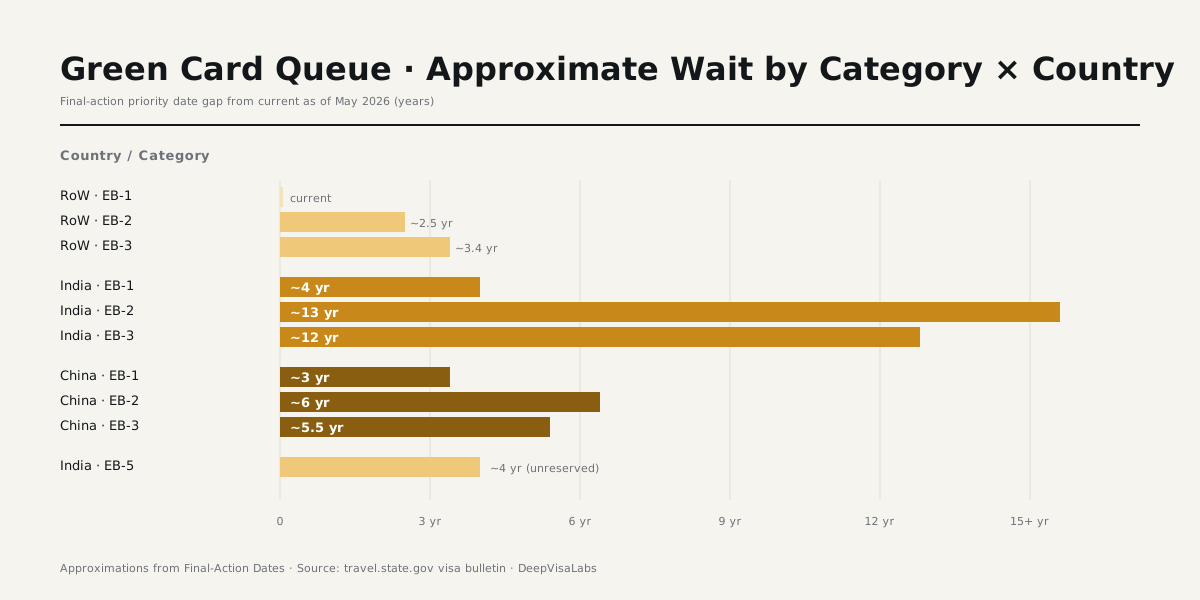
EB-3 cut-offs vary by chargeability. The current visa bulletin shows EB-3 All Chargeability Areas at June 1, 2024. India and China face the deepest backlogs; Mexico and Philippines have shorter but non-trivial waits.
EB-3 movement is volatile — categories can retrogress in fiscal-year final quarters when annual caps are exhausted. Travel.state.gov publishes the bulletin monthly around the 8th–15th.
EB-2 to EB-3 Downgrade
Indian and Chinese applicants in EB-2 backlogs sometimes downgrade to EB-3 when EB-3 moves faster than EB-2 in the relevant country line. Mechanics: file a new I-140 in EB-3 against the same PERM (the position must qualify for EB-3); retain the original priority date under INA §204(j) portability.
Downgrade is reversible — if EB-2 later moves ahead of EB-3, applicants can refile EB-2. The original PERM remains valid through both filings as long as the position description supports the lower category.
Premium Processing
USCIS premium processing (Form I-907) is available for EB-3 I-140 petitions at $2,805 fee for 15-calendar-day adjudication. Useful when employer or beneficiary needs faster I-140 approval to set priority date or unlock concurrent I-485 filing.
I-140 standard processing currently runs 10–18 months per the USCIS dashboard.
Cross-Pillar Reading
- EB-2 — Advanced Degree / Exceptional Ability · the higher preference category
- EB-1 — Extraordinary Ability and Multinational Manager · faster path for qualifying petitioners
- Form I-140 · the immigrant petition itself
- PERM Labor Certification · required pre-step for EB-3
- PERM Processing Time · current DOL FLAG dashboard
- I-485 Adjustment of Status · concurrent / sequential filing
- Visa Bulletin · current EB-3 priority dates by country
Bottom line
Verdict: backlogged. Cut-off is June 1, 2024; total wait stacks queue time + USCIS adjudication.
Frequently asked questions
- What is the priority date in EB-3?
- The priority date is the date USCIS / DOL accepted the underlying labor-certification or I-140 petition. For PERM-required categories, it is the PERM filing receipt date; for PERM-exempt EB-1A or EB-2 NIW, it is the I-140 receipt date.
- Can I port my priority date to another I-140?
- Once an I-140 is approved, the priority date can be carried forward to a future I-140 in the same or higher preference. This is critical for India / China EB-2 / EB-3 applicants stuck in long backlogs.
- What's the difference between adjustment of status and consular processing?
- AOS keeps you in the US during adjudication and grants employment / travel authorization while pending. CP requires leaving the country for a consular interview, and timing is harder to predict because of NVC backlogs.
- What if EB-3 retrogresses while my I-485 is pending?
- Filing during a current window protects against later retrogression: if the priority date moves backward, USCIS holds the I-485 and processes it once the date is current. EAD / advance parole continue to renew.
- Does EB-3 require a labor certification (PERM)?
- PERM is mandatory for EB-2 and EB-3 cases tied to an employer-specific job. EB-1A, EB-1B, EB-1C, and EB-2 NIW are PERM-exempt because the petitioner is the beneficiary or the role is too senior for a labor-market test.
Sources
- https://www.uscis.gov/working-in-the-united-states/permanent-workers/employment-based-immigration-third-preference-eb-3
- https://travel.state.gov/content/travel/en/legal/visa-law0/visa-bulletin.html
- https://www.uscis.gov/i-140
- https://flag.dol.gov/programs/perm
- https://egov.uscis.gov/processing-times/