Green Card Lawyer: Employment-Based vs Family-Based Specialization
green card lawyer typically runs $3,000–$12,000 in attorney fees, plus government filing fees that USCIS sets separately. The right fee structure depends on case complexity, urgency, and whether premium processing is in play.
"Green Card Lawyer" Splits Into Two Practice Areas
Green-card cases run on two largely separate procedural tracks, and lawyers tend to specialize in one or the other:
Employment-Based
Built on labor-market and qualification analysis: PERM labor certification (most EB-2 / EB-3 cases), prevailing-wage determinations, EB-1A / EB-1B / EB-1C, EB-2 NIW, EB-5 investment, then I-140 immigrant petition, then I-485 adjustment of status (or consular processing). The flow is bureaucratic but the core analysis is "does this person + this job qualify under the regulatory category."
Family-Based
Built on relationship documentation and admissibility analysis: I-130 immediate-relative or family-preference petition, then I-485 adjustment (if in the US in lawful status) or consular processing (DS-260) at a US embassy/consulate. K-1 fiancé(e) and K-3 spouse paths add nonimmigrant visa stages. The core analysis is "is the relationship bona fide" and "is the beneficiary admissible".
An employment-based specialist isn't necessarily strong on bona-fides examiner challenges in I-130 spouse cases, and a family-based specialist isn't necessarily strong on EB-2 NIW Dhanasar framing. Specialization fit matters.
Employment-Based: What Specialists Handle
- PERM strategy — recruitment design, prevailing-wage challenges, audit response.
- I-140 drafting — different in EB-1A (extraordinary ability) vs EB-1B (outstanding researcher) vs EB-2 (advanced degree or exceptional ability) vs EB-2 NIW vs EB-3 (skilled worker).
- Priority-date management — per-country retrogression, CSPA child-age preservation, INA §204(j) portability.
- I-485 concurrent / sequential filing — when current priority date allows, filing I-485 alongside or after I-140.
- AC21 portability — moving employers post-I-140 approval after 180 days of I-485 pendency.
- Consular processing alternative — DS-260 at US consulate when adjustment isn't available or strategic.
For employment-based specialization, see EB-1 lawyer, EB-1A lawyer, and EB-2 NIW lawyer for sub-category analysis.
Family-Based: What Specialists Handle
- I-130 spouse / parent / sibling — categorization (immediate relative vs preference category), priority-date implications.
- Bona-fides documentation — joint financial records, photographs, witness affidavits, communication history. Defending against bona-fides examiner challenges (Stokes interviews) and IMFA (marriage-fraud) suspicions.
- I-485 adjustment vs consular processing — the strategic choice depends on the beneficiary's location, prior immigration history, and admissibility profile.
- K-1 / K-3 nonimmigrant pathways — fiancé(e) and spouse visas as bridge nonimmigrant stages.
- Conditional residence (I-751) — removing conditions on a 2-year green card after marriage to a US citizen.
- VAWA self-petitions — for abused spouses, parents, and children of US citizens or LPRs (not strictly "family-based" but adjacent).
- Admissibility waivers — I-601, I-601A provisional waivers for unlawful-presence and other inadmissibility grounds.
The Three Stages of a Green Card Case
- Qualification. PERM + I-140 (employment) or I-130 (family). Establishes the beneficiary's place in the green-card queue and the priority date.
- Wait for an available immigrant visa number. Per the monthly visa bulletin. Immediate-relative family categories (US-citizen spouse / parent / minor child) and EB-1 for most countries are typically current; preference categories and India / China EB-2 / EB-3 retrogress significantly.
- Adjustment of status (I-485) or consular processing (DS-260). Final step that confers LPR status. Adjustment if the beneficiary is in the US in lawful status; consular processing otherwise.
Cost Range
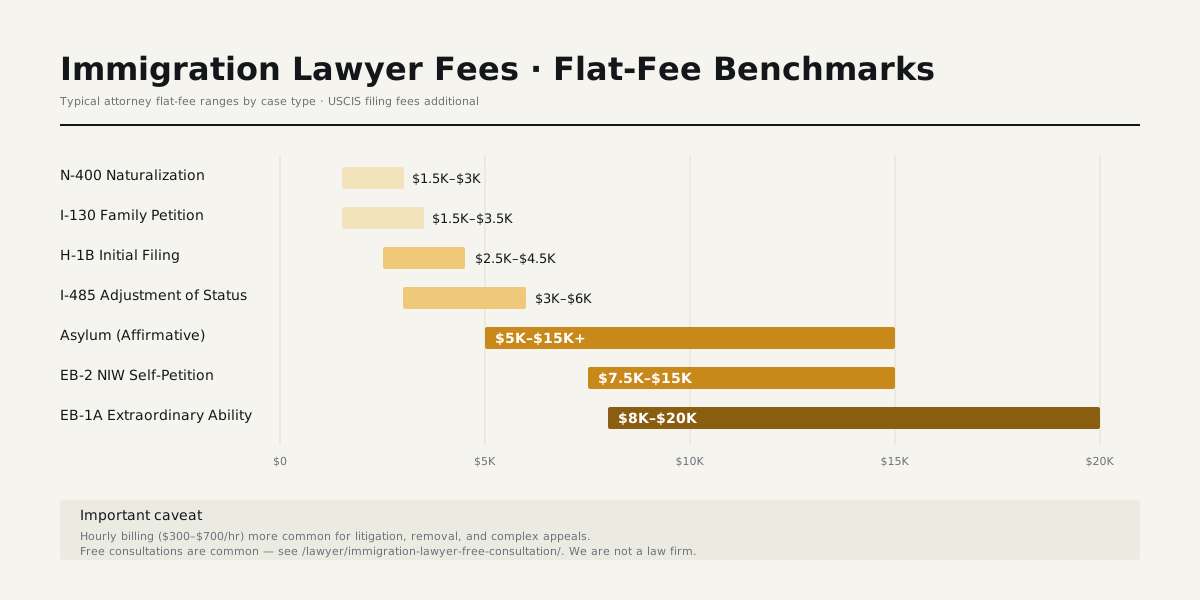
Green-card attorney fees are case-stage-specific. Aggregate estimates per case type:
- I-130 spouse + I-485 adjustment (immediate relative): $3,000–$6,500 attorney fees combined.
- I-130 spouse + DS-260 consular processing: $3,500–$7,000.
- K-1 fiancé(e) + adjustment after marriage: $4,500–$8,500.
- PERM + I-140 + I-485 (employment-based): $7,000–$15,000+ depending on category complexity.
- EB-1A or EB-2 NIW + I-485: $10,000–$25,000+ — see specialization-specific lawyer pages.
- I-751 removal of conditions: $1,500–$3,500.
Government fees: I-485 alone is over $1,400 (2024 fee rule), I-140 is over $700, I-130 is over $625 online. Confirm at the USCIS filing-fees page.
Bottom line
How to evaluate: match attorney experience to employment-based and family-based green card cases specifically — case-type approvals, engagement-letter clarity, communication cadence, and bar verification. We do not recommend lawyers; we describe what to look for.
Frequently asked questions
- How do I know if an immigration attorney is licensed?
- Verify bar admission through the state bar association's online directory in the state where the attorney practices. The American Immigration Lawyers Association (AILA) member directory at aila.org is also a useful (but non-exclusive) starting point.
- What questions should I ask before hiring?
- Useful questions: how many cases of this exact type have you handled in the past year? What is the flat-fee scope? When and how do you communicate updates? What happens if the case is denied — do you handle MTRs / appeals?
- Are flat fees or hourly billing better?
- The right model matches scope predictability. A bounded I-130 spouse petition is a flat-fee fit; a multi-year asylum case with consular and federal-court touchpoints is hourly territory.
- Can I file my immigration case without an attorney?
- Pro-se filing is fully legal. The cases that benefit most from attorney involvement are ones with prior denials, criminal-history issues, complex eligibility theories (NIW, asylum, EB-1A), or RFE responses requiring legal-argument drafting.
- What are red flags when choosing an immigration lawyer?
- Watch for: guaranteed-outcome promises (no attorney can guarantee a USCIS approval), opaque fee structures, refusal to provide a written engagement letter, pressure to sign on the first call, and any non-attorney 'consultant' who offers to file forms for a fee in states where that is unauthorized practice.