L-1B Visa: Specialized-Knowledge Intracompany Transferee Standard
L-1 is the multinational-transferee visa: L-1A for managers/executives, L-1B for specialized-knowledge workers. Eligibility requires a qualifying corporate relationship (parent/subsidiary/affiliate/branch) and 1+ year of foreign employment in the past 3 years.
Specialized-Knowledge Standard
L-1B is the specialized-knowledge branch of the intracompany-transferee program. INA §214(c)(2)(B) defines "specialized knowledge" as "special knowledge of the company product and its application in international markets" or "an advanced level of knowledge of processes and procedures of the company."
The 2015 USCIS policy memorandum clarified that specialized knowledge does not need to be unique or proprietary — but it must be: (a) demonstrably distinct from general knowledge held by similarly-employed workers in the industry, and (b) advanced beyond an ordinary employee's understanding. USCIS Policy Manual Volume 2, Part L codifies this two-prong test.
The Two-Prong Knowledge Test
USCIS evaluates L-1B petitions against two non-exclusive standards. Special knowledge: knowledge of the petitioner's products, services, research, equipment, techniques, management, or other interests, and the application of those products / services / processes in international markets — knowledge that is distinct or uncommon compared to others in the petitioner's industry.
Advanced knowledge: knowledge of (or expertise in) the petitioner's specific processes and procedures that is not commonly found in the relevant industry and is greatly developed or further along in progression, complexity, or understanding than that generally found within the employer.
A successful L-1B petition typically argues both prongs. Priya Anand's editorial line: when only one prong fits, the petition is RFE-bound — pivot to L-1A function-manager analysis or H-1B specialty-occupation framing.
The 2015 Memo and RFE Pattern
Before March 2015, L-1B RFE rates ran 40%+ as USCIS adjudicators applied inconsistent definitions of specialized knowledge. The March 24, 2015 USCIS Policy Memorandum on L-1B (PM-602-0111) standardized the test and was incorporated into the Policy Manual.
Common contemporary RFE patterns: (1) requests for evidence the knowledge is "non-routine and highly developed," (2) comparison evidence showing how few peer employees within the petitioner hold similar knowledge, (3) documentation of how the knowledge was acquired (typically multi-year internal training), and (4) explanation of why the knowledge cannot be readily transferred to a US worker through reasonable training.
The 5-Year Cumulative Cap
L-1B beneficiaries receive an initial period of up to 3 years (1 year for new-office L-1B), with one extension of up to 2 years for a 5-year cumulative maximum. There is no further extension beyond 5 years — unlike L-1A, which extends to 7 years.
The L-1B-to-L-1A conversion (filed via amended Form I-129) requires that the beneficiary be in a managerial or executive role for at least 6 months before the L-1A 7-year clock starts. Employers planning a long US assignment often start beneficiaries on L-1B and amend to L-1A as the role matures.
Documenting Specialized Knowledge
Successful L-1B petitions assemble evidence in three buckets. Petitioner-specific evidence: descriptions of proprietary methodologies, internal training programs, product specifications, and organizational processes that the beneficiary mastered. Beneficiary-specific evidence: years-long training history, prior positions involving the specific knowledge, projects where the beneficiary applied the knowledge, and credentialing where applicable.
The third bucket — comparison evidence — is where most L-1B petitions thin out. USCIS wants to see how the beneficiary's knowledge differs from a peer engineer in the same industry. Headcount data showing how few employees within the petitioner hold equivalent expertise carries significant weight.
Blanket L vs Individual L-1B
Large multinationals can apply for a Blanket L approval (Form I-129S processed at the consulate) that pre-qualifies the corporate relationship and allows individual L-1A / L-1B beneficiaries to be processed at the consulate without separate I-129 filings at USCIS.
Blanket L petitions accelerate consular processing significantly but apply a stricter "specialized knowledge professional" standard for L-1B — the beneficiary must hold the equivalent of a US bachelor's degree plus the specialized knowledge. Smaller employers and L-1B beneficiaries who cannot meet the higher Blanket L standard file individual I-129 petitions instead.
Premium Processing and Filing Fees
Individual L-1B I-129 petitions are eligible for premium processing under Form I-907 at $2,805 with a 15-business-day adjudication target. Blanket L beneficiaries do not need premium because consular adjudication is on the consular calendar, not a USCIS service-center queue.
Standard I-129 base fee, the $500 anti-fraud fee, and the asylum program fee tier apply to L-1B individual petitions. Premium for L-1B amendments — adding a worksite or a material change in duties — is usually well worth the fee because RFE-related delays on amendments can run 6+ months without it.
L-1B Green Card Path — No EB-1C Equivalent
L-1B does not map to EB-1C. Multinational-manager EB-1C requires the beneficiary to have served in a managerial or executive role abroad — a standard L-1B beneficiaries by definition do not meet. L-1B beneficiaries pursue the green card primarily through EB-2 (with PERM) or EB-3 (with PERM), which require the standard labor-certification process.
Dual intent is explicitly authorized for L-1 under INA §214(h), so filing PERM and the I-140 does not jeopardize L-1B renewals. Practitioners often start the PERM process around year 2 of L-1B to avoid the 5-year cap forcing a departure mid-process.
Cross-Pillar Reading
- L-1 Visa Overview · L-1A vs L-1B comparison
- L-1A Visa · managerial / executive standard
- PERM Labor Certification · L-1B's primary green-card path
- EB-2 NIW · alternative immigrant path bypassing PERM
- USCIS Processing Times · current I-129 service-center windows
Bottom line
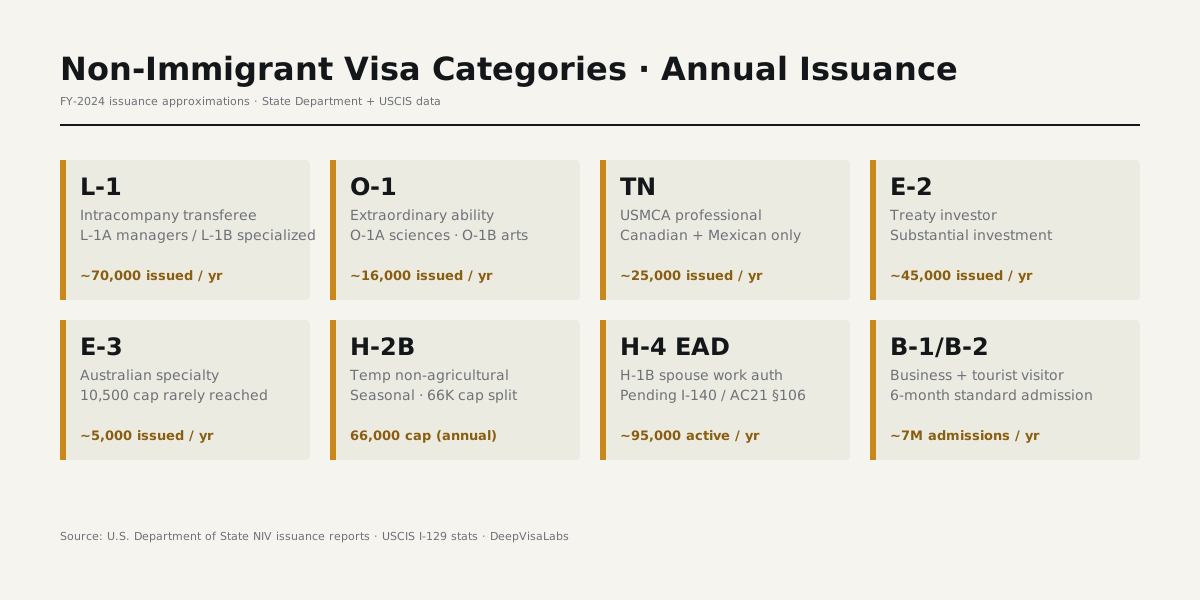
L-1B sits in the broader non-immigrant work-visa landscape. Each category has distinct eligibility, evidence, and validity-period rules — read the USCIS Policy Manual chapter and 8 CFR §214.2 sub-section before filing.
Frequently asked questions
- How long is the L-1B validity period?
- L-1A: 7 years cumulative; L-1B: 5 years; O-1: 3 years initial + 1-year extensions indefinitely; TN: 3 years renewable; E-3: 2 years renewable indefinitely; H-2B: tied to job duration up to 1 year + extensions to 3 years; E-2: 2 years renewable indefinitely.
- Does L-1B allow dual intent?
- INA §214(b) presumes nonimmigrant intent for most categories; INA §214(h) carves exceptions for H-1B and L-1. Other categories must demonstrate intent to depart at the end of authorized stay — though pursuing immigration through I-140/I-485 doesn't automatically disqualify.
- Can my spouse work on L-1B?
- Work-authorization for spouses varies. L-2 and E-3D/E-2 spouses: automatic. O-3, TN-D, H-4 (H-2B): no general work authorization. Spousal benefit is a significant differentiator between categories.
- Is premium processing available for L-1B?
- I-129 premium processing applies to most L-1B petitions. Categories without I-129 (TN port-of-entry for Canadians, E-2/E-3 consular processing) follow different acceleration models — typically just consulate scheduling.
- What evidence does USCIS expect for L-1B?
- Evidence packages vary by category. L-1: corporate-relationship evidence; O-1: 3-of-8 criteria + advisory opinion; TN: Annex 16-A occupation match; E-3: Australian citizenship + specialty occupation; H-2B: TLC + temporary need; E-2: substantial investment.
Sources
- https://www.uscis.gov/working-in-the-united-states/temporary-workers/l-1b-intracompany-transferee-specialized-knowledge
- https://www.uscis.gov/i-129
- https://www.uscis.gov/policy-manual/volume-2-part-l
- https://www.uscis.gov/i-907
- https://travel.state.gov/content/travel/en/us-visas/employment/temporary-worker-visas.html