Day 1 CPT: SEVP Authorization, USCIS Risk, and Day-1-CPT Universities
'Day 1 CPT' programs let F-1 students start CPT-authorized employment at the start of their program rather than the standard one-academic-year wait. The legal basis exists in SEVP regulation, but USCIS routinely RFEs H-1B and I-485 cases where Day 1 CPT was used for the bulk of a degree.
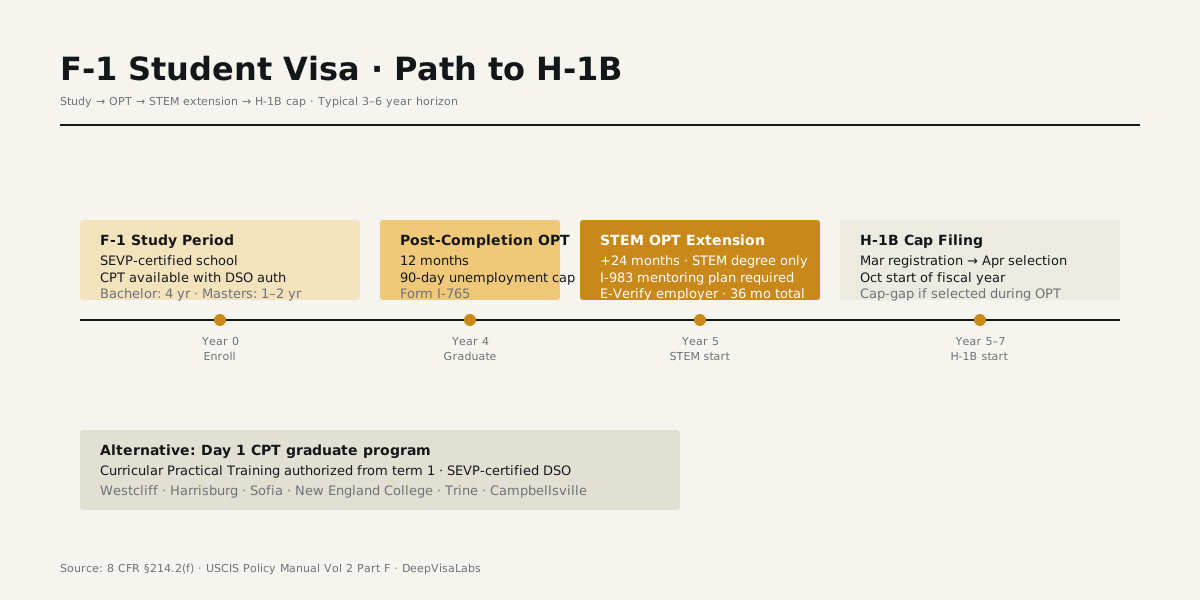
What "Day 1 CPT" Means
Curricular Practical Training (CPT) is F-1 work authorization tied to a specific curriculum. Under 8 CFR §214.2(f)(10)(i), CPT is permitted when the practical training is "an integral part of an established curriculum" — typically required internships, cooperative-education programs, or practicum requirements. The Designated School Official (DSO) authorizes CPT by updating the I-20.
Standard CPT vs Day 1 CPT
The standard CPT timing requirement is that the F-1 student must have completed one full academic year before being eligible (with limited exceptions for graduate programs that require immediate practical training). "Day 1 CPT" refers to graduate programs at a small set of universities that authorize CPT from the first term — meaning the student can work full-time off-campus from program enrollment, not after the standard one-year wait.
How DSO Authorization Flows in SEVIS
Day 1 CPT requires the DSO to update SEVIS with the specific employer name, address, and authorization period before work begins. Each new employer or material change to the placement requires re-authorization. CPT terminates immediately if the underlying curriculum requirement changes or if the student withdraws from the program.
The Regulatory Basis
SEVP Guidance Authorizes Day 1 CPT
Day 1 CPT is allowed by SEVP regulation when the curriculum genuinely requires off-campus training from term one. Per SEVP guidance at studyinthestates.dhs.gov: the training must be an integral part of an established curriculum; the DSO must authorize CPT through SEVIS for a specific employer and date range; and graduate-level programs may require CPT from the program's start when immediate practical training is academically necessary.
Full-Time vs Part-Time CPT
CPT can be full-time (more than 20 hours/week) or part-time. Twelve months or more of full-time CPT eliminates eligibility for post-completion OPT. This is a hard rule under 8 CFR §214.2(f)(10)(i)(C) — students using Day 1 CPT continuously for a full year forfeit the OPT bridge.
Why Day 1 CPT Itself Is Not Banned
Day 1 CPT is not banned by any USCIS regulation, SEVP policy memo, or judicial decision as of 2026. The legal authority exists. The risk is downstream: USCIS treats heavy Day 1 CPT use as a flag in later H-1B, I-140, and I-485 adjudications.
USCIS Scrutiny — The Real Risk
USCIS officers have flagged Day 1 CPT in immigration adjudications as evidence the F-1 status was held primarily for work authorization rather than legitimate study.
Patterns That Invite Scrutiny
- Full-time CPT employment (40 hours/week) for the duration of a graduate program.
- Universities operating primarily on weekend or evening schedules with online-only components.
- Transfer to a Day 1 CPT program immediately after H-1B lottery non-selection.
- Multiple consecutive degrees at Day 1 CPT programs (back-to-back master's, then an additional master's).
- Geographic disconnect between school (e.g., New Hampshire) and the only physical employment location (e.g., San Francisco).
Documented USCIS Responses
- RFEs on H-1B I-129 cases requesting transcripts, syllabi, and proof curriculum required immediate off-campus training.
- I-485 denials citing failure to maintain F-1 status during the underlying Day 1 CPT period.
- Material-change denials when CPT employment description doesn't match the SEVIS authorization record.
- NTA (Notice to Appear) issuance in egregious cases — rare, but documented.
How Risk Compounds Over Multiple Adjudications
The Day 1 CPT period is not just evaluated once — it surfaces in every subsequent USCIS filing. An H-1B selected during Day 1 CPT might pass with an RFE, but the same Day 1 CPT period can later be re-examined in an I-140 review or an I-485 adjudication years later, creating compounding risk over the green-card pathway.
Universities That Operate Day 1 CPT Programs
The Day 1 CPT school list is dynamic. Universities have entered and exited the category as SEVP audits and university policy changes have occurred. As of 2026, recognizable Day 1 CPT-offering institutions include:
Recognizable Day 1 CPT Schools (2026)
- Westcliff University (California) — graduate business and engineering programs.
- Harrisburg University of Science and Technology (Pennsylvania) — STEM master's tracks.
- Sofia University (California) — psychology and computer science.
- New England College (New Hampshire) — selected business and tech programs.
- Trine University (Indiana) — graduate engineering.
- Campbellsville University (Kentucky) — graduate IT and business.
- Northwest Missouri State University (selected programs).
- California Institute of Advanced Management (CIAM).
Why Verify SEVP Certification Before Enrolling
Always verify current SEVP certification for a specific school at studyinthestates.dhs.gov/school-search before enrolling. SEVP can suspend or revoke certifications, and student SEVIS records depend on the school's standing. Recently revoked certifications have left students with abrupt status problems.
What to Check Beyond SEVP Status
Beyond SEVP certification, evaluate: (1) the school's accreditation by a regional accrediting body recognized by the U.S. Department of Education, (2) curriculum syllabi for in-person learning components, (3) faculty credentials and academic publication history, (4) recent USCIS RFE patterns for H-1B applicants from this institution, and (5) any pending or completed federal investigations.
Day 1 CPT vs Alternative Bridges
Day 1 CPT is most often used as a bridge for unselected H-1B candidates. Alternatives to consider:
STEM OPT Extension (Safest Bridge)
If you completed a STEM-designated bachelor's or master's, you have 36 months of OPT (12 + 24 STEM extension). This is the safest bridge and doesn't require new enrollment. See STEM OPT for the e-Verify employer requirement and reporting obligations.
O-1 Visa for High-Credentials Candidates
For high-credentials applicants, O-1 (extraordinary ability) is a valid alternative to H-1B. It requires substantial evidence but has no annual cap. See O-1 visa.
H-1B Cap-Exempt Employers
Universities, university-affiliated nonprofits, and government research organizations are not subject to the H-1B annual cap. Some applicants secure cap-exempt employment as a bridge — see H-1B cap-exempt.
Country-of-Birth Treaty Visas
E-3 (Australia), TN (Canada/Mexico), H-1B1 (Chile/Singapore) bypass the lottery for eligible nationals. See E-3 and TN visa.
Short-Term Day 1 CPT (Stop-Gap Use)
1-2 semester use during an H-1B pendency carries materially less scrutiny than full-program Day 1 CPT. The risk profile is closer to standard CPT when the duration is brief and the underlying program is academically rigorous.
F-1 Status Maintenance During Day 1 CPT
Maintaining Full-Time Enrollment
Even with Day 1 CPT, F-1 students must maintain full-time enrollment per SEVP rules. Graduate programs typically require 6 credit hours/semester. Drop below the threshold and you fall out of status — CPT authorization terminates immediately.
Online vs In-Person Coursework Limits
F-1 students can take only one online or distance-learning class per semester (3 credits) toward the full-course requirement. Day 1 CPT programs that operate primarily online violate this rule and trigger immediate status problems.
Travel Considerations During Day 1 CPT
International travel during Day 1 CPT requires a valid visa stamp, a current I-20 with active CPT endorsement, and the school's signature within 12 months. Re-entry while on Day 1 CPT can trigger CBP secondary inspection — expect questions about the curriculum's academic legitimacy.
From Day 1 CPT to H-1B / OPT
H-1B Lottery While on Day 1 CPT
Students on Day 1 CPT can register for the H-1B lottery if they have a sponsoring employer. If selected, the change-of-status I-129 filing must occur before the cap-gap period — typically the spring after lottery selection, with H-1B start date October 1.
OPT Eligibility After Day 1 CPT
Twelve months or more of full-time Day 1 CPT eliminates OPT eligibility entirely. Part-time Day 1 CPT (less than 20 hours/week) does not count toward this limit. Strategic short-term Day 1 CPT use preserves OPT as a backup.
I-140 Adjudication Risk
Even after a successful H-1B → I-140 → I-485 sequence, USCIS can re-examine the original Day 1 CPT period during I-485 final review. RFEs on adjustment-of-status applications have asked for transcripts, syllabi, and faculty correspondence from the Day 1 CPT period years after enrollment ended.
Practical Decision Framework
If you're considering Day 1 CPT, the questions to answer with counsel:
- Is this a stop-gap (1-2 semesters) or a multi-year strategy? Stop-gaps are materially safer.
- Does the school have stable SEVP certification and a record of curriculum integrity, or is it on the SEVP audit radar?
- Will I have legitimate academic engagement throughout the program (in-person classes, coursework, project deliverables), or is the program primarily online with weekend in-person sessions?
- Are my long-term plans (H-1B, I-140, I-485) compatible with the RFE and adjudication risk Day 1 CPT imposes on each future filing?
- Have I maximized safer alternatives (STEM OPT, O-1, cap-exempt employment) first?
Cross-Pillar Reading
- F-1 / OPT / CPT pillar hub · all student-visa work authorization paths
- Standard CPT (1-year wait + integral curriculum) · the regular CPT path
- OPT — post-completion + STEM extension · the safer 36-month bridge
- STEM OPT 24-month extension · e-Verify employer requirement
- Day 1 CPT schools — directory + risk profile
- H-1B lottery · why Day 1 CPT exists as a bridge between cycles
- H-1B cap-exempt employers · alternative path that bypasses the lottery
- O-1 visa (extraordinary ability) · alternative to H-1B for high-credentials applicants
Bottom line
Day 1 CPT is regulatorily permitted but operationally fragile. The legal basis exists in 8 CFR §214.2(f)(10)(i); the practical risk is downstream USCIS scrutiny on every later filing. Use deliberately, with counsel, not as default.
Frequently asked questions
- What is Day 1 CPT and what does it mean?
- Day 1 CPT means the university authorizes Curricular Practical Training from the first term of enrollment instead of after the standard one academic year in status. The authorization itself comes from the DSO under 8 CFR 214.2(f)(10)(i), and the training must be an integral part of the established curriculum — which is why Day 1 CPT programs are almost always graduate degrees with a required internship or practicum component built into every semester.
- What happens if SEVP audits the Day 1 CPT school?
- SEVP can revoke a school's certification or place restrictions on CPT issuance. Past SEVP enforcement actions against suspect Day 1 CPT operators have included program closure, terminating active student SEVIS records, and referral to ICE.
- Is Day 1 CPT a safe alternative to H-1B?
- It is an alternative but not a 'safe' one. Practical-training authorization requires genuine curriculum integration and the use pattern matters at later USCIS adjudications. Treat it as a stop-gap, not a multi-year strategy without legal advice. Weigh the Day 1 CPT risks — RFE exposure at the H-1B or green-card stage — against the benefit of continuous work authorization.
- Is Day 1 CPT legal?
- There is no SEVP regulation prohibiting Day 1 CPT. The DSO has discretion to authorize CPT when the curriculum requires it from day one. USCIS scrutiny on later filings is the real risk, not the CPT authorization itself.
- Why do USCIS officers scrutinize Day 1 CPT use?
- The pattern that draws scrutiny: full-time CPT employment (40 hours/week) for the duration of a graduate program at a university with weekend or online-only classes. USCIS reads this as F-1 misuse and may issue NTAs in extreme cases.
- Which universities offer Day 1 CPT programs?
- The Day 1 CPT school list shifts as SEVP audits and university policy changes occur. As of 2026, recognizable programs include Westcliff University (CA), Harrisburg University (PA), Sofia University (CA), New England College (NH), Trine University (IN), and others. Verify current SEVP certification at studyinthestates.dhs.gov.
- Can I use Day 1 CPT after OPT ends?
- Yes — enrolling in a new degree program with Day 1 CPT after OPT (or after the 24-month STEM extension) is one of the most common use patterns. The enrollment must be a bona fide academic program: USCIS officers reviewing a later H-1B or I-485 filing look at whether the second program shows genuine curriculum progression or reads as a work-authorization bridge. Keep transcripts, course-integration evidence, and CPT authorization records from every term.
Sources
- https://www.ice.gov/sevis/practical-training
- https://studyinthestates.dhs.gov/students/training-opportunities-in-the-united-states/curricular-practical-training
- https://www.uscis.gov/working-in-the-united-states/students-and-exchange-visitors/students-and-employment
- https://studyinthestates.dhs.gov/students/study/employment
- https://www.uscis.gov/i-765