Day 1 CPT Schools: SEVP-Certified Programs and Audit Risk Profile
Day 1 CPT is allowed by the DSO when curriculum requires off-campus practical training from term one. The risk is downstream: USCIS treats heavy Day 1 CPT use as evidence the student maintained F-1 status only as a work-authorization vehicle, which can damage future visa adjudications.
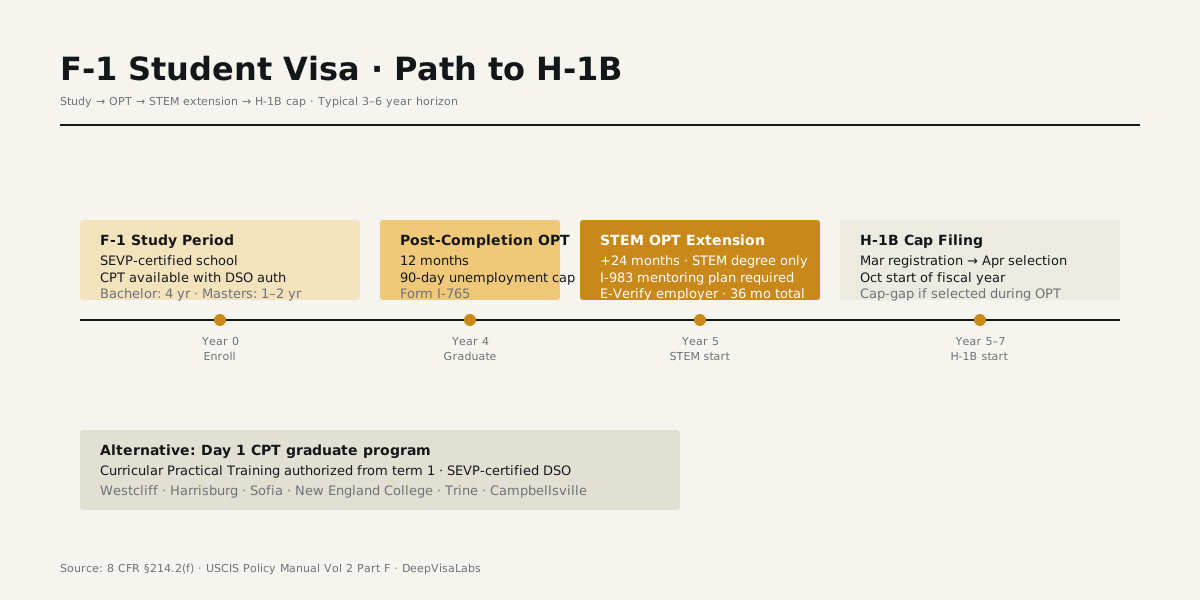
Why a "Day 1 CPT School" Comparison Exists
Curricular Practical Training (CPT) is regulatorily authorized by SEVP under 8 CFR §214.2(f)(10)(i). Most universities require F-1 students to complete one academic year of full-time enrollment before authorizing CPT. A small subset of US graduate-only or graduate-heavy institutions operate "Day 1 CPT" programs where curriculum requires off-campus practical training from term one.
Day 1 CPT schools cluster in specific accreditation regions and program designs. The list shifts as SEVP audits and program changes occur. As of 2026, the recognizable institutions running Day 1 CPT include:
- Westcliff University (Irvine / Anaheim, CA — WSCUC accredited)
- Harrisburg University of Science and Technology (Harrisburg, PA — MSCHE accredited)
- Sofia University (Palo Alto, CA — WSCUC accredited)
- New England College (Henniker, NH — NECHE accredited)
- Trine University (Angola, IN — HLC accredited)
- Campbellsville University (Campbellsville, KY — SACSCOC accredited)
- California Institute of Advanced Management (CIAM)
- International Technological University (ITU) — note: SEVP suspension and program-discontinuation history
Verify current SEVP certification on the Study in the States school search before enrolling.
What to Compare Across Day 1 CPT Schools
Tuition / location is the surface comparison; the deeper comparison is structural:
Accreditation
Regional accreditation (WSCUC, MSCHE, NECHE, HLC, SACSCOC) is the meaningful credential. Schools without regional accreditation invite USCIS scrutiny on later filings — and in some cases the credentials may not transfer.
SEVP Certification History
The SEVP school search shows current certification status. Past suspension or compliance history matters: schools with SEVP-action history pose elevated risk that students will lose status mid-program if certification is suspended again.
Curriculum Integration of CPT
The legal basis for Day 1 CPT is 8 CFR §214.2(f)(10)(i) — practical training that is "an integral part of an established curriculum." That standard is met when course assignments require off-campus experience, when capstone projects integrate practicum work, and when grading reflects the practicum. Schools where CPT is structurally bolted on (rather than integrated) face higher SEVP audit risk.
Class Schedule and In-Person Requirements
Programs with primarily evening, weekend, and online-only classes draw the most USCIS scrutiny because they suggest the F-1 was held primarily for work authorization. Schools that require regular in-person attendance during business hours fare better at USCIS adjudication.
Alumni Outcomes — H-1B and I-485 Approvals
Schools with documented alumni H-1B selection and I-485 approval reduce the marginal risk to your downstream cases. Programs with concentrated H-1B-rejection or I-485-RFE patterns warrant caution.
Cost of Attendance
Day 1 CPT graduate programs typically cost $15,000-$35,000 per year of tuition (USD). Total cost of attendance with living expenses runs higher. The cost is real even if the immediate work-authorization payoff appears to justify it.
Risk Tiering — How USCIS Adjudicators Look at Day 1 CPT
USCIS officers assessing later filings (H-1B, I-140, I-485) cluster Day 1 CPT use into informal risk tiers:
- Lowest risk: Day 1 CPT used as a 1-2 semester bridge after H-1B lottery non-selection, in a STEM program at a regionally accredited institution with documented SEVP good-standing history.
- Moderate risk: full-program Day 1 CPT (e.g. all 4 semesters of an MBA) at a regionally accredited school with curriculum justification and regular class attendance.
- Elevated risk: full-program Day 1 CPT in an evening-only / online-heavy program at a school with prior SEVP audit issues.
- Highest risk: enrollment immediately after H-1B lottery loss, full-time CPT for the entire program, school with active SEVP compliance issues, no documented in-person curriculum.
Tier placement matters at H-1B adjudication, I-140 review, and especially I-485 final-merits analysis where USCIS reviews the full F-1 maintenance history.
Bottom line
Day 1 CPT is regulatorily permitted but operationally fragile. The legal basis exists in 8 CFR §214.2(f)(10)(i); the practical risk is downstream USCIS scrutiny on every later filing. Use deliberately, with counsel, not as default.
Frequently asked questions
- Can I switch from a regular F-1 program to Day 1 CPT?
- F-1 transfer to a Day 1 CPT program is a regular SEVIS school transfer. The risk: USCIS may later view the transfer as a status-of-convenience move, especially if it follows H-1B lottery non-selection.
- Does Day 1 CPT reset OPT eligibility?
- Each new degree level (master's, second master's at a higher level, doctorate) generally provides a new OPT eligibility window. Two master's degrees at the same level generally do not provide two separate OPT periods; SEVP guidance is the controlling source.
- Can H-1B be sponsored while on Day 1 CPT?
- Day 1 CPT students can be H-1B-sponsored. The downstream issue: at adjudication, USCIS often issues RFEs requesting curriculum proof, course schedule, and evidence the program was not used as a work-authorization shell.
- What happens if SEVP audits the Day 1 CPT school?
- SEVP can revoke a school's certification or place restrictions on CPT issuance. Past SEVP enforcement actions against suspect Day 1 CPT operators have included program closure, terminating active student SEVIS records, and referral to ICE.
- Is Day 1 CPT a safe alternative to H-1B?
- It is an alternative but not a 'safe' one. Practical-training authorization requires genuine curriculum integration and the use pattern matters at later USCIS adjudications. Treat it as a stop-gap, not a multi-year strategy without legal advice.