New England College Day 1 CPT: MSIT, MBA, and the New Hampshire Cohort
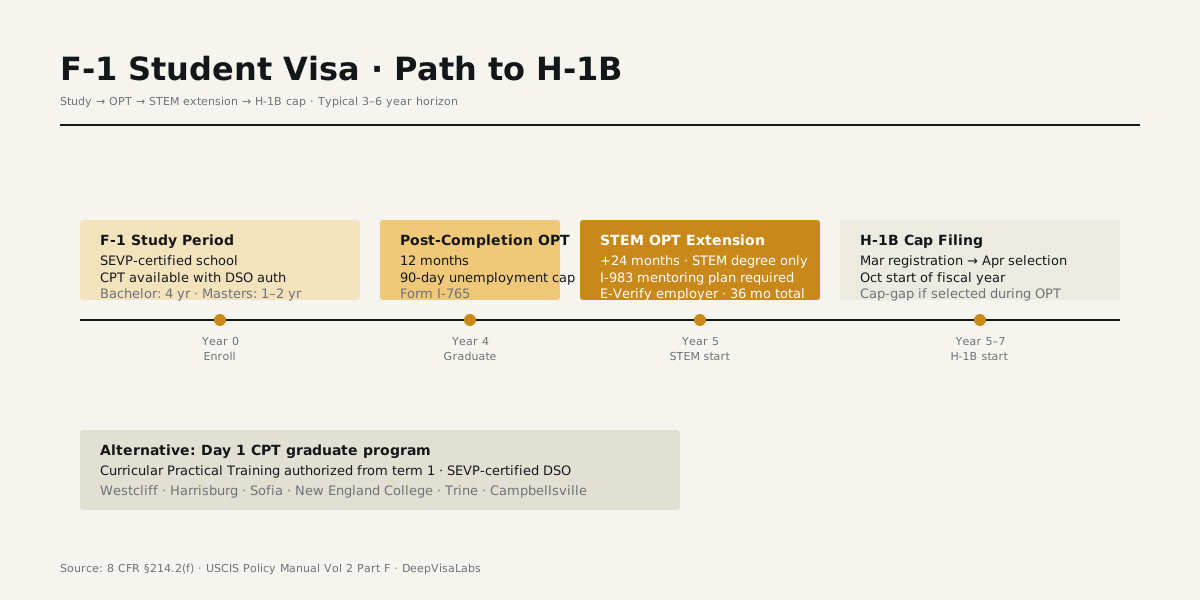
Day 1 CPT means CPT authorization issued by the DSO from the start of the F-1 program (versus the standard 1-academic-year wait). It's a regulatory option, not a USCIS-blessed pathway — most large universities reject it; a smaller cohort of universities operate Day 1 CPT programs with proper curriculum integration.
New England College at a Glance
- Location: Henniker, NH (main campus) with Manchester, NH presence for graduate / professional programs.
- Accreditation: New England Commission of Higher Education (NECHE) — regional accreditation.
- SEVP certification: yes — verify current status on Study in the States.
- Programs (graduate): MS in Information Technology (MSIT), MBA, MS in Project Management, MEd, several doctoral programs.
- Approximate annual tuition (graduate): $14,000-$22,000 USD per year.
NEC is a long-established (founded 1946) regional liberal-arts college that has expanded its graduate offerings to include Day 1 CPT-eligible MSIT and MBA programs. The institution's longer institutional history differs meaningfully from many newer Day 1 CPT operators — it confers credibility at USCIS adjudication.
How CPT Is Structured at New England College
NEC's MSIT and MBA programs include a curriculum-integrated practicum / experiential-learning requirement. CPT is authorized by the DSO when the student's program of study requires off-campus practical training from term one.
- Class schedule: hybrid model with some weekend-cohort residencies in Manchester and online instruction. Specific scheduling varies by program and cohort.
- Practicum integration: structured deliverables tie off-campus work to course objectives.
- Program length: most master's programs run 18-24 months full-time.
- Cohort size: smaller than Harrisburg, comparable to Sofia.
USCIS Scrutiny Pattern for NEC Alumni
Institutional Credibility
NEC's NECHE accreditation and 75+ year institutional history confer credibility that newer Day 1 CPT operators don't have at USCIS adjudication. RFEs framing the school as a "shell program" don't land as easily when the institution has decades of documented liberal-arts and graduate education.
Class Attendance and Documentation
Standard RFEs request transcripts, attendance records, and practicum evaluations. NEC's hybrid weekend-residency model produces consistent documentation. Students who maintained regular attendance and submitted practicum deliverables on schedule typically clear F-1 maintenance challenges.
Specialty-Occupation Alignment for H-1B
MSIT graduates targeting IT and software-engineering H-1B roles have a clear specialty-occupation argument. MBA graduates pursuing general-management H-1B roles face the typical MBA-and-H-1B variability — an MBA-specialty-occupation argument requires the position to genuinely require an advanced business degree, not merely benefit from one.
Risk Profile and Decision Framework
- Pros: NECHE regional accreditation, long institutional history (founded 1946), mid-Atlantic / New England geography (lower cost-of-living than CA-based Day 1 CPT options), structured hybrid scheduling.
- Cons: smaller cohort sizes mean fewer alumni-network signals, lower national name recognition, hybrid scheduling still draws standard scrutiny.
- Best fit: MSIT candidates pursuing IT-specialty H-1B roles, candidates wanting institutional credibility from a long-established regionally-accredited college, candidates preferring lower cost-of-living than California options.
- Worst fit: candidates relying on a brand-name school for H-1B specialty-occupation arguments where the role isn't clearly IT-specialty.
Comparison to Other Day 1 CPT Programs
- NEC vs Westcliff — different accreditation regions; Westcliff's California location offers proximity to tech employers, NEC offers institutional history.
- NEC vs Harrisburg — Harrisburg's STEM concentration is stronger for STEM OPT; NEC's MSIT is single-program rather than a portfolio.
- NEC vs Sofia — both smaller cohorts; Sofia's Palo Alto MSCS offers Bay Area employer access.
Bottom line
Verdict: Day 1 CPT works as a short bridge between H-1B lottery cycles, but full-program Day 1 CPT usage attracts USCIS RFEs and SEVP audit risk. Choose schools with documented SEVP standing and curriculum integrity.
Frequently asked questions
- What happens if SEVP audits the Day 1 CPT school?
- SEVP can revoke a school's certification or place restrictions on CPT issuance. Past SEVP enforcement actions against suspect Day 1 CPT operators have included program closure, terminating active student SEVIS records, and referral to ICE.
- Is Day 1 CPT a safe alternative to H-1B?
- Day 1 CPT is not equivalent to H-1B. The status is fragile, the school list shifts, USCIS pre-decision scrutiny is elevated, and downstream filings (H-1B, I-140, I-485) carry RFE risk. Counsel before using it as a multi-year plan.
- Is Day 1 CPT legal?
- There is no SEVP regulation prohibiting Day 1 CPT. The DSO has discretion to authorize CPT when the curriculum requires it from day one. USCIS scrutiny on later filings is the real risk, not the CPT authorization itself.
- Why do USCIS officers scrutinize Day 1 CPT use?
- USCIS scrutiny tends to focus on: percentage of program completed via CPT, whether classes were primarily evening/weekend/online, and whether the practical training is genuinely tied to academic learning. ICE has revoked F-1 status in egregious cases.
- Which universities offer Day 1 CPT programs?
- The Day 1 CPT school list shifts as SEVP audits and university policy changes occur. As of 2026, recognizable programs include Westcliff University (CA), Harrisburg University (PA), Sofia University (CA), New England College (NH), Trine University (IN), and others. Verify current SEVP certification at studyinthestates.dhs.gov.